



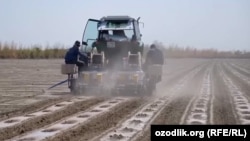
A wave of land disputes that began in eastern Uzbekistan has spread to Sirdaryo, where farmers say authorities are using courts, debt enforcement, and administrative pressure to shift farmland into a system that favors foreign, particularly Chinese, investors.
Gayrat Usmonov, a farmer in the Xovos district, lost his leased farmland in 2021 when authorities reassigned it to a Saudi investor. After three years of court battles, Usmonov briefly regained control of the land in 2025, after the investor abandoned the plot.
But he says local authorities are once again trying to take away his lease on the land -- this time allegedly to make way for Chinese investors.
Usmonov says the local governor's office accused him of illegally planting rice, which under the strict terms of his contract would be grounds to revoke his lease. Under Uzbek law, farmland is leased from the state for up to 49 years and can be revoked only for specific violations, such as unpaid fees or misuse.
He claims he's never planted a grain of rice, and yet local officials have taken the case to court and used the claims as grounds to successfully revoke his lease.
"They don't examine the facts," Usmonov told RFE/RL. "The court sides only with the authorities."
Usmonov's case is one of many since a national law passed last May created regional "directorates."
While authorities say the policy is aimed at recovering debt and improving land use, farmers who spoke to RFE/RL, many on condition of anonymity for fear of reprisal, say it has become a tool for removing local producers from fertile land they spent years developing and repurposing it for foreign agricultural deals.
Since January, Usmonov and other farmers in Xovos say they have faced a sweeping campaign, with a dozen farmers telling RFE/RL that nearly half of the district's farms are being targeted for transfer into the state land reserve under the new directorate system.
"The land moves from farmer, to state reserve, to directorate, to investor," one farmer from Xovos told RFE/RL. "But in this chain, no one asks what happens to the human being in the middle."
Clearing The Way For Chinese Investors
While farmers interviewed by RFE/RL say Chinese companies are the primary beneficiaries of transfers in Sirdaryo, authorities have not publicly confirmed any specific cases in the region.
But RFE/RL's Uzbek Service reported last year that farmland in several Andijon districts in eastern Uzbekistan was being handed to Chinese companies.
After that report, transfers briefly stopped, but farmers say the pressure resumed after the directorate system was created -- a system RFE/RL investigated in January and found had leased confiscated land to Chinese investors.
The law that created the directorate system established offices in Sirdaryo and six other regions of Uzbekistan -- Andijon, Jizzakh, Namangan, Tashkent, Ferghana, and Qashqadaryo -- that are tasked with supervising land use and subleasing farmland to local and foreign investors.

The majority of interested foreign investors are from China, which has expanded its role in Uzbekistan's agriculture through financing, infrastructure, and technology transfers. In 2024, Uzbekistan approved a $220 million loan from China's Export–Import Bank for irrigation projects implemented by Chinese state-owned firms, including CITIC Construction and China CAMC Engineering.
Chinese agribusiness delegations and regional officials have visited districts in eastern and central Uzbekistan over the past year, while a Sirdaryo government delegation traveled to China in December to arrange further agricultural cooperation.
Farmers in Xovos told RFE/RL that Chinese investors were initially offered unused or degraded land in the area, such as overgrown roadside plots or abandoned Soviet-era collective farms, which they refused to accept.
"They demanded fertile land that was already developed -- land that our farmers spent years making productive despite harsh conditions," one farmer said.
Local farmers estimate that up to 17,000 hectares in the Xovos district alone are slated for transfer this year, primarily into the directorate system and ultimately for sublease to foreign investors.
The move would affect some 300 farms and add to the more than 10,000 hectares that have already been seized through court rulings or applications obtained through pressure since late 2024, according to their calculations.
'I'll Take Everything'
Farmers who spoke to RFE/RL and shared their experiences with the new directorates claim the system is being abused with the knowledge or approval of senior regional officials, including Governor Erkinjon Turdimov.
Manuchehr Mirzaev, the spokesman for Turdimov's office, did not respond to RFE/RL's requests for comment about the confiscation of farmland and the accusations of coercion.

One Xovos farmer who spoke to RFE/RL recalled a meeting with regional officials that he says left him shaken when farmers were summoned early in the day and made to wait for hours for Turdimov to arrive.
"He immediately started threatening people," the farmer said. "One man said he owed 1 billion soms ($81,330) because he had invested in drip irrigation and was repaying it gradually. The governor told him: 'You'll live on the street. I'll take everything from you, even your house.'"
The farmers say they were offered a choice between surrendering land "voluntarily" -- in which case authorities promised that debts would be settled once land was reassigned -- or refuse and face court seizure of the land and not have their debts resolved.
According to one farmer, police were stationed at doors during meetings to prevent people from leaving. Farmers were addressed individually to sign the papers -- allegedly under pressure.
For those who refused to sign the papers, the consequences came quickly.
"The next day, the property seizures began," the farmer said. "Officials came to houses and took everything -- TV sets, livestock, whatever they could."
Pressure From Above
District authorities maintain the land seizures are justified by the massive debts that farmers have incurred.
In a statement posted on the district administration's Telegram channel, Xovos officials said farms in the district owed 40 billion soms ($3.2 million) in taxes and 128 billion soms ($10 million) to banks, with hundreds of cases being processed. Authorities also confirmed they have filed lawsuits to cancel lease agreements with at least 110 farms.
Farmers and analysts say the statement does not explain how the debts were accrued or whether local authorities and agricultural associations share responsibility.

Regional agricultural associations in Uzbekistan are largely state-controlled and closely aligned with local authorities.
Economist Otabek Bakirov said the farming system itself often pushes farmers into debt.
He told RFE/RL that during the 2024 and 2025 harvests, many farmers "did not receive full payment from cotton and wheat clusters" from the regional associations and as a result, "fertilizers were delivered late or not at all. Harvests suffered."
"The majority of farmers fell into debt," Bakirov said.
Local Uzbek authorities maintain that allocating more farmland to foreign investors will be a boost for the economy, but the implementation often involves displacing workers from farms, which is the main form of employment in much of rural Uzbekistan.
The loss of roughly 300 farms in Xovos, as local farmers have estimated, could leave thousands of families without an income.
"Farmers leave, workers leave, villages empty out," one local resident of Xovos told RFE/RL. "Migration increases. Investors come and go, while we are left with nothing."
As word of the pressure campaign across Xovos has spread, some political pushback has emerged from the national government.
Lawmakers of the ruling Uzbekistan Liberal Democratic Party sent a formal parliamentary inquiry to Turdimov demanding an explanation about the situation faced by the farmers in Xovos.
So far, there has been no response from the governor.



