



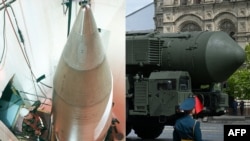
WASHINGTON, DC -- The New Strategic Arms Reduction Treaty (New START), the final remaining bilateral agreement limiting US and Russian nuclear arsenals, expired on February 5, closing a chapter that began in the Cold War and survived its end.
With no successor treaty in place, the world’s two largest nuclear powers -- which together possess roughly 90 percent of global nuclear warheads -- now face one another without legally binding limits, inspections, or verification regimes.
Arms control advocates warn the lapse could accelerate an already intensifying competition involving not just Washington and Moscow, but Beijing as well.
US officials, however, argue the treaty’s expiration reflects reality rather than rupture.
"Today, the United States faces threats from multiple nuclear powers. In short, a bilateral treaty with only one nuclear power is simply inappropriate in 2026 and going forward," Under Secretary of State for Arms Control and International Security Thomas DiNanno told delegates at the Disarmament Conference in Geneva on February 6.
Those comments came after Russia had suggested both sides voluntarily extend the terms of the agreement for a year to discuss a successor treaty.
New Geopolitical Reality
US President Donald Trump, though, has said there should be a new treaty to replace New START, which was signed in 2010 by the United States and Russia and limited the two countries to 1,550 deployed warheads each.
"There is an understanding, and this was also discussed in Abu Dhabi, that both sides will act responsibly and will recognize the need to start negotiations on this issue as soon as possible," Kremlin spokesman Dmitry Peskov said in reference to talks US officials had with Russian military contacts in the Middle East on February 6.
At the heart of the matter, according to US officials, is geopolitical reality: There are no longer only two nuclear superpowers that should be bound by such treaties.
In a Substack essay published on February 6, US Secretary of State Marco Rubio rejected claims that Washington is ushering in a new arms race with its position, arguing that Russia had effectively rendered New START unworkable years ago by suspending implementation in 2023 after what he described as repeated violations.
But central to Rubio’s argument is China.
He noted that Beijing’s rapid and opaque nuclear buildup -- from a stockpile in the low 200s in 2020 to more than 600 warheads today, with projections exceeding 1,000 by 2030 -- has made bilateral arms control obsolete.
Any future framework, he said, must account for a world in which the US confronts two nuclear peers, not one.
Rubio outlined three principles guiding the administration’s approach: arms control must be multilateral, must not ignore noncompliance, and must be pursued from a position of strength, including maintaining a robust and modernized US nuclear deterrent.
Still, he emphasized that the administration shares Trump’s stated desire to reduce global nuclear dangers and move toward fewer nuclear weapons in reality, not just on paper.
For officials who served in the Biden administration, the treaty’s final years were already hollow.
Thomas Wright, the former senior director for strategic planning at the National Security Council, described the post-2023 New START as a “zombie extension” -- a shell stripped of inspections and verification after Russia suspended those provisions and linked arms control to the war in Ukraine.
Wright argued the US simply should not have observed the treaty’s limits without demanding the restoration of inspections, noting that meaningful arms control cannot exist without verification.
New Era Of Arms Control
Still, he acknowledged that Russia’s broader behavior -- from nuclear threats related to Ukraine to new destabilizing weapons and a parallel buildup with China -- signaled the effective end of the era Americans had grown accustomed to.

Thomas Countryman, chairman of the Arms Control Association, and a former senior State Department official, offered perhaps the starkest framing.
He said two futures now loom.
One is a new arms control era that brings China into the equation with new mechanisms to reduce nuclear competition -- an outcome he said he strongly supports. The other is a trilateral arms race among the United States, Russia, and China that would exceed the one during the Cold War in both cost and risk.
Speaking at the Quincy Institute on February 5, Countryman said the pessimistic scenario currently appears more plausible, noting that the US has taken little concrete action on arms control over the past decade despite spending more than $100 billion annually on nuclear forces.
Countryman said US and Russian officials need to immediately authorize their negotiators to resume talks while also bringing China in to the dialogue, avoiding unnecessary increases in deployed weapons in the meantime.
He warned that insisting on trilateral negotiations as a precondition risks becoming an excuse for inaction between Washington and Moscow.

