



Accessibility links

Breaking News

The Farda Briefing

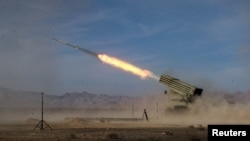
A missile is launched during a military exercise in Isfahan, Iran. (file photo)

Welcome back to The Farda Briefing, an RFE/RL newsletter that tracks the key issues in Iran and explains why they matter.

I'm RFE/RL correspondent Kian Sharifi. In this edition of the Farda Briefing, I'm looking at how Israel is shifting its focus to Iran’s missile program as the most pressing existential threat and whether that’s a prelude to another war.

What You Need To Know

Is Iran Drifting Toward A 1923-Style Meltdown?: Iran has been battling double-digit inflation for years, and the dollar’s value has exploded, and now stands at roughly 100 times higher than a decade ago. It’s not quite at hyperinflation levels like Venezuela, Argentina, or Germany in 1923, but the warning lights are flashing. More on this in RFE/RL’s Radio Farda analysis in Persian here.

International Calls To Stop Execution Of Female Activist: Prominent women worldwide and UN experts this week called on Iran to immediately release Zahra Shahbaz Tabari, a 67-year-old electrical engineer facing execution. Tabari was sentenced to death in October for “baghi,” or armed rebellion against the Islamic republic. Her alleged crime? Possessing a piece of cloth with the slogan “Women, Resistance, Freedom” -- a play on the “Women, Life, Freedom” motto that became a rallying cry during Iran’s 2022 protests. Authorities claim she intended to display it publicly.

Tehran’s Growing Cafe Culture: Cafes in Iran -- especially in Tehran, where they've exploded in number lately -- aren't just spots for coffee or hanging out anymore. They're like a mirror reflecting all the social, cultural, and even political shifts over the past four decades. They’re now one of the biggest signs of urban life buzzing with the changes in society. Read Radio Farda’s report in Persian here.

The Big Issue

US President Donald Trump (right) and Israeli Prime Minister Benjamin Netanyahu shake hands at the conclusion of a joint press conference in the White House in Washington, D.C. in September.

More Missiles, More Problems

For weeks now Israeli officials and media have turned their attention to Iran’s missile program. They see it as Israel’s biggest headache right now -- huge enough to top Prime Minister Benjamin Netanyahu’s list when he sits down with US President Donald Trump on December 29.

Iran, of course, swears it’s all about self-defense. Tehran has poured tons of cash into missiles and drones to make up for its outdated air force. Remember the war back in June? It took Israel no time to establish dominance over Iranian airspace.

Why it matters: Iran is rebuilding its missile stockpile fast after the June war, and Israeli leaders worry it’s ramping up big time. If US media reports are spot on, Netanyahu is heading to Trump with a pitch for fresh strikes to knock it back.

During the 12-day war earlier this year, Israel took out senior Iranian military commanders and, with help from the United States, set back Iran’s nuclear program -- which Tehran still maintains is peaceful. Missile factories were hit too, but not hard enough to stop production.

Iran fired off about 550 missiles at Israel, and 36 slipped through defenses. Experts talking with Radio Farda say Iran is restocking more quickly than Israel can buy more interceptors. What if the next barrage overwhelms everything?

What’s being said: Farzin Nadimi, a senior fellow at The Washington Institute, told Radio Farda that smashing Iran’s missile game could force a “surrender or fundamental doctrinal shift,” maybe even a dash for nukes.

Meanwhile, Hamidreza Azizi, a fellow at the German Institute for International and Security Affairs, says curbing missiles is tough, and Washington knows that. He figures the real play is squeezing a weakened Iran for wins like ditching uranium enrichment at home or ending support for Hezbollah and the Houthis.

That's all from me for now. This is our final edition of the Farda Briefing in 2025. Our next Iran newsletter, with a new look and a new name, will land in your inbox in January.

Merry Christmas and Happy New Year -- see you soon.

Kian Sharifi

If you enjoyed this briefing and don't want to miss the next edition, subscribe here. It will be sent to your inbox every Friday.
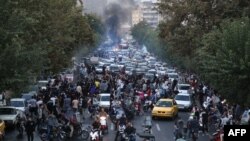
Iranian demonstrators take to the streets of the capital Tehran in September 2022 during a protest for Mahsa Amini, days after she died in police custody.

Welcome back to The Farda Briefing, an RFE/RL newsletter that tracks the key issues in Iran and explains why they matter.

I'm RFE/RL correspondent Kian Sharifi. In this edition, I explore the significance of a criminal complaint filed against Iran in Argentina for its brutal crackdown on the 2022 protests. I will also touch on why Iranians are upset with China and the state of Iran's national currency.

What You Need To Know

In Pursuit Of Accountability: For the first time, victims of Iran’s Woman, Life, Freedom protests have filed a criminal complaint against 40 officials of the Islamic republic, accusing them of crimes against humanity. It’s a bold move, and one that takes the fight for accountability thousands of kilometers away, all the way to Argentina.

China Angers Iran By Backing UAE Islands Claim: China has angered Tehran by again siding with the United Arab Emirates in a decades-old dispute over three strategic islands near the Strait of Hormuz. A joint statement during Chinese Foreign Minister Wang Yi’s visit to Abu Dhabi backed the United Arab Emirates' (UAE) push for a “peaceful solution,” without mentioning Iran. Iranian officials criticized the UAE but avoided direct attacks on Beijing, leaving hard-line media to accuse China of hypocrisy over its own Taiwan stance.

Rial Hits Another Record Low: Iran’s currency is in free fall again. The rial slid past 1.3 million to the dollar this week -- its weakest level ever and just days after breaking the 1.2 million mark. The drop, fueled by sanctions and mounting regional tensions, is driving up prices for food and everyday goods. For many Iranians, already coping with soaring living costs, a recent gas price hike is making things even tougher.

The Big Issue

Protesters face off with security forces in Tehran, Iran, September 2022

Justice Crosses Borders

The criminal complaint against 40 officials of the Islamic republic was submitted with help from the Iran Human Rights Documentation Center and the Strategic Litigation Project at the Atlantic Council. They chose Argentina because its courts recognize something called universal jurisdiction -- basically, the idea that some crimes are so serious, any country’s court can investigate them, no matter where they happened.

The complaint asks Argentinian judges to look into the role of senior intelligence, security, and military officials, including the Islamic Revolutionary Guards Corps (IRGC), in what it describes as a widespread and coordinated assault on civilians during the 2022 protests that followed the death of Mahsa Amini. Amini died in police custody after being detained for allegedly flaunting Iran’s dress code for women.

For now, the list of accused names is sealed, but Shahin Milani from the Human Rights Documentation Center told RFE/RL’s Radio Farda that those details will be released once Argentina’s prosecutor officially opens the investigation.

The accusations include targeted shootings, intentional blinding of protesters, arbitrary arrests, torture, and even executions -- abuses that, as the complaint notes, “are still continuing today.”

In a 2024 report, Sara Hossain, who leads the UN’s Independent Fact-Finding Committee on Iran, said the government was directly responsible for the violence that led to Mahsa Amini’s death. The committee went further, calling Iran’s broader actions against women “crimes against humanity.” Iran has accused the committee of bias.

Why It Matters: Argentina’s judiciary has a long record of pursuing international justice cases. Its courts have invoked universal jurisdiction in dozens of human rights trials over the past decade and are currently handling cases from 16 countries.

Notably, Argentina is also familiar with Iran-related cases: earlier this year, an Argentinian judge ordered in absentia trials for seven Iranian and three Lebanese suspects over the 1994 AMIA bombing in Buenos Aires, which killed 85 people.

What's Being Said: The plaintiffs see Argentina as a natural venue. As Milani noted, “this is a judiciary that knows Iran’s track record.”

Mahsa Piraei, one of the plaintiffs in the case and a UK resident, lost her 62‑year‑old mother, Minoo Majidi, in the early days of the protests. Her mother was shot dead by security forces.

“We couldn’t pursue a case in Iran because there’s no fair court or independent judiciary,” she wrote on X, adding that she was glad they had managed to bring their complaint before an Argentinian court.

That's all from me for now.

Until next time,

Kian Sharifi

If you enjoyed this briefing and don't want to miss the next edition, subscribe here. It will be sent to your inbox every Friday.

Load more

XS
SM
MD
LG