




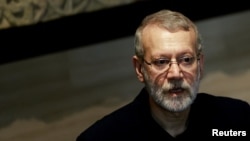
Ali Larijani, one of Iran’s most powerful figures and a close confidant of the late Supreme Leader Ayatollah Ali Khamenei, was killed in an air strike in the capital, Tehran, on March 17.
Holding the powerful post of secretary of Iran's Supreme National Security Council, the country's key policymaking body, Larijani emerged as the de facto leader of the Islamic republic after Khamenei was killed in an Israeli strike on February 28.
While not a cleric, he was a unifying figure who brought together competing political factions and maintained strong ties with the Islamic Revolutionary Guards Corps (IRGC), intelligence services, and clerical establishment.
With Khamenei gone, his son a contested successor, and now Larijani dead, Iran faces what is seen as a leadership vacuum of extraordinary depth. His death, experts say, could also complicate any diplomatic efforts to end the current war.
"Among those we know are still within the Islamic republic system right now -- the politicians we can confirm are still [alive] -- there is no replacement for Ali Larijani for this role," said Babak Dorbeiki, a Britain-based political analyst.
The System’s Operator
During a political career spanning decades, the 67-year-old Larijani served as a nuclear negotiator, parliament speaker, and state enforcer, among other roles. But above all, he was a survivor.
Larijani twice fell from official favor only to mount political comebacks. After Iran’s 12-day war with Israel and the United States in June 2025, he played an increasingly prominent role as the national-security chief.
Larijani’s career underscored his versatility. He served in the IRGC, ran the state broadcaster for a decade, shepherded the 2015 nuclear deal with world powers through parliament, and spent 12 years as speaker of parliament.

For the Islamic republic, Larijani functioned as a bridge between the clerics and generals at home and between Tehran and Western capitals abroad. He was never an ideological firebrand. But he was seen as the system's most capable operator.
Even then, the system twice rejected him. In 2021 and again in 2024, Larijani was barred from running for president by the Guardians Council, a clerical body dominated by hard-liners. The decisions shocked even his critics.
Analysts widely interpreted the disqualifications as factional maneuvering -- a way to clear the field for hard-liners -- but the message was humiliating for a man who had served the Islamic republic at the highest levels for decades.
‘Kennedys Of Iran’
Born in the holy Shi’ite city of Najaf, in neighboring Iraq, Larijani came from a family so steeped in the political elite that emerged following the Islamic revolution in 1979 that Time magazine once described them as the "Kennedys of Iran."
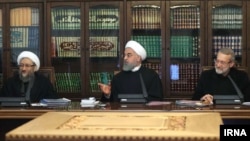
His father was a prominent religious scholar -- and his marriage into the family of Morteza Motahhari, the chairman of the Council of the Revolution tasked with establishing the Islamic republic -- ensured his place near the corridors of power from the outset.
Unlike many of his peers who came solely from Islamic seminaries, Larijani also carried a secular academic pedigree, holding master's and doctorate degrees in Western philosophy from the University of Tehran. He wrote a thesis on the works of German philosopher Immanuel Kant.
Wartime Resurrection
After spending several years in relative political limbo, Larijani’s fortunes changed in the aftermath of the 12-day war.
In January, the US Treasury imposed sanctions on Larijani for his role in the brutal state crackdown on mass protests that erupted in late December 2025 and killed thousands of people.
Last month, before the United States and Israel launched their war on Iran, Khamenei designated Larijani as the preferred candidate to temporarily manage the country in the event of his death. Khamenei was killed just days later.
Since then, Larijani had been one of the most vocal official voices in Iran. On March 13, in a show of defiance, Larijani and other senior Iranian leaders appeared on the streets of Tehran as Israel carried out air strikes on the city. That was the last time he was seen in public.