




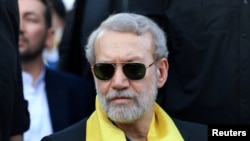
As Iran reels from a US and Israeli bombing campaign that has killed several or perhaps even dozens of senior leaders, national security chief Ali Larijani has emerged as one of the key figures in what remains of the country's power structures.
A veteran politician whose career encompasses almost the entire history of the Islamic republic, he reemerged from a relative hiatus last year and has since been taking an increasingly prominent role.
A Political Comeback
A crucial moment for Larijani's recent fortunes was Iran's 12-day war with Israel and the United States in June last year.
The previous year, the 67-year-old had been barred from running for president for the second time in three years.
But in August, in the aftermath of the conflict, Larijani was appointed to the powerful post of secretary of Iran's Supreme National Security Council, the country's key policymaking body.
"Several important developments occurred during the 12-day war. One major issue, as highlighted by officials in the media, was the miscalculation of Iran's defense capabilities," London-based Iranian political analyst Babak Dorbeigi told RFE/RL's Radio Farda at the time.
"Yet the most critical issue -- one that takes precedence over all others -- was the realization that, in a time of war, the supreme leader [Ayatollah Ali Khamenei] could not be relied upon," Dorbeigi said.
Khamenei is now dead, as once again Iran's air defenses have been overwhelmed. Since then, Larijani has been one of the most vocal official voices in Iran. So far, it's a voice of defiance -- with Larijani declaring on March 2 that Iran "will not negotiate."
He has followed up on that statement with aggressive tweeting, including messages that appear to be trolling US President Donald Trump. "Trump has betrayed 'America First' to adopt 'Israel First,'" he wrote in one all-caps English-language post.
On March 1, he said a temporary new leadership council had been set up to govern the country until a successor to Khamenei could be announced. It consists of Alireza Arafi, a longstanding senior figure in the clerical establishment; President Masud Pezeshkian; and hard-line judiciary head Gholamhossein Mohseni-Ejei.
Under the Iranian Constitution, this council will lead the country until the 88-member Assembly of Experts can gather to elect a new supreme leader.
"At present, there are no clear signs of systemic collapse inside Iran. Decision-making structures remain functional. Security institutions are operating cohesively," wrote Danny Citrinowicz, a senior researcher on Iran at the Institute for National Security Studies at Tel Aviv University on March 2.
Born In Iraq
Larijani was born in Najaf, Iraq, in 1958 to a family of leading Iranian clerics. The family moved to Iran when he was still a child, and as a young man he experienced the Islamic Revolution in 1979.
He was a commander in the Islamic Revolutionary Guards Corps (IRGC), where he served between 1981-83, spent a decade as head of state TV and radio from 1994, was Iran's chief nuclear negotiator from 2005 to 2007, and served as speaker of Parliament from 2008 to 2020. He also held his current security role from 2005 to 2007.
In his senior roles, Larijani gained international prominence, particularly with his backing of the 2015 nuclear deal with the United States and other world powers.
The first Trump administration walked away from the deal, but Larijani remained involved as Khamenei's top adviser on nuclear issues.
Since his reappointment to head the Supreme National Security Council, his power and prominence have risen further. During the brutal crackdown on protesters in January, Washington added him to its sanctions list.
"Larijani was one of the first Iranian leaders to call for violence in response to the legitimate demands of the Iranian people," said a US Treasury statement from January 15.
Rights groups said thousands of people were killed by Iranian security forces, although the real number is thought to be much higher.
Last month, Larijani visited Oman to prepare for the indirect talks with US negotiators that ultimately failed to avert war. He was also a frequent visitor in Moscow in recent months, working on security ties with Russia that have failed to help protect Iran in both this and the previous conflict.
During this time, Larijani appeared to be living up to his reputation as a pragmatist, stating the nuclear issue was "resolvable" and voicing openness to talks.
This has, for now, been replaced by a more strident tone.