


WASHINGTON -- Forty-eight hours into a US-Iran cease-fire, the situation on the ground already appears increasingly unstable.
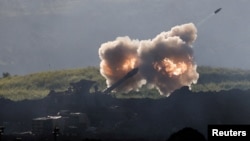
Reports of continued Israeli strikes in Lebanon, attacks across the Gulf, and renewed threats around the Strait of Hormuz are raising urgent questions about whether this pause can hold.
Plus, the key disagreement between the US and Iran over whether the cease-fire even applies to Lebanon, where Israel has been striking what it says are Hezbollah targets. Hezbollah is the Iran-backed militant group designated a terrorist organization by the United States.
RFE/RL spoke with Allison Minor, director of the Atlantic Council’s Project for Middle East Integration and former director for Arabian Peninsula affairs at the White House National Security Council during Donald Trump’s first term, to unpack these early developments and gauge what could come next for the war and the region.
Pause Or Turning Point?
RFE/RL: We are now 48 hours into a two-week cease-fire announced by Washington and Tehran, with mediation from Pakistan -- but it already feels more like a standoff than a solution. Big picture question: Given the continued strikes tied to Lebanon and reports of retaliation across the Gulf, is this cease-fire a real diplomatic opening or just a strategic intermission before the next phase of war?

Allison Minor: I think it’s still too soon to tell. It does suggest that both sides are at least interested in exploring de-escalation. But the reality is that their positions remain very far apart. There are still major unresolved questions -- particularly about Lebanon’s role and about what happens in the Strait of Hormuz. Will it return to a prewar normal, or will Iran retain some level of control?
Those uncertainties could easily undermine the cease-fire and even trigger escalation beyond what we saw before. So, at this stage, it’s less a breakthrough than a reflection of how complex and unstable the situation remains.
RFE/RL: Washington and Israel appear to treat Lebanon as a separate track, while Tehran links it directly to the cease-fire. Can this deal hold if that gap isn’t resolved?
Minor: It’s difficult to see how it can. Iran has made clear that it will not halt attacks in the Gulf unless Lebanon is included. The question now is whether US negotiators -- arriving in Pakistan in the next 24-48 hours -- can bridge that gap, likely in coordination with Israel.
What’s striking is that Iran does not appear deterred. It seems emboldened and believes it can dictate cease-fire terms more on its own terms than on Washington’s.
RFE/RL: Some analysts point to possible command-and-control issues inside Iran. Does that suggest a lack of control -- or deliberate ambiguity?
Minor: It’s probably both. Iran has long delegated authority to commanders in the field, which allows it to respond quickly even when leadership structures are disrupted. At the same time, it has spent decades refining a strategy of plausibly deniable attacks.
What concerns me now is that we may be seeing a new threshold for those deniable operations. Attacks on shipping and on Gulf states are becoming more severe, and that raises the risk of escalation significantly.

RFE/RL: So are we entering a phase where attribution is murky, but escalation risks are higher?
Minor: Exactly. As Iran recalibrates after this war, it may continue lower-level attacks while probing for new red lines. The key question is whether the United States, Israel, or others will respond forcefully -- or whether they will tolerate a higher baseline of Iranian activity in exchange for relative calm.
That uncertainty has serious implications, especially for Gulf economies. Places like Dubai depend on perceptions of stability for investment, trade, and financial flows.
The Strait Of Hormuz: A Lasting Pressure Point
RFE/RL: You’ve warned that Iran is entering negotiations while still effectively controlling the Strait of Hormuz. How much leverage does that give Tehran?
Minor: It gives them tremendous leverage. The strait was always considered a kind of “third rail” -- something Iran would avoid disrupting. But during this war, they crossed that line and discovered that enforcing it is extremely difficult for the US.
Now, even if Iran reduces attacks or signals that shipping can resume -- potentially even charging transit fees -- the damage is already done. Commercial actors remain wary. We saw a similar dynamic in the Red Sea: Even after attacks subsided, shipping traffic stayed significantly reduced because insurers and companies were unwilling to take the risk.
RFE/RL: Does that mean a new normal where global energy flows remain exposed to Iranian pressure?
Minor: Yes, I think it does. Iran now has the ability to keep a kind of noose around global supply chains -- not just oil, but also critical goods like aluminum and fertilizer -- as well as the economies of its Gulf neighbors.
Negotiations Ahead -- And Signals To Watch
RFE/RL: Negotiators are heading into talks shortly in Pakistan. Given Iran’s expanding demands, including potential US force reductions, is there a meaningful middle ground -- or are both sides buying time?
Minor: It’s possible Iran’s private demands differ from its public messaging. Both sides are clearly trying to project strength. But Iran does appear emboldened and may push for more far-reaching concessions than before the war -- on its nuclear program, missile capabilities, and regional posture.
The real question is how Washington responds: What are its red lines? And how much pressure will it face from partners -- from Israel, which has maximalist goals, and from Gulf states, which fear this emerging “new normal”?

There’s also a domestic dimension in the United States, with rising oil prices and political pressure, especially in a midterm election year.
RFE/RL: Two weeks is a very short window. What key signals will you watch to determine whether this cease-fire holds?
Minor: Ultimately, it comes down to the White House. The cease-fire is already showing signs of strain -- continued attacks, disrupted shipping. So, the question is whether Washington declares it failed or tries to sustain it despite those violations.
Right now, this is not a robust or stable arrangement. It’s a fragile framework under significant stress.
RFE/RL: Finally, given the Lebanon dimension and current dynamics, what would count as a “win” for the United States coming out of these talks?
Minor: It’s hard to define a clear win. Ideally, you’d see the Strait of Hormuz return to prewar conditions, Iran scaling back to earlier negotiating positions, and an end to attacks on US partners.
But even achieving those prewar baselines will be extremely difficult. Given the scale of the conflict and the costs involved, expectations were that outcomes would improve -- yet even restoring the previous status quo now looks like a very high bar.

