




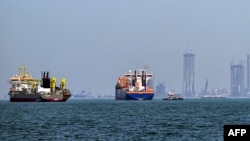
WASHINGTON -- US President Donald Trump has called on allies to help secure the strategically vital Strait of Hormuz, urging partners to send naval forces to keep global energy shipments flowing through the waterway amid the Iran conflict.
The appeal has drawn mixed reactions from capitals in Europe and Asia, exposing uncertainty about whether a visible multinational coalition will form to ensure the critical shipping lane remains open.

Republican strategist Matthew Bartlett, a former political appointee in the first Trump administration and co-founder of the lobby group Darby Field Advisors, told RFE/RL that despite the hesitation, keeping the strait open is in every country's economic interest.
He said Washington has signaled both military dominance and a willingness to escalate if Tehran uses energy flows as leverage.
RFE/RL spoke with Bartlett about the strategy behind Trump's message to allies, the economic stakes of a prolonged confrontation, and whether the crisis could test unity within North Atlantic Treaty Organization.
RFE/RL: Trump has called on allies to send warships to help secure the Strait of Hormuz, but reactions from different capitals have varied. From a Republican strategic perspective, how serious is the problem if Washington cannot assemble a visible multinational coalition to reopen the strait?
Matthew Bartlett: There are many aspects to this engagement, to this war -- military, economic, and diplomatic -- and this situation around the strait certainly has implications for the global economy.
I believe it is largely in everyone's interest to get this open, and irrespective of what people or other nations think of President Trump or even the war with Iran, it is certainly in their interest to have the strait open. Much of the oil that goes through the strait goes to other nations.
So we will see if countries heed President Trump's call for a coalition and whether that means diplomatic pressure, military engagement, or some sort of on-the-ground assistance in escorting ships and ensuring the strait remains open.
That is the global situation. Of course, it is only aided by the help and assistance of other nations working in accordance with the United States and in their own interests. But again, that reality remains elusive and very far from the current state of affairs.
RFE/RL: President Trump said the United States has struck every military target on Kharg Island but deliberately spared oil infrastructure for now. Is that essentially a bargaining chip, a signal to Tehran that if the Strait of Hormuz remains closed the US could target Iran's main export lifeline?
Matthew Bartlett: Again, it seems as if the United States has engaged with Iran with overwhelming military force and has negated Iran's navy and air force, wiped out much of their ballistic program, and nullified their opportunity to strike back.
It seems Iran is trying to respond in asymmetric ways, namely by using its oil commodities as something of an offensive weapon against the United States and the global economy.
Because Kharg Island is an oil transfer station, if you will, the president has taken aim there and defanged some of their defense systems. If Iran chooses to escalate this war and use oil as a bargaining chip in its asymmetric response, President Trump has signaled that he is prepared to take that capability out of their hands.
It does not seem as if he wants to do this, and it does not seem as if it would be beneficial to anyone. Yet it remains quite possible that if Iran chooses to use its oil commodities to hold the rest of the world hostage, the president is ready to take action to address that as well, just as he did with their military threat.
RFE/RL: In this standoff, Iran can disrupt shipping and energy markets while the United States has overwhelming military superiority. Which side ultimately has the greater tolerance for economic pain if this becomes a prolonged confrontation around the strait?
Matthew Bartlett: I would argue clearly that you have an evil, illogical, erratic regime that has responded internally by killing its own people and externally by striking its neighbors. Now it may try to hold the world economy hostage. I would argue that this is to its own peril.
They have a population inside Iran wondering why neighboring countries are investing in their people and their future, diversifying from oil, engaging in the global economy, and participating in the global community while the Iranian people continue to suffer because their regime pursues nuclear and offensive military weapons.
It is at the expense of the Iranian people, who have a wonderful, storied culture and who yearn to be free. We support those people, many of whom have taken to the streets, many who have put their own lives on the line, and sadly too many who have died at the hands of this evil regime.

If the regime continues to escalate in asymmetric ways, I would argue it is at their peril. The world will continue to unite and recognize the threat they pose to their own people and to the rest of the world.
Even if nations are not currently involved, they may be forced to become involved because of economic constraints. At the end of the day, that does not work out well for the Iranian regime.
RFE/RL: From a Republican perspective, how should Washington explain this strategy to allies in Europe and Asia that depend heavily on Gulf energy?
Matthew Bartlett: The message is self-apparent: You have an erratic regime that has taken bizarre military action against its neighbors in the Gulf and is now holding global economic commerce hostage. That affects world interests, whether in Asia or Europe.
In some ways, we should appreciate just how naked this regime's response has been and how clearly it illustrates the issues at hand. Each country should recognize that and act according to its own self-interest. Iran is clearly working against those interests.
So a coalition -- diplomatic, military, naval, or otherwise -- that protects international commerce and minimizes Iran's destabilizing behavior would benefit everyone.

RFE/RL: From the GOP perspective, is this also a test of unity and burden-sharing within NATO?
Matthew Bartlett: At this point, I'm unsure what specific steps NATO has been taking, but it should absolutely be considering what steps might be appropriate. We have seen Iran potentially sending missiles toward NATO member states, namely Turkey. We have seen asymmetric links between Russia, Iran, and China, including drone cooperation connected to the battlefield in Ukraine.
There are links here. That does not mean NATO should fully engage or escalate the situation, but it must be prepared to take appropriate action -- military, diplomatic, or economic -- as the situation continues to develop globally. NATO should be prepared, whether that means statements urging Iran to change its behavior or preparing military assets if necessary.
RFE/RL: Germany's government said this war "has nothing to do with NATO." What is your reaction?
Matthew Bartlett: Part of that is true right now, and part of that could change as the battlefield changes -- whether through economic consequences, threats to NATO allies like Turkey, or the broader links between Russia and Iran. So there is some truth in that statement, but unfortunately it is not as simple as it sounds.
RFE/RL: Some European governments have historically been more cautious about confronting Iran. Do Republicans believe NATO allies will ultimately align with Washington to protect shipping through the Strait of Hormuz, or could this expose fractures within the alliance?
Matthew Bartlett: It is unclear. NATO is an alliance, and it is only as strong as its weakest member. NATO already has a lot on its plate, namely the war between Russia and Ukraine. NATO has stepped up tremendously there, and the Ukrainians have shown remarkable courage while also demonstrating how modern warfare is evolving, particularly with drones.
NATO should continue to assess realistic threats. It should not overextend its mission or distract from the primary concern of Ukraine. Yet it must also be keenly aware of the links and implications involving Iran -- from the battlefield in Ukraine to the Middle East and to threats to the global economy that affect NATO states.
RFE/RL: Iran appears to be betting that economic pain in the United States and Europe might pressure Washington to pull back. Is that a miscalculation?
Matthew Bartlett: It certainly seems that way. Their response has only illustrated their true intent. This is an evil regime intent on nuclear weapons. We have nuclear weapons and choose not to use them. Looking at their behavior over the past couple of weeks, I believe it is clear that if they had nuclear weapons, they might have used them.
Now they are trying to create more pain and havoc for their own people and for the world. I'm not sure that strengthens their hand. Quite the opposite. It exposes them further and heightens the need to address this situation immediately.
Yes, there might be economic pain in the short term. But if they escalate that further, it will only increase pressure on other nations to help address the situation because it is unsustainable. Ultimately, that will not bode well for the Iranian regime.
RFE/RL: There is still debate about what the ultimate US objectives in this war actually are. How do you interpret the White House's goals?
Matthew Bartlett: We have seen shifting language about issues such as regime change and how long this conflict could last.
Ultimately, it seems there is a simple goal: a neutered Iranian regime that cannot threaten America, the West, or its neighbors. Over 47 years, this regime has been a destabilizing force in the Middle East and has American blood on its hands, from Iraq to its proxies such as Hezbollah and Hamas, including the horrific attacks of October 7 [2023].
It seems we are willing to tolerate their rhetoric -- "death to America, death to Israel" -- so long as they do not have the capability to act on it. That means eliminating their nuclear ambitions, ballistic missiles, drones, and proxy networks so that their hostility is reduced to words rather than actions.
RFE/RL: Beyond Iran, what message do Republicans believe this sends to other US adversaries such as Russia and China?
Matthew Bartlett: I'm not sure it is wise for anyone around the world to think that Donald Trump is a fool. It seems he is prepared to engage globally in ways that no other president has been willing to -- diplomatically, economically, and militarily.
If you are an adversary, you should think twice about US interests and your own behavior around the world. Allies, too, should be better prepared to stand with the United States and recognize that this president, even in a short time, has asserted US leadership globally in many different ways -- and he is certainly not done yet.

