




WASHINGTON -- As the United States and Israel's conflict with Iran converges on the Strait of Hormuz -- the world's most critical energy chokepoint -- the economic consequences of a major disruption to oil and gas supplies could reverberate around the world.
About a fifth of global oil and liquefied natural gas (LNG) normally flows through the narrow waterway connecting the Persian Gulf to international markets. Yet tanker traffic has slowed sharply amid security concerns, military threats, and reports that Iran is deploying mines and other asymmetric measures to inflict damage on vessels attempting to use the strait.

Already the market response has been seen: Oil surged toward $120 per barrel before retreating slightly while aviation fuel prices remain around double the levels seen in January.
For analysts, these swings underscore a fundamental question: Can Tehran leverage the global energy system as a strategic weapon, or can the United States and its partners prevent that scenario?
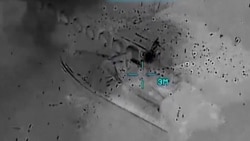


The US military said it knocked out 16 Iranian mine-laying ships near the Strait of Hormuz on March 10. But Iran still appeared capable of wreaking havoc in the waterway, with three commercial vessels reportedly hit by explosions on March 11, according to United Kingdom Maritime Trade Operations (UKMTO), a British naval coordination center that monitors security threats to commercial shipping.
Markets Reacting To Risk, Not Supply
So far, analysts said the market appears to be pricing in uncertainty rather than actual supply disruptions.
"What we're seeing is minute-by-minute, hour-by-hour market reactions to the scale and duration of the conflict," said Mason Hamilton, vice president for economics and research at the American Petroleum Institute.
Before the crisis, oil markets anticipated a supply glut and relatively low prices. The sudden threat to the Strait of Hormuz -- through which roughly 20 million barrels of oil and petroleum liquids move daily -- upended that outlook.
Experts at the Center for Strategic and International Studies (CSIS) note that markets often move ahead of physical shortages.
Kevin Book, the think tank's senior analyst, said traders are preparing for the possibility that Gulf producers could be forced to halt production if exports stall.
Even modest price swings carry enormous financial consequences: a $30 per barrel shift in a market of 100 million barrels per day represents roughly $3 billion in daily value changes, excluding derivatives.
Iran's Asymmetric Leverage
For Tehran, targeting global energy flows may be among the few strategic options it has left against far more powerful adversaries like the United States.
"Iran's objective is survival," said Khalid Azim, director of the MENA Futures Lab at the Atlantic Council. "It cannot confront the US or Israel head on, so it relies on asymmetric tactics to raise the cost of conflict."
Even minor disruptions in the Strait can have outsized effects, given the concentration of global energy trade in a handful of maritime chokepoints.
Azim warned that current market reactions may underestimate the risks, noting financial markets outside energy have remained relatively calm.
"There is a lot of asymmetric risk that the market is not fully pricing," he said.
Washington's Calculus: Pressure Without A Shock
For the United States, the challenge is balancing military objectives with the imperative to prevent a global energy shock.

US President Donald Trump has said Washington is ready to escort tankers through the Strait of Hormuz if necessary, although media outlets -- including Reuters -- have reported that the US Navy has so far has refused all shipping industry requests for military escorts because of the current high risk.
Meanwhile, officials from the Group of Seven (G7) nations are also talking about the potential release of emergency oil stockpiles to soften the market impact of any halt in energy flows because of the situation.
Richard Goldberg, a former Trump administration National Security Council official, said the US strategy combines market tools and military measures: insurance guarantees for shipping, encouragement of tanker movements, and naval escort operations if necessary. Carrier strike groups and missile-defense assets are already in position.
"The goal is to show Iran it cannot successfully choke off global oil flows without facing overwhelming countermeasures," Goldberg told an Atlantic Council event on March 10.
He emphasized that efforts are designed to mitigate disruption, not replace a major supply corridor indefinitely.
Even if production continues, the crisis exposes the fragility of energy logistics.
"There are two layers of risk: the infrastructure that produces barrels and the flow of those barrels," said Sara Vakhshouri, president of SVB Energy International. Refineries have been shut as a precaution, storage tanks are filling, and some producers have already curtailed output as exports slow.
Shipping companies face their own dilemma: Insurance alone may not compel crews to navigate a war zone. Extended delays could force Gulf producers to shut in millions of barrels, amplifying market instability.

The Strait of Hormuz also channels roughly 20 percent of global LNG, meaning disruptions could ripple through electricity, petrochemical, and fertilizer supply chains.
Asia, as the largest Gulf oil importer, is particularly exposed. Europe, reliant on LNG and refined products, faces vulnerability at a moment of low gas reserves after winter.
Restarting facilities after shutdowns can take weeks or months. "These are complex industrial systems designed to run continuously," Hamilton noted.
The crisis is unfolding amid a broader shift in US energy strategy. With the United States now the world's largest oil and gas producer, energy supply is increasingly treated as a strategic asset, giving policymakers leverage to pursue security objectives while cushioning domestic markets.
Duration Will Decide the Stakes
The crisis's severity hinges on how long disruptions persist. A brief interruption may be absorbed, but prolonged closure, according to Washington analysts, could keep oil prices above $100 per barrel, stoke inflation, slow economic growth, or even trigger recession in vulnerable economies.
CSIS experts note that while inventories, alternative routes, and emergency reserves provide buffers, they are designed for short-term disruptions, not a protracted shutdown of the Strait of Hormuz.
The unfolding confrontation is a test of the global energy system's resilience. Sustained Iranian pressure could prolong instability, while effective US and allied measures could demonstrate the limits of energy coercion.
For now, the key question remains: Will the Strait of Hormuz remain open or become the epicenter of a new energy war?

