



Accessibility links

Breaking News

News

Czechs Protest After Babis Government Survives No-Confidence Vote

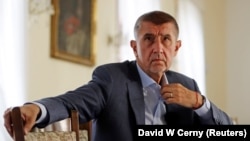
Czech Prime Minister Andrej Babis (file photo)

Thousands of Czechs have demonstrated in the capital, Prague, after the government of Prime Minister Andrej Babis survived a no-confidence vote triggered by a fraud investigation.

Opposition parties in parliament only garnered 92 of the 101 votes needed to approve the vote, with the Social Democrats and and Communist Party members refusing to vote against the billionaire businessman.

But thousands joined the protests in Prague's historic city center chanting slogans such as "We want a decent government" in calling for Babis's resignation.

"The government should be led by an ethical, moral, and honest person who has credit even with his political opponents," Ivan Bartos, head of the opposition Pirate Party, said in parliament before the vote.

Babis -- who heads a minority government but enjoys the support of President Milos Zeman -- has been battling police charges that he hid the ownership of one of his many companies by listing his adult children as the owners. The company is alleged to have received a 2 million-euro grant that it should not have qualified for.

Protests have been ongoing since last week, when a media report quoted Babis's son as saying his father had him involuntarily taken to Crimea in 2017 in order to keep him from being questioned by investigators.

The prime minister denies any wrongdoing and says the investigation is being used to push him out of politics. He also said his son, who lives in Switzerland, is being treated for a mental illness.

Police are looking into the son's claim.

Based on reporting by Reuters and AFP

All Of The Latest News

Updated

Outgoing UN Rights Chief Blasts 'Serious' Chinese Abuses In Xinjiang As Possible 'Crimes Against Humanity'

Outgoing UN High Commissioner for Human Rights Michelle Bachelet (file photo)

Departing UN High Commissioner for Human Rights Michelle Bachelet has excoriated Beijing for "serious human rights violations" and possible "crimes against humanity" in a western region where China's leadership is accused of mass roundups and other mistreatment of Uyghurs and other minorities, despite Beijing's strong-arm tactics to block the assessment.

Bachelet's report suggests that the discriminatory detention of Muslim groups in Xinjiang Province might constitute crimes against humanity and calls on China to "take prompt steps" to release all of those detainees in so-called training centers, prisons, or detention facilities.

It cites a "discriminatory pattern" and "patterns of torture" allegations in Xinjiang as "credible" and says the situation requires "urgent" international attention.

"The extent of arbitrary and discriminatory detention of members of Uyghur and other predominantly Muslim groups, pursuant to law and policy, in context of restrictions and deprivation more generally of fundamental rights enjoyed individually and collectively, may constitute international crimes, in particular crimes against humanity," the report said.

Chinese officials' treatment of Uyghurs and other minorities in Xinjiang Province, where more than 1 million Uyghurs have been forced into a network of detention camps, has been labeled genocide by the United States and harshly condemned by dozens of other countries, including at the United Nations in October.

August 31 was Bachelet's last day on the job and she vowed months ago to release the conclusions from her trip to the Xinjiang region in May before she left.

Chinese Ambassador Zhang Jun warned earlier in the day that Beijing was "firmly opposed" to the release of the document and had made its opposition "very clear" to Bachelet.

He acknowledged that Chinese officials "haven’t seen this report yet, but we are completely opposed to such a report [and] we do not think it will produce any good to anyone."

Bachelet recently said she was under "tremendous pressure" from both sides regarding the report, which UN officials and Western diplomats say has been mostly ready for months.

Its publication with the weight of the United Nations behind it marks a big blow to Beijing.

Uyghurs are a Turkic ethnic group mainly originating from and culturally affiliated with the Central and East Asian regions.

UN special rapporteur on modern slavery Tomoya Obokata this month concluded that China's coercing of Muslim Uyghurs and other minorities into forced labor in agriculture and manufacturing in Xinjiang could amount to "enslavement as a crime against humanity."

Chinese envoy Zhang called "the so-called Xinjiang issue...a completely fabricated lie out of political motivations" whose "purpose is definitely to undermine China’s stability and to obstruct China’s development."

Human rights groups and journalists have long documented shocking abuses in Xinjiang.

Beijing calls the detention facilities "training centers."

Family members and rights advocates previously expressed bitter disappointment at the failure of Bachelet, a former political detainee in Pinochet's Chile, a doctor for tortured children, and a one-term president, to more squarely confront China on the Xinjiang abuses.

It is unclear who will succeed Bachelet as the top UN rights advocate but she will initially be replaced by a deputy, a spokesperson for UN Secretary-General Antonio Guterres said this week.

"We are looking for somebody who is willing to speak out in a principled way, regardless of the perpetrator," Human Rights Watch (HRW) head Kenneth Roth said of the appointment.

With reporting by AFP, AP and Reuters

EU's Michel Urges Faster Work Toward Peace From Azerbaijani, Armenian Leaders

EU Council President Charles Michel (center) meets with Azerbaijani President Ilham Aliyev (left) and Armenian Prime Minister Nikol Pashinian in Brussels on August 31.

European Council President Charles Michel said after a trilateral meeting in Brussels with the leaders of Azerbaijan and Armenia on August 31 that the Caucasus rivals had agreed to accelerate "substantive work" toward a peace treaty.

The head of the EU executive said the fourth such trilateral talks since an intense 44-day war in late 2020 were "open and productive" and included discussions on reestablishing transport links, borders, and the freeing of wartime detainees.

The first EU-mediated meeting since May 22 was attended by Azerbaijani President Ilham Aliyev and Armenian Prime Minister Nikol Pashinian.

It follows an outbreak of fighting over the breakaway region of Nagorno-Karabakh on August 1-3 in which at least one Azerbaijani and two ethnic Armenian soldiers were killed. The two sides blame each other for the violence.

"Today we agree to step up substantive work to advance on the peace treaty governing inter-state relations between Armenia and Azerbaijan and tasked the foreign ministers to meet within one month to work on draft texts," Michel's statement said.

"We also had a detailed discussion on humanitarian issues, including demining, detainees and the fate of missing persons."

Michel said he stressed to the Azerbaijani side the importance of further freeing Armenian detainees, which has been a major demand since Yerevan's reluctant acceptance of a Moscow-brokered cease-fire that returned significant territory long held by ethnic Armenians to Azerbaijan.

He also urged each side to better prepare its public for peace despite decades of frozen conflict since the demise of the Soviet Union.

The Brussels meeting comes one day after Armenian and Azerbaijani commissions on border delimitation gathered in Moscow on August 30.

"With all these discussions, I would like to underline that it is important to take the population along on both sides and prepare them for a long-term sustainable peace," Michel said. "Public messaging is critical in this regard -- in a sensitive situation like this every word spoken in public is obviously listened to by the other side and weighed."

Michel said a meeting between border authorities would take place in November.

Nagorno-Karabakh, which along with seven adjacent districts had been under ethnic Armenian control for nearly three decades prior to the war in 2020, is internationally recognized as part of Azerbaijan.

Armenia lost control over parts of the breakaway region and the seven adjacent districts as part of the Russian-brokered cease-fire after a six-week war over Nagorno-Karabakh broke out in 2020, leaving more than 6,500 dead. An estimated 2,000 Russian troops have been deployed to monitor the situation.

Earlier this month, Baku forcibly took control of several strategic heights near the disputed region.

Belarus Designates Group Of Ex-Cops Who Oppose Regime As Terrorists

BYPOL was founded in 2020 in the wake of unprecedented mass protests questioning official presidential election results giving a victory and sixth term to authoritarian leader Alyaksandr Lukashenka. (file photo)

The Supreme Court of Belarus has labeled a group called BYPOL, which unites former law enforcement officers who support opposition politicians, as a terrorist organization.

The Prosecutor-General's Office said on August 31 that it initiated the hearing, which also outlawed BYPOL's structural branches, the Situational Analytical Center and Victory Mobilization Plan, as terrorist groups.

They accuse BYPOL of involvement in the "formation of radical ideas in society and pushing citizens to conduct extremist activities aiming to change the constitutional order" of Belarus.

BYPOL was founded in 2020 in the wake of unprecedented mass protests questioning official presidential election results giving a victory and sixth term to authoritarian leader Alyaksandr Lukashenka earlier in the year.

Lukashenka had been in power since 1994.

BYPOL's members have said the group was created to investigate police brutality during the violent dispersal of the anti-Lukashenka rallies and to convince active police officers to "take the Belarusian people's side" to stop the massive crackdown to suppress the monthslong protests.

The opposition and the West say the poll was rigged and followed the persecution and exclusion of potential challengers.

Many opposition politicians and activists have since been forced to leave the country or have been jailed.

Russian Trial Begins Of Mother Of Exiled Chechen Rights Activists

Zarema Musayeva is the mother of Abubakar and Ibragim Yangulbayev, both of whom have fled abroad citing harassment from Chechen authorities over their online criticism of Kremlin-backed Chechen head Ramzan Kadyrov.

The trial has opened in a fraud and assault case against the mother of two outspoken critics of authorities in Russia's North Caucasus region of Chechnya in a prosecution that critics insist is politically motivated.

The OVD-Info rights watchdog said on August 31 that the lawyers of defendant Zarema Musayeva requested at the first court session in the Chechen capital, Grozny, that their client be released to house arrest, citing her diabetes.

The court rejected the motion and quickly adjourned until September 7.

Musayeva is the mother of Abubakar and Ibragim Yangulbayev, both of whom have fled abroad citing harassment from Chechen authorities over their online criticism of Kremlin-backed Chechen head Ramzan Kadyrov.

Chechen police and security officers seized Musayeva in January in her apartment in the Russian city of Nizhny Novgorod, some 1,800 kilometers from Chechnya, and forcibly returned her to Grozny.

Kadyrov, other Chechen officials, and a member of the Russian Duma have publicly vowed to kill all members of the Yangulbayevs' family, calling them "terrorists."

Journalists, rights activists, and other Russians have urged the government to punish those who issued the threats.

Abubakar Yangulbayev has accused Kadyrov's law enforcement and security officers of "lawlessness on a daily basis in Chechnya" and said the case against his mother is Kadyrov's retaliation for his activities.

Both brothers have said they faced years of pressure from Chechen authorities over their online criticism of Kadyrov and the rights situation in Chechnya.

Many of their relatives have been similarly harassed in Chechnya and even deprived of their homes since Kadyrov and his people vowed to kill them and their family.

The activists' father, retired federal judge Saidi Yangulbayev, and a sister fled Russia in January following the threats.

Russian and international human rights groups have for years accused Kadyrov of overseeing grave human rights abuses, including abductions, torture, extrajudicial killings, and the persecution of the LGBT community.

Kremlin critics say Putin has turned a blind eye to the abuses because he relies on the former rebel commander to control separatist sentiment and violence in Chechnya.

Two Imams Attacked In Iranian City Of Qom Amid Rise In Assaults On Clerics

One of the two Imams has been hospitalized and needs surgery, according to reports.

Two imams have been attacked by unknown assailants in the central Iranian city of Qom, the latest in a series of assaults against clerics across the country.

According to the Hawzah news agency, which is affiliated with the Islamic Seminary of Qom, two young men attacked the imams "with an iron pipe for no reason." The cars of the clerics were also damaged.

One of the two was hospitalized and needs surgery, Hawzeh news reported.

The Qom police department has yet to publish a report on the incident.

There has been an increase in reports of attacks on clerics in various parts of Iran in recent months, which coincides with rising tensions among the population over worsening living conditions.

In July, a young Iranian cleric named Mojtaba Hosseini was stabbed several times in the back while giving a sermon in the city of Karaj, according to a local official. That same month, an imam was injured in an assassination attempt by an assailant passing by on a motorcycle in Isfahan city.

Several other attacks have also been recorded.

Mohammad Taghi Fazel Meybodi, a senior member of the Islamic Seminary of Qom, said earlier that many clerics and seminary students don't appear in public gatherings because of the "teasing or cursing" they hear from people.

Written by Ardeshir Tayebi based on an original story in Persian by RFE/RL's Radio Farda

Iranian Ministry Says It's Reviewing More Than 200 Textbooks On Ayatollah's Orders

Iranian Supreme Leader Ayatollah Ali Khamenei

More than 200 textbooks in Iran are being reviewed to ensure they address concerns made about them by Supreme Leader Ayatollah Ali Khamenei.

Education Minister Youssef Nouri said on August 31 that the books in question were printed for the new academic year, but after Ayatollah Khamenei went through them and made comments, changes to them will be made. The books will be introduced into grades 1 through 12 in the next school year, he added.

Nouri did not specify what the changes were. Khamenei has previously said that the teaching of many humanities subjects in universities causes disbelief in divine and Islamic teachings.

Textbooks have been changed several times in Iran since the 1979 revolution and the creation of an Islamic republic to include religious discourse and promote revolutionary, Islamic values among youth.

Officials have suggested that the reported changes are part of an effort to bring the textbooks in line with the clerical establishment’s education policies, including the Fundamental Reform Document Of Education, adopted in 2011.

These policies say the country needs an “education system capable of materializing [the ideal Islamic life], universal justice, and Islamic-Iranian civilization.”

In May, Khamenei demanded the removal of "useless" materials from textbooks during a meeting with a group of teachers.

Written by Ardeshir Tayebi based on an original story in Persian by RFE/RL's Radio Farda

FBI Experts To Investigate Massive Cyberattack In Montenegro

A source from Montenegro's National Security Agency said that "critical state infrastructure" had been targeted in the early-morning cyberattack.

A rapid deployment team of FBI cyberexperts is heading to Montenegro to investigate a massive and coordinated attack on the Balkan nation's government and its services.

“This is another confirmation of the excellent cooperation between the United States of America and Montenegro and proof that we can count on their support in any situation,” Montenegro's Ministry of Internal Affairs said on August 31.

On August 26, a high-ranking source with Montenegro's National Security Agency (ANB) told RFE/RL's Balkan Service that "critical state infrastructure" was targeted in the early-morning cyberattack and that Russian security services were suspected of involvement.

The ANB source, who requested anonymity due to the sensitivity of the issue, described the cyberattack as "unprecedented" in scale, and said it was prepared over a long period of time.

Later, a Cuban hacker group claimed responsibility while experts said it could also be the work of both individuals and organized criminal groups.

Montenegro was also hit by a cyberattack on August 23. The government's IT structures, Interior Ministry, and Prosecutor-General's Office were all involved in the investigation into that attack.

Russian state security bodies have been accused of involvement in numerous hacks and cyberattacks targeting Western governments and businesses in recent years. Experts have warned about the increased dangers of such attacks following Russia's unprovoked invasion of Ukraine in February, which led Western countries to impose punitive sanctions against Moscow.

Russia has denied any involvement in the cyberattacks.

With reporting by AP

Hungary Says EU To Suspend Visa Deal With Russia, Hold Off On Total Ban

Hungarian Foreign Minister Peter Szijjarto (file photo)

Hungarian Foreign Minister Peter Szijjarto says the European Union will suspend an accord with Russia on easier visa issuance for tourists, but avoid the outright ban some of the bloc's members have been pushing for at a meeting in Prague.

"There won't be a general blanket visa ban imposed for Russian citizens...Several member states have raised their voice against this, including myself," Szijjarto wrote in a post on Facebook on August 31.

He added that the visa issuance agreement will be suspended with a qualified majority of the bloc's 27 members, though he did not say whether Hungary would be one of them.

There was no immediate confirmation from the EU as the meeting continues in the Czech capital.

The matter of limiting visas to Russians has gained steam among some EU countries in recent days but an agreement must be reached by all 27 members of the bloc in order for it to become the latest sanction against Russia over its invasion of Ukraine.

EU countries that share borders with Russia -- the Baltic states, Poland, and Finland -- have led the drive for more restrictive bans on visas for Russian tourists.

With air service barred by the EU on flights from Russia, most travelers are using their land borders to travel on to other EU countries.

Updated

UN Says Iran Ups Uranium Enrichment, Tehran Demands More U.S. Guarantees To Revive Nuclear Deal

Iranian Foreign Minister Hossein Amir-Abdollahian (left) meets his Russian counterpart, Sergei Lavrov, in Moscow on August 31.

The UN nuclear watchdog says Iran has expanded its enrichment of uranium to a recently installed cluster of centrifuges, signaling another potential challenge to reviving a hobbled international nuclear deal after Tehran insisted it needed more U.S. guarantees to ink any agreement.

Reuters said it had seen a confidential report by the International Atomic Energy Agency (IAEA) on August 31 in which the agency said Iran was now using the second of three cascades, or clusters, of advanced IR-6 centrifuges at the underground Natanz plant to enrich uranium.

A separate report on August 29 said the first cascade had come onstream.

Each of the first two cascades of up to 174 machines enriches up to 5-percent fissile purity, and no nuclear material has been fed into the third cascade, the IAEA assessment said.

Earlier on August 31, Iranian Foreign Minister Hossein Amir-Abdollahian said his country needs stronger guarantees from Washington for the revival of the 2015 Joint Comprehensive Plan Of Action (JCPOA), and reiterated that the IAEA should drop its "politically motivated probes" of Tehran's nuclear work.

During a visit to Moscow where he met Russian Foreign Minister Sergei Lavrov, Amir-Abdollahian said Tehran was “carefully” reviewing Washington’s response to an EU text for the revival of the nuclear agreement, which has been on the verge of collapse since former U.S. President Donald Trump withdrew the United States unilaterally in 2018 and reimposed crippling sanctions.

After 16 months of indirect talks between Tehran and Washington, EU foreign policy chief Josep Borrell said on August 8 that the EU had put forward a final offer to overcome an impasse for the revival of the agreement.

The IAEA has been probing the origins of nuclear material found at three undeclared Iranian sites.

Since the United States withdrew from the pact four years ago and started reimposing sanctions on Iran, Tehran has progressively rolled back its own commitments to the deal. The deal was designed to prevent Iran from building a nuclear bomb. Tehran insists its nuclear program is for civilian purposes only.

Amir-Abdollahian's visit to Moscow follows a report by The Washington Post that Tehran has delivered a first shipment of Iranian-made combat drones to Russia.

Tehran last month denied U.S. claims about sending drones to Russia, which has invaded Ukraine.

Based on reporting by Reuters and IRNA

Amnesty Accuses Iran, Turkey Of Firing At Afghans Trying To Reach Safety

Afghan refugees gather at the Iran-Afghanistan border in August 2021.

Amnesty International has accused Iranian and Turkish forces of “repeatedly” pushing back Afghans who attempt to cross their borders and opening fire on men, women, and children trying to reach safety.

In a new report released on August 31, the London-based rights group said Afghans who manage to enter Iran or Turkey are detained and subjected to torture and other ill-treatment before being forcibly returned to Afghanistan, despite the poor human rights situation there.

Amnesty said it has documented the killing of 11 Afghans by Iranian security forces and three Afghans by Turkish security forces.

The rights group said none of those killed represented an “imminent threat of death or serious injury” to security forces or others that would meet the threshold for the use of firearms under international law and standards.

“We documented how Iranian security forces have unlawfully killed and injured dozens of Afghans since last August, including by firing repeatedly into packed cars. Turkish border guards have also unlawfully used live ammunition against Afghans, firing into the air to repel people, and also shooting at them in some cases,” Marie Forestier, researcher on refugee and migrants rights at Amnesty International, said in a statement.

The rights group called on Turkish and Iranian authorities to immediately end all pushbacks and deportations of Afghans, end torture and other ill-treatment, and ensure safe passage and access to asylum procedures for all Afghans seeking protection.

“Security forces must immediately end the unlawful use of firearms against Afghans at the borders, and perpetrators of human rights violations, including unlawful killing and torture, must be held accountable,” Amnesty International said.

Amnesty International said it is also calling on all countries not to forcibly return Afghans not only to Afghanistan, but also to Turkey or Iran, where Afghans would be at risk of deportation to Afghanistan.

The rights group also called on countries hosting Afghans to support safe passage and evacuations from Afghanistan for all those at risk of reprisals from the Taliban.

The hard-line group, which returned to power in August 2021, has been accused of serious human rights abuses, particularly against women whose rights have been crushed.

In past months, hundreds of thousands of Afghans have fled the country as the Taliban militants took power.

The United Nations Refugee Agency (UNHCR) says there are 2.6 million registered Afghan refugees in the world, of whom 2.2 million are registered in Iran and Pakistan alone.

Anti-War Activist In Russia's Tatarstan Remanded In Custody

The Supreme Court of Russia's Republic of Tatarstan

KAZAN, Russia -- Activist Andrei Boyarshinov, who was charged with terrorism over his calls for Russia to stop its ongoing unprovoked invasion of Ukraine, has been remanded in pretrial detention by the Supreme Court of Russia's Republic of Tatarstan.

Boyarshinov's lawyer, Rim Sabirov, told RFE/RL that the Supreme Court on August 31 rejected his client's appeal of an earlier decision by the Vakhitov district court in Tatarstan's capital, Kazan, to extend the activist's pretrial detention until at least November 17.

Boyarshinov was arrested in March and charged with public calls for terrorism and justifying terrorism.

The charges stem from posts he made on Telegram before and during unsanctioned rallies in Kazan where demonstrators demanded a halt to Russia's war in Ukraine.

The court initially placed Boyarshinov umder house arrest, but after prosecutors appealed the ruling, the pretrial restriction was changed and the activist was sent to a detention center.

Boyarshinov has told RFE/RL that he considers the case against him politically motivated, saying, "I am, and will be, against this war."

Many activists, journalists, and others have left Russia for other countries since Moscow launched a wide-scale attack on Ukraine on February 24.

Days after the sending troops into Ukraine in late February, President Vladimir Putin signed a law that calls for lengthy prison terms for distributing "deliberately false information" about Russian military operations as the Kremlin seeks to control the narrative about its war in Ukraine.

The law envisages sentences of up to 10 years in prison for individuals convicted of an offense, while the penalty for the distribution of "deliberately false information" about the Russian Army that leads to "serious consequences" has a punishment of up to 15 years in prison.

It also makes it illegal "to make calls against the use of Russian troops to protect the interests of Russia" or "for discrediting such use," with a possible penalty of up to three years in prison. The same provision applies to calls for sanctions against Russia.

Manana Aslamazian, 'Matriarch Of Russian Journalism,' Hit By Car, Killed In Yerevan

Manana Aslamazian

The former director-general of the Internews Foundation in Russia, Manana Aslamazian, has died at the age of 70 in the Armenian capital, Yerevan.

Journalist Viktor Muchnik wrote on Facebook that Aslamazian died after being hit by a car on August 31.

"Manana was a big friend and our mother. The matriarch of Russian journalism. I even do not know anyone who did more for all of us than she did," Muchnik wrote.

Aslamazian was the laureate of the 2002 Media Manager of Russia Award. She was also a recipient of the Russian Television Academy’s special Award for Personal Contribution to Russian Television's Development.

In 2002, she became a member of the staff of Russia's National Association Of Radio and Television Broadcasters.

Five years later, she was excluded from the association after authorities launched a criminal case against her, accusing her of "foreign-currency smuggling" for having 9,500 euros in her possession when she entered Russia from France, which at the time had a value above the $10,000 limit.

Aslamazian said at the time that she was not aware of the exchange rate between the euro and the U.S. currency.

Aslamazian left Russia then, and the Internews Foundation stopped functioning shortly after that.

Updated

Borrell Says EU Members Agree On Suspension Of Visa Deal For Russians

EU foreign policy chief Josep Borrrell

PRAGUE -- The European Union's top diplomat, Josep Borrell, says the bloc's 27 members have agreed to suspend an agreement with Russia, which had made it easier for Russians to obtain tourist visas, as a sanction for Moscow's unprovoked invasion of Ukraine.

Borrell announced the decision, which falls short of the total ban on visa issuance some countries sought, on August 31 after the second day of a meeting of EU foreign ministers in the Czech capital.

A 2007 visa agreement to ease EU entry requirements for Russians was partially suspended in late February, targeting people close to Russian President Vladimir Putin, such as Russia's official delegations and holders of diplomatic passports. But it left so-called “ordinary Russians” untouched, allowing them to continue to enjoy EU visa-facilitation benefits, such as reduced waiting times and costs and the need to present fewer documents when applying.

Countries that share borders with Russia -- the Baltic states, Poland, and Finland -- have led the drive for more restrictive bans on visas for Russian tourists. With air service barred by the EU on flights from Russia, most travelers are using their land borders to travel on to other EU countries.

Borrell said the agreement is aimed at stopping Russians from "visa shopping" by applying for their travel documents with countries in the bloc where the rules are not as strict. Once granted a visa to an EU country, the holder of the document can then travel freely within the EU's Schengen Area.

The suspension of the pact makes the EU visa process more complicated, more expensive, and more bureaucratic, as well as increasing waiting times for approval, according to European Commission guidelines.

"Given the challenging implications for the bordering countries, we acknowledge that measures can be taken at a national level to restrict entry into the EU in conformity with the EU Schengen border code," Borrell said in a nod to the EU's acceptance that a regional solution for the three Baltic countries, Poland, and Finland may be reached as well.

Lithuanian Foreign Minister Gabrielius Landsbergis said after the meeting that the EU countries bordering Russia will immediately seek such a regional solution on "how we're going to approach the national-security issue of people crossing from Russia with Russian passports and Schengen visas to our countries or through our countries further to Europe."

Still, some said the situation falls short of what is needed.

"This goes in the right direction but once again we saw that so far there has been a lot of talk and little action," Finnish Foreign Minister Pekka Haavisto told reporters, adding that the situation should be reevaluated within a few months.

"When Russia is invading Ukraine and we receive refugees from Ukraine and try to help Ukraine in every way, this is not a time for holidaymaking and luxury tourism (for Russians)," Haavisto added.

Germany and France had led the other side of the debate, saying the limiting of visas to Russians would be counterproductive as the EU tries to fight for the "hearts and minds" of those Russians who don't support Moscow's aggression against Ukraine.

Kyiv has called for the bloc to ban issuing visas to all Russians except political dissidents.

Ukrainian Foreign Minister Insists EU Drop ‘Illusions’ About Welcoming Russian Tourists
please wait

No media source currently available

0:00 0:03:24 0:00

Ukrainian Foreign Minister Dmytro Kuleba told RFE/RL in an interview on August 30 that "calling this war a 'Putin problem' and not the problem of the Russian society that mostly supports its president is self-deception."

All 27 EU members had to agree to any measure adopted that would limit the issuance of visas throughout the bloc.

Russian Paratrooper Who Condemned War In Ukraine Arrives To Seek Asylum In France

Pavel Filatyev

A Russian paratrooper who fled his homeland after criticizing the invasion of Ukraine has entered France following official authorization that allowed him to leave the asylum seekers' waiting area at Charles de Gaulle Airport on August 30.

A lawyer for Pavel Filatyev said her client had been freed and has eight days to file an asylum claim.

"We are delighted at this decision and are going to file the political asylum request in the days ahead," the lawyer, Kamalia Mehtiyeva, said.

Filatyev took part in Russia's attack on Ukraine in February and March. He later wrote a book titled ZOV (A Call) in Russian, a play on the signs "Z" and "V" that mark Russian military vehicles in Ukraine and have become symbols promoted by Russian state media and officials of support for the war.

Before leaving Russia, Filatyev gave an interview to The Guardian saying that after his book was published, he changed his address several times to avoid possible arrest.

A France-based human rights activist said his group had helped Filatyev "urgently" leave Russia.

Filatyev also said that he was not aware of whether a criminal case had been launched against him. But he told AFP from the airport that, "When I heard the higher-ups were calling for me to be sentenced to 15 years in prison for fake news, I realized that I wouldn't get anywhere here and my lawyers couldn't do anything for me in Russia."

President Vladimir Putin in March signed a law that calls for lengthy prison terms for distributing "deliberately false information" about Russian military operations as the Kremlin seeks to control the narrative about its war in Ukraine, launched in late February.

It also makes it illegal "to make calls against the use of Russian troops to protect the interests of Russia" or "for discrediting such use," with a penalty possible of up to three years in prison. The same provision applies to calls for sanctions against Russia.

Another Russian soldier, Daniil Frolkin of the 64th Motorized Rifle Brigade from the Far Eastern Khabarovsk Krai region, recently acknowledged that Russian troops took part in robberies, looting, and murders of civilians in Ukraine under orders from their supervisors. He also confessed that he had killed a Ukrainian civilian in the village of Andriyivka.

Based on reporting by AFP, Meduza, and RFE/RL's Russian Service

Russia Halts Gas Flows Via Nord Stream 1 Amid Concerns Over Energy Supplies

Russian energy giant Gazprom has said that the three-day work at a compressor are “necessary.” (file photo)

Russia halted gas supplies via a major pipeline to Europe on August 31 amid concerns that Moscow is curbing supplies to pressure Western countries.

Live Briefing: Russia's Invasion Of Ukraine

RFE/RL's Live Briefing gives you all of the latest developments on Russia's ongoing invasion, how Kyiv is fighting back, Western military aid, global reaction, and the plight of civilians. For all of RFE/RL's coverage of the war, click here.

Flows fell to zero on the Nord Stream 1 pipeline to Germany via the Baltic Sea, according to flow data from entry points linking Nord Stream 1 to the German gas network, for maintenance due to last until the early hours of September 2.

Russian energy giant Gazprom has said that the three-day work at a compressor are “necessary.”

But Germany's Federal Network Agency chief Klaus Mueller has called it a "technically incomprehensible" decision, warning that it was likely just a pretext by Moscow to wield energy supplies as a threat.

Experience shows that Moscow "makes a political decision after every so-called maintenance," he said, adding that "we'll only know at the beginning of September if Russia does that again."

The outage has fueled fears that Russia is curbing supply to put pressure on Western nations and break their unity in sanctioning Russia for its war against Ukraine, a charge Moscow denies.

On August 30, French Energy Minister Agnes Pannier-Runacher accused Russia of "using gas as a weapon of war."

She made the comments after Gazprom said it would be suspending gas deliveries to French gas and power group Engie because of missed payments.

"As we anticipated, Russia is using gas as a weapon of war and is using Engie's way of applying the contracts as a pretext to further reduce French supplies," Agnes Pannier-Runacher said in a statement.


"France has been preparing for this scenario since the spring...," the French minister said, adding that the country had already reduced its exposure to Russian gas imports to 9 percent from roughly the double that amount before the invasion of Ukraine.

Russia's disruption and reduction in supply has sent gas prices soaring and forced European governments to scramble for alternative supplies ahead of the winter.

Based on reporting by Reuters and AFP
Updated

UN Nuclear Inspectors Arrive In Zaporizhzhya Ahead Of Mission To Russian-Held Plant

Ukrainian President Volodymyr Zelenskiy (left) shakes hands with IAEA Director-General Rafael Grossi in Kyiv on August 30.

A team of UN nuclear safety inspectors has arrived in the war-torn southern Ukrainian city of Zaporizhzhya ahead of an urgent mission to the nearby nuclear power plant amid international concern at the potential for disaster at the Russian-occupied facility.

But the International Atomic Energy Agency (IAEA) head leading the mission has already signaled hopes for a more prolonged mission than that envisaged by Russians controlling the area, some 450 or so kilometers southeast of Kyiv.

IAEA Director-General Rafael Grossi said inspectors were likely to reach the nuclear complex on September 1 and the initial inspection should last "a few days," but he hopes to establish a permanent mission in Ukraine to monitor Europe’s largest nuclear plant.

"The mission will take a few days," Grossi said. "If we are able to establish a permanent presence, or a continued presence, then it’s going to be prolonged,” Grossi told reporters at a hotel in Zaporizhzhya.

"We have a very important task there to perform: to assess the real situation there, to help stabilize the situation as much as we can."

But the Russian-installed officials in Enerhodar, the town where the plant is based, said the IAEA team could stay anywhere from one to eight days.

Live Briefing: Russia's Invasion Of Ukraine

RFE/RL's Live Briefing gives you all of the latest developments on Russia's ongoing invasion, how Kyiv is fighting back, Western military aid, global reaction, and the plight of civilians. For all of RFE/RL's coverage of the war, click here.

Another official, Yevgeny Balitsky, the Moscow-appointed head of Ukraine's southeastern Zaporizhzhya region, told Interfax that the IAEA inspectors "must see the work of the station in one day."

Separately, Mikhail Ulyanov, Russia's representative to international organizations in Vienna, welcomed the possibility that IAEA experts could stay at the plant on a permanent basis.

Grossi has stressed the complexity of the inspection operation in a war zone, and the need for "explicit guarantees not only from the Russians but also from the Republic of Ukraine."

“We have been able to secure that...so now we are moving,” Grossi told reporters before setting out from Kyiv.

He said the team "will be reporting back after the mission."

Ukrainian President Volodymyr Zelenskiy called the inspection "probably one of the top-priority questions regarding safety of Ukraine and the world today."

Zelenskiy repeated Kyiv's and the international community's call for the "immediate demilitarization of the plant," which was occupied by Russian forces early in the 6-month-old war.

Zelenskiy, who has accused Russia of "nuclear blackmail" and "nuclear terrorism" in the conflict, also said the Soviet-era atomic energy plant should be returned to "full Ukrainian control."

Meeting Grossi on August 30, Zelenskiy said he was "very thankful" for the visit and warned that the situation around the plant was "extremely menacing.”

"The risk of a nuclear catastrophe due to Russian actions is not diminishing for even an hour," Zelenskiy said.

European Union foreign policy chief Josep Borrell renewed a call to Russia for the area around the power plant to be fully demilitarized.

“They are playing games. They are gambling with nuclear security,” Borrell told reporters in Prague. “We cannot play war games in the neighborhood of a site like this.”

Shelling dangerously close to the reactors, exhausted workers held at gunpoint, and disconnections have intensified fears of a Chernobyl-style disaster that could spread radioactivity far and wide.


Ukraine on August 30 accused Russia of shelling a corridor that IAEA officials would need to use to reach the plant in an effort to get them to travel via Russian-annexed Crimea instead. There was no immediate response from Russia.

Ukraine's armed forces General Staff said Russia was attacking with tanks, rockets, and artillery along a contact line in the Zaporizhzhya region.

Russian and Ukrainian forces have accused each other of shelling the plant, raising concerns about a possible nuclear disaster.

The IAEA's experts were set to assess physical damage to the plant, determine the functionality of safety and security systems, evaluate staff conditions, and perform urgent safeguards activities, the agency said.

The United States this week said a “controlled shutdown” of Zaporizhzhya is the “safest option” and urged Moscow to agree to a demilitarized zone around the site, echoing an earlier call from UN Secretary-General Antonio Guterres.

With reporting by Reuters, dpa and AFP
Updated

Condolences Pour In As Last Soviet Leader Mikhail Gorbachev Dead At 91

Soviet President Mikhail Gorbachev (1931-2022)

Dignitaries around the world are recalling the historical legacy of Mikhail Gorbachev, the last Soviet leader whose reforms helped end the Cold War and free Eastern Europe from communism.

Gorbachev died on August 30 in Moscow at the age of 91 following a prolonged illness.

The news unleashed an immediate outpouring of praise from foreign leaders, especially in the West, for the man who triggered a pivotal turning point in world history.

The reception in Russia and some of the other former Soviet states was much cooler, with Moscow so far not committing to a state funeral for the former leader.

Gorbachev was "a one-of-a-kind statesman who changed the course of history. He did more than any other individual to bring about the peaceful end of the Cold War," UN Secretary-General Antonio Guterres said.

"The world has lost a towering global leader, committed multilateralist, and tireless advocate for peace," said Guterres who also served as Portugal’s prime minister from 19952002.

U.S. President Joe Biden called Gorbachev a "rare leader – one with the imagination to see that a different future was possible and the courage to risk his entire career to achieve it.”

Biden said the former Soviet leader – who won the 1990 Nobel Peace Prize – made the world safer and freer for millions of people.

Gorbachev, who was born in the south of Russia in 1931, took over the Communist Party and Soviet leadership in 1985 at a time of growing tension between the Soviet Union and the West.

A generation younger than many of his contemporaries, he ushered in political and economic changes known as glasnost (openness) and perestroika (restructuring) that helped trigger the fall of the Berlin Wall, the reunification of Germany, and ultimately the Soviet demise.

German Chancellor Olaf Scholz on August 31 hailed Gorbachev's role in reuniting Germany but lamented that his attempt to establish an enduring democracy in Russia had "failed," a thinly veiled criticism of Putin, who has rolled back many of the freedoms unleashed by glasnost.

"The democracy movements in Central and Eastern Europe benefited from the fact he was in power then in Russia," Scholz said. However, Gorbachev "died at a time in which democracy has failed in Russia."

The former Soviet leader’s death comes as Putin pushes ahead with his unprovoked invasion of Ukraine, jailing citizens who speak out against the war or even refer to it other than as a "special military operation."

Britain's outgoing Prime Minister Boris Johnson also took a swipe at the current Kremlin leader as he praised Gorbachev.

"In a time of Putin's aggression in Ukraine, his tireless commitment to opening up Soviet society remains an example to us all."

French President Emmanuel Macron said Gorbachev was a "man of peace" whose decision opened a "path of freedom" for Russians and “changed” European history.

China, like the Soviet Union a one-party state, praised Gorbachev but not for his political reforms.

Beijing highlighted his part in improving ties between Beijing and Moscow in the 1980s and 1990s after decades of tensions over ideological differences and competing geopolitical interests.

"Mikhail Gorbachev made positive contributions to the normalization of Sino-Soviet relations," Foreign Ministry spokesman Zhao Lijian told a press conference, adding: "We mourn his death and express our condolences to his family."

Critics of Gorbachev noted the sometimes-violent response by Soviet authorities to the impending breakup of the Soviet Union, the economic collapse that engulfed many states, and the decline of Moscow's geopolitical influence.

In January 1991, Soviet troops killed 14 people at Lithuania's main TV tower in an attack that Gorbachev denied ordering. In Latvia, five demonstrators were killed by Soviet special forces.

“Lithuanians will not glorify Gorbachev," tweeted Lithuanian Foreign Minister Gabrielius Landsbergis, the son of Vytautas Landsbergis, who led Lithuania’s independence movement in the early 1990s.

"We will never forget the simple fact that his army murdered civilians to prolong his regime’s occupation of our country. His soldiers fired on our unarmed protesters and crushed them under his tanks. That is how we will remember him,” he added.

WATCH: Former Soviet leader Mikhail Gorbachev, who has died aged 91, presided over the collapse of the Soviet bloc and the end of the Cold War.

Obituary: Mikhail Gorbachev -- The Man Whose Empire Crumbled
please wait

No media source currently available

0:00 0:10:52 0:00

Gorbachev was politically debilitated by a hard-line coup in August 1991 that failed in large part due to a popular resistance led by Boris Yeltsin.

In late December, he resigned as president of the Soviet Union, bringing an end to Moscow's empire.

Russia's transition to a market economy following the Soviet collapse was accompanied by surging inflation, widespread job losses, and poverty.

In an attempt to find a scapegoat, many Russians pointed their finger at the reforms ushered in by Gorbachev and his successor Yeltsin.

Putin's Reaction

Putin, who called the collapse of the Soviet Union "the greatest geopolitical catastrophe of the century," delivered a dispassionate statement following Gorbachev’s death.

"Mikhail Gorbachev was a politician and statesman who had a tremendous influence on the course of world history," reads the condolence message to relatives released by the Kremlin on August 30.

Gorbachev led the country to a time of "dramatic change" and recognized the great need for reform at the time, Putin’s message said.

"I would like to particularly emphasize the great humanitarian, charitable and educational activity that Mikhail Sergeyevich Gorbachev carried out all these past years," it added.

Gorbachev Made 'Contribution To Human Freedom,' Says Fukuyama
please wait

No media source currently available

0:00 0:01:33 0:00

A more critical assessment of Gorbachev's legacy was made by Oleg Morozov, a member of Russia's lower house of parliament, or Duma, representing Putin’s ruling United Russia party.

He called Gorbachev one of the "co-authors" of a new world order that in Moscow’s eyes was "unjust."

Gorbachev will be buried on September 3 in Moscow next to his wife. It is not clear if he will receive a state funeral.

If not, he would be the first former Kremlin leader not to receive a state funeral since ousted General Secretary Nikita Krushchev, who died in 1971.

Grigory Yavlinsky, a liberal politician who as a Soviet economist authored a plan to transition the communist state to a free market one, said Russians critical of Gorbachev need to do some soul searching.

Gorbachev "gave freedom to hundreds of millions of people in Russia and near abroad as well as half of Europe.”

“How we in Russia used the freedom that was gifted to us -- [how we used] this great opportunity -- that is our responsibility," he said.

With reporting by Izvestia, TASS, Interfax, Reuters, Forbes, and The New York Times

Gazprom To 'Totally' Suspend Gas Deliveries To France's Engie

Europe is already on notice that Gazprom will shut off the Nord Stream 1 gas pipeline to Germany from August 31 to September 2 for maintenance.  (file photo)

Russian state-run natural gas giant Gazprom said it was completely suspending gas deliveries to French gas and power group Engie, heightening concerns over energy supplies to Europe as the Nord Stream 1 pipeline shuts for maintenance.

Gazprom said late on August 30 that the cutoff of the Engie supplies was because of missed payments.

"Gazprom Export has notified Engie of a total suspension of gas supplies from September 1, 2022, until the full receipt of the financial sums due for the deliveries," Gazprom said in a statement published on Telegram.

Earlier, Engie said it was informed by Gazprom on August 30 that a reduction would occur immediately. It did not any details on the nature of the dispute with Gazprom.

It said that Russian gas supplies had already been reduced substantially since Moscow launched its unprovoked war on Ukraine in late February.

"Very clearly Russia is using gas as a weapon of war and we must prepare for the worst case scenario of a complete interruption of supplies," France's Energy Transition Minister Agnes Pannier-Runacher told France's Inter radio.

Engie said it had taken action to protect itself.

"Engie had already secured the volumes necessary to meet its commitments towards its customers and its own requirements, and put in place several measures to significantly reduce any direct financial and physical impacts that could result from an interruption to gas supplies by Gazprom," Engie said in its statement.

Europe is already on notice that Gazprom will shut off the Nord Stream 1 gas pipeline to Germany from August 31 to September 2 for maintenance.

The outage has fueled fears that Russia is curbing supply to put pressure on Western nations and break their unity in sanctioning Russia for its war against Ukraine, a charge Moscow denies.

Russia's disruption and reduction in supply has sent gas prices soaring and forced European governments to scramble for alternative supplies ahead of the winter.

Based on reporting by Reuters and AFP

U.S. Navy Says IRGC Tried And Failed To Seize Unmanned Vessel In Persian Gulf

A U.S. Navy Saildrone Explorer unmanned surface vessel in the Persian Gulf. (file photo)

The U.S. Navy says it prevented an Iranian naval vessel from seizing one of its unmanned surface vessels in international waters in the Persian Gulf overnight on August 29-30.

It said the Iranian Islamic Revolutionary Guards Corps (IRGC) ship was trying to "detain" one of the Fifth Fleet's Saildrone Explorer unmanned surface vessel (USV) but disconnected a towing line and left the area about four hours after the USS Thunderbolt responded.

It said there was no further incident.

In a statement, the U.S. Fifth Fleet's commander called the actions of the IRGC support ship, the Shahid Baziar, "flagrant, unwarranted and inconsistent with the behavior of a professional maritime force."

There was initially no confirmation from Iranian officials.

Saildrone-type vessels are generally used for mapping or collecting data, and the U.S. Navy said the USV technology is "available commercially and does not store sensitive or classified information."

Reports of foiled actions are fairly common in the Persian Gulf, a vital shipping route that is routinely patrolled by U.S. and Iranian military vessels.

Dangerous naval encounters involving Western and Iranian militaries or commercial shippers have eased in recent years despite persistent tensions over sanctions-busting and influence in the region.

Tensions are still high between Iran and the United States over a hobbled nuclear deal and what Washington regards as malign activities by Tehran.

Ukraine Says Europe Should Ban Travel To All Russians Except 'Real' Opponents Of Putin

Speaking to RFE/RL's Ukrainian Service on August 30, Kuleba said Europe is deluding itself if it thinks that only Russian President Vladimir Putin is to blame for the ongoing war and not wide swaths of Russian society.

PRAGUE -- Ukrainian Foreign Minister Dmytro Kuleba called on the European Union to ban all Russians except political dissidents from traveling to the bloc on the grounds that Moscow’s unprovoked invasion enjoys wide support at home.

Speaking to RFE/RL's Ukrainian Service on the sidelines of an informal meeting of EU foreign ministers in Prague on August 30, Kuleba said Europe is deluding itself if it thinks that only Russian President Vladimir Putin is to blame for the ongoing war and not wide swaths of Russian society.

"When interviewed on the streets, most Russians support Putin’s policies...so calling this war a 'Putin problem' and not the problem of the Russian society that mostly supports its president is self-deception," Kuleba said.

WATCH: Ukrainian Foreign Minister Insists EU Drop 'Illusions' About Welcoming Russian Tourists

Ukrainian Foreign Minister Insists EU Drop ‘Illusions’ About Welcoming Russian Tourists
please wait

No media source currently available

0:00 0:03:24 0:00

EU foreign and defense ministers are in the Czech capital to discuss additional punishments against Russia, including a possible blanket ban on Russian travel to the bloc, as well as ways to help Ukraine defend itself six months into the full-scale war.

The push for a visa ban has been gaining steam in recent weeks, especially among Central and Eastern European nations, but has faced pushback from some heavyweight members. The measure needs the approval of all 27 member states.

Hours before the meeting, France and Germany issued a joint paper arguing that limiting visas for Russians would be counterproductive as the EU tries to win the "hearts and minds" of those Russians who don't support the invasion.

Kuleba said "real" Russian opponents of Putin should be allowed to visit the European Union as well as select others on "humanitarian" grounds -- a possible reference to those needing medical attention abroad -- but dismissed the idea that travel to the bloc will influence the views of other Russians toward Putin or the war.

Kuleba argued that since the EU simplified visa requirements for Russians in 2007, Moscow has invaded Georgia and Ukraine, assassinated political opponents in Europe, and used its gas and oil as weapons against the bloc.

"My question is: How's that transformative impact [of eased travel to the EU] working out? Maybe they should see what's really happening and admit that those are just illusions," he said.

Easy travel to Europe "did not help teach Russians to respect others, other countries, and other peoples," he said.

The EU has since February tightened visa restrictions for Russians and banned Russian planes from its airspace, significantly slashing the number of visitors from the country entering the bloc.

Yet Russians, including some officials and their relatives, are still arriving in EU states to vacation and the number of Russians seeking a visa for EU travel has surged.

Images of regime elite like Liza Peskova, the daughter of Putin spokesman Dmitry Peskov, who recently visited Greece, have fed international resentment as Ukrainian casualties and hardships mount.

Russians "must choose," Kuleba said: "If you support Putin then stay in Russia and enjoy it; don't use Europe for your benefit."

He called the issue "a matter of self-respect" for Europeans, saying Putin has unleashed aggression not just against Ukraine but against the West more broadly.

"The only difference is that Putin attacks us with missiles and tanks. He attacks Europeans with energy prices, inflation, propaganda. But the goal is the same: to destroy the democratic world."

During the 30-minute interview, Kuleba also touched on other major topics, including NATO membership, relations with Turkey, and peace talks with Russia.

He said Ukrainian President Volodymyr Zelenskiy's administration is working with the West on finding a temporary solution to the country's desire for a security guarantee.

Ukraine has been seeking to join NATO for years, but Washington and Brussels have repeatedly said that Kyiv is not ready and years away, something experts said was an attempt by the West to postpone a decision and avoid provoking Russia.

Kuleba said that following Russia’s invasion, it would be "indecent" if NATO again demanded Ukraine go through "some long endless process" before receiving membership in the alliance.

He said Kyiv welcomed Turkish President Recep Tayyip Erdogan's efforts to serve as an intermediary but said his call for talks between Zelenskiy and Putin were premature.

WATCH: 'Tourism Is Not A Fundamental Right': Romanian Minister Backs EU Ban On Russian Tourists

'Tourism Is Not A Fundamental Right': Romanian Minister Backs EU Ban On Russian Tourists
please wait

No media source currently available

0:00 0:03:42 0:00

"We do not share the opinion that Russia is now ready for negotiations. All Russia's actions demonstrate that it believes in its war and is looking for a military solution to the conflict."

Kuleba reiterated that Ukraine will not compromise its territorial integrity to end the war and rebuked outsiders for trying to pressure Kyiv to do so.

"I'm tired of their skepticism. These are all groups that never believed in Ukraine, who were advocates of semi-measures against Russia," he said.

Kuleba described victory as a three-stage process: restoration of Ukraine's territorial integrity, prosecution of Russian war criminals and payment of reparations, and Russia's public repentance for its aggression against Ukraine much as Germany had done following World War II.

"I continue to believe that the day will come when a Russian leader will come to Ukraine, kneel in front of the monument to the victims of Russian aggression, and apologize to the Ukrainian people for all the evil done to us. And when this happens, it will be the final victory of Ukraine."

Nonetheless, he said, it could take Ukraine generations to restore relations with Russia.

Zelenskiy Meets With IAEA Team Ahead Of Urgent Mission To Occupied Ukrainian Nuclear Plant

The Zaporizhzhya nuclear power plant on August 22

Ukraine's president met in Kyiv on August 30 with a team of UN nuclear inspectors ahead of their planned journey to the Russian-occupied Zaporizhzhya nuclear power plant in war-torn southern Ukraine, his office said.

International Atomic Energy Agency (IAEA) chief Rafael Grossi and around a dozen experts reportedly arrived in the Ukrainian capital late on August 29.

They were expected to quickly travel on to Zaporizhzhya but it was not immediately clear if the team would be allowed access to the nuclear site by Russian forces.

According to his office, President Volodymyr Zelenskiy said Grossi and the inspectors' mission was aimed at vital questions with urgent implications for regional and global safety.

"This is probably one of the top-priority questions regarding safety of Ukraine and the world today," Zelenskiy said, according to his office.

Zelenskiy repeated Kyiv's and the international community's call for the "immediate demilitarization of the plant," which was occupied by Russian forces early in the six-month-old war.

Zelenskiy also said the Soviet-era nuclear plant -- Europe's largest -- should be returned to "full Ukrainian control."

Shelling dangerously close to the reactors, exhausted workers held at gunpoint, and disconnections have intensified fears of a Chernobyl-style disaster that could spread radioactivity far and wide.

The IAEA's experts were set to assess physical damage to the plant, determine the functionality of safety and security systems, evaluate staff conditions and perform urgent safeguards activities, the agency said.

The United States this week said a “controlled shutdown” of Zaporizhzhya is the “safest option” and urged Moscow to agree to a demilitarized zone around the site, echoing an earlier call from UN Secretary-General Antonio Guterres.

Based on reporting by dpa and AFP

EU Ministers Gather For Contentious Debate On Blanket EU Visa Ban For Russians

With air service barred by the EU on flights from Russia, most travelers are using Russia's land borders with Poland, Finland, and the Baltic states to travel to other EU countries. (file photo)

A proposal by European Union members to ban tourist visas to Russians over the war in Ukraine appeared to hit a major hurdle as the bloc's ministers gathered in Prague on August 30.

France and Germany issued a joint position paper just ahead of the meeting saying the matter of limiting visas to Russians would be counterproductive as the EU tries to fight for the "hearts and minds" of those Russians who don't support Moscow's unprovoked aggression against Ukraine.

The matter of limiting visas to Russians has gained steam among some EU countries in recent days but an agreement must be reached by all 27 members of the bloc in order for it to become the latest sanction against Russia over its invasion of Ukraine.

"We should think about smart ways to make use of the important lever of the issuing of visas," the joint paper from Germany and France reads.

WATCH: Ukrainian Foreign Minister Insists EU Drop 'Illusions' About Welcoming Russian Tourists

Ukrainian Foreign Minister Insists EU Drop ‘Illusions’ About Welcoming Russian Tourists
please wait

No media source currently available

0:00 0:03:24 0:00

"While limiting contacts with regime representatives and authorities to areas of vital EU interest, we need to strategically fight for the 'hearts and minds' of the Russian population -- at least the segments not yet completely estranged from 'the West'," it adds, suggesting visas remain open to students, artists, scientists, and other key professionals looking to enter the EU.

Countries that share borders with Russia -- the Baltic states, Poland, and Finland -- have led the drive for more restrictive bans on visas for Russian tourists. With air service barred by the EU on flights from Russia, most travelers are using their land borders to travel to other EU countries.

In an interview with RFE/RL on the sidelines of the Prague meeting, Estonian Foreign Minister Urmas Reinsalu urged his 26 EU counterparts to ban tourist visas to Russians because "we have to do everything to pressure Russian society" and failing to take such a strong measure was to compromise "with evil."

A 2007 visa agreement to ease EU entry requirements for Russians was partially suspended in late February, targeting people close to Russian President Vladimir Putin, such as Russia's official delegations and holders of diplomatic passports.

But it left so-called ordinary Russians to continue to enjoy EU visa-facilitation benefits such as reduced waiting times and costs and the need to present fewer documents when applying.

Romanian Foreign Minister Bogdan Aurescu told RFE/RL that Bucharest "fully supports" the suspension of the visa-facilitation agreement with Russia and offered its "full availability" to discuss further measures restricting Russians' access to EU territories.

He noted that Romania is not yet part of the Schengen zone so access to many other EU states is not unfettered.

Ukrainian President Volodymyr Zelenskiy this month called on the EU to cease issuing all visas for Russia citizens to punish Moscow for its attack on his country.

In Prague on August 30, Ukrainian Foreign Minister Dmytro Kuleba said all Russians except political dissidents should be banned.

He told RFE/RL in an interview that "calling this war a ‘Putin problem’ and not the problem of the Russian society that mostly supports its president is self-deception.”

“There has already been a partial suspension [of the visa regime]. And I think there's going to be another step further," European Union foreign policy chief Josep Borrell told RFE/RL in an interview in Prague on August 29.

"But I cannot tell you if it will be a complete [ban].... I would not be in favor of saying no Russians, never, for any reason could go to Europe.... But it's up to the EU ministers to decide,” the bloc's top diplomat added.

Borrell is also looking to get approval at the informal meeting of ministers in Prague to begin working on an EU military training mission for Ukraine.

With reporting in Prague by RFE/RL's Rikard Jozwiak, dpa, Reuters and AP

Belarusian Prosecutor Seeks Lengthy Prison Terms For U.S. Citizen, Co-Defendants

Ryhor Kastusyou, the leader of the opposition Belarusian Popular Front, was among those sentenced to 12 years in prison.

MINSK -- Prosecutors have asked a court in Minsk to convict and sentence Yuras Zyankovich, a Belarusian-born lawyer who also holds U.S. citizenship, and his five co-defendants to lengthy prison terms for planning to assassinate authoritarian ruler Alyaksandr Lukashenka and his family and seize power.

The Minsk-based Vyasna (Spring) human rights center said on August 30 that the prosecutor asked the court to sentence Zyankovich, political observer and literary expert Alyaksandr Fyaduta, and the leader of the opposition Belarusian Popular Front, Ryhor Kastusyou, to 12 years in prison each.

Zyankovich and Fyaduta were snatched off a street in Moscow and driven more than 700 kilometers to Belarus in April 2021. Lukashenka claimed at the time that Zyankovich had formed a group that was part of a U.S.-backed assassination plot. Washington has denied the accusation.

Zyankovich did not enter a plea, but he reportedly said during the trial that he had agreed to cooperate with investigators. His wife has claimed that the charges against her husband are ludicrous and that if he confessed it was to save his life.

Kastusyou pleaded not guilty to the charges, while Fyaduta pleaded partially guilty. Krauchuk and Halubovich pleaded guilty.

Five others accused of being members of the group are currently residing abroad.

Lukashenka, who was ruled Belarus for nearly three decades, has frequently accused Western countries of trying to topple him after he claimed victory in the August 2020 presidential election.

Since the election, Belarus has been gripped by unprecedented protest and political turmoil, with opposition groups saying it was a rigged vote.

Belarusian security forces have arrested tens of thousands of people in a crackdown that has led to accusations of beatings and other rights abuses against demonstrators. The United States and the European Union have imposed sanctions against individuals and companies tied to Lukashenka's regime.

Most prominent opposition leaders have left the country.

The West has refused to accept Lukashenka's victory, and few countries aside from Russia acknowledge him as president of Belarus.

Estonian FM Says EU Can't Compromise With 'Evil' On Russian Visas

Estonian Foreign Minister Urmas Reinsalu met with Ukrainian President Volodymyr Zelenskiy on August 3.

PRAGUE -- Estonian Foreign Minister Urmas Reinsalu has called on his 26 European Union counterparts to ban tourist visas to Russians over the war in Ukraine, saying failing to take such a strong measure was to compromise "with evil."

Reinsalu and the rest of the bloc's foreign ministers are in the Czech capital from August 30 for an informal two-day meeting where the visa regime for Russians looking to enter the EU will take center stage.

Some members say the matter of limiting visas to Russians would be counterproductive as the EU tries to fight for the "hearts and minds" of those Russians who don't support Moscow's unprovoked aggression against Ukraine.

WATCH: Estonian Foreign Minister Calls For Nuremberg-Style War Crimes Trial For Putin, New Sanctions

Estonian Foreign Minister Calls For Nuremberg-Style War Crimes Trial For Putin, New Sanctions
please wait

No media source currently available

0:00 0:01:35 0:00

But Estonia's top diplomat said that was the wrong way to look at the situation.

"We have to do everything to pressure Russian society.... They also have to wake up. There is also their moral responsibility that their passivity is in a way legitimizing these atrocities that have taken place by the regime against the Ukrainian people," he told RFE/RL in an interview in Prague on August 30.

"We have to act immediately and show our determination to our adversary that our willpower is stronger than Russian willpower.... [Are] we compromising with evil, or with the war in Ukraine?" he added.

Countries that share borders with Russia -- the Baltic states, Poland, and Finland -- have led the drive for more restrictive bans on visas for Russian tourists. With air service barred by the EU on flights from Russia, most travelers are using their land borders to travel to other EU countries.

Reinsalu said that even with several rounds of crippling sanctions against Russia already being imposed, the bloc must "ramp up" its efforts to isolate Moscow and bring the conflict, which is now in its seventh month, to an end.

"These are not just punitive sanctions because Russia did something and let's discipline Russia. No. The aim of sanctions is that the aggressor will [see] that the price tag is too high, and he will avoid further aggression and we stop its war," he said.

"This is actually the end because only one person can stop the war. And it's [Russian President Vladimir] Putin," he added, noting that the length of the war will also depend on the West's willpower to stay united and make the tough choices that are necessary to make Russia halt its attack.

Estonia recently raised Moscow's ire after it removed a Soviet-era monument in a region with a sizable ethnic Russian majority.

A day later, it said it was targeted by "the most extensive cyberattacks since 2007," and Reinsalu said more could be on the way, though the country is ready.

In the end, Reinsalu said that the only acceptable outcome to the entire situation was Russia's complete defeat and Putin facing a war crimes panel.

"We need Russia [to] lose the war," he said.

Serbia's Vucic Insists Belgrade EuroPride Won't Go Ahead Despite Organizers' Defiance

Protestors march in Belgrade on August 28 against the international LGBT event EuroPride scheduled to be held in the Serbian capital later this month.

Serbian President Aleskandar Vucic warned on August 30 that his government's decision to block the EuroPride event next month in Belgrade must be respected in the interest of security, a climbdown from his earlier suggestion that the event might be rescheduled.

Vucic was dismissing organizers' pushback after officials in the mostly Orthodox Balkan country bowed to pressure from thousands of religious and other conservatives marching this month to ban the week of European LGBT pride scheduled for September 12-18.

"There will be no fights and no conflicts," said Vucic, whose national populism relies in part on support from the powerful Serbian Orthodox Church.

EuroPride promotes lesbian, gay, bisexual, transgender, and intersex pride at the pan-European level and is hosted by a different European city each year.

This year, it is slated for Belgrade and its 1.4 million or so residents.

It includes a Pride Parade, scheduled for September 17.

Vucic suggested Serbian authorities could not ensure security for the event.

The leadership of the European Pride Organizers Association that licenses EuroPride has vowed that the events will go ahead as planned in Belgrade.

A 2010 pride rally in Belgrade descended into violence that injured dozens of police and civilians when anti-LGBT mobs attacked participants.

But annual pride events have continued since 2014 -- aside from the 2020 event during the pandemic emergency -- without major incidents.

Serbian Prime Minister Ana Brnabic, a Vucic ally, became the Balkans' first openly lesbian leader when she took office in 2017.

Brnabic attended the 2017 Pride rally.

Load more

XS
SM
MD
LG