




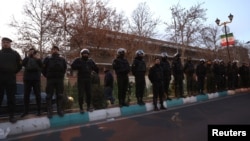
Security forces are reportedly maintaining a heavy presence on the streets in parts of Iran as more than two weeks of protests ease following a crackdown that has left thousands of Iranians dead and an ongoing Internet blackout.
Reports appear to indicate that the massive protests, along the brutal crackdown authorities unleashed to quell the unrest, have abated.
"Our independent sources confirm a heavy military and security presence in cities and towns where protests previously took place, as well as in several locations that did not experience major demonstrations," the Norway-based rights group Hengaw said.
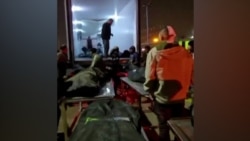

Iranian authorities have waged one of their most violent crackdowns ever after people across the country took to the streets in anti-government protests seen as one of the biggest challenges to clerical rule since the 1979 Islamic Revolution.
With a near total Internet blackout in its eighth day, according to watchdog NetBlocks, tensions remain high and information scarce. NetBlocks noted that the outage exceeds the core duration of a shutdown during protests in 2019.
"In 2019, it was only after connectivity was restored that the scale of the brutal crackdown became known," it added.
Rights groups say there is growing evidence of mass killings of protesters by Iran's security forces after the nationwide demonstrations escalated on January 8.
The independent US-based rights monitor HRANA said that according to its confirmed and verified data on January 15 the death toll in the protests had risen to 2,677 protesters, with more than 19,000 others detained. Norway-based Iran Human Rights said its research showed at least 3,428 protesters have been killed.
Meanwhile, Human Rights Watch reported that, starting on January 8, "security forces scaled up their deadly crackdown in a coordinated manner…resulting in large-scale killings and injuries of protesters and bystanders across the country."
It also said the severe restrictions on communications have limited independent verification of the full scale of the atrocities. Many groups have said the actual death toll is likely several times higher that the figures reported so far.
Across the Middle East, tensions have also eased over the possibility of US strikes on Iran over the crackdown.
The White House said on January 15 that US President Donald Trump and other officials had warned Tehran there would be "grave consequences" if there is further bloodshed.
Reports had said that one detained protester, 26-year-old Erfan Soltani, would be executed on January 14, six days after his arrest on charges of "waging war against God" over his role in the protests.
Rights groups said the execution did not take place after a warning by Trump, as he later thanked the "Iranian leadership" for what he called the cancellation of "over 800 executions."
"I greatly respect the fact that all scheduled hangings, which were to take place yesterday (Over 800 of them), have been cancelled by the leadership of Iran," Trump wrote in Truth Social on January 16.
The Iranian Judiciary Media Center later said the reports Soltani faced execution were "fabricated" and that he is charged with "gathering information and colluding against the country's internal security and propaganda activities against the regime."
Trump has not elaborated on what actions the United States may take against Iran and when, but some personnel have been advised by Washington to leave the main US air base in the region after Tehran warned neighboring countries hosting US troops that it would retaliate against American bases if Washington carries out its threats.
On January 16, Reza Pahlavi, the son of the late shah of Iran, who was ousted from power in 1979, said he was still confident the Islamic republic and its regime will fall in the face of mass protests.
"The Islamic republic will fall -- not if, but when," he told a news conference in Washington. "I will return to Iran."
The former crown prince has emerged as a leading opposition figure during the current unrest, with the broader opposition as a whole fragmented and unorganized.
In recent weeks, Pahlavi has repeatedly called for intervention by Trump. At the news conference, he once again appealed for greater international pressure to aid protesters and ratchet up pressure on Tehran.
"Iranian people are taking decisive actions on the ground. It is now time for the international community to join them fully," he said.
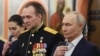
Russian President Vladimir Putin has been silent on uprising since it started.
On January 16, the Kremlin said Putin discussed the situation in Iran in separate calls with Iranian President Masud Pezeshkian and Israeli Prime Minister Benjamin Netanyahu, and said Moscow was willing to mediate in the region.
Russia has long been an ally of Tehran, which in turn has supported Moscow in its full-scale invasion of Ukraine, especially with supplies of military hardware such as drones.

