





Concern Grows Over Spread Of Spill From Grounded Tanker Carrying Russian Oil Off Oman
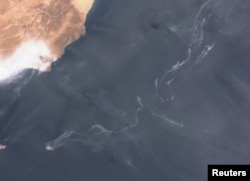
A large oil spill from a sanctioned tanker that was carrying Russian crude and ran aground off Oman’s coast six weeks ago is spreading and causing increasing concern amid the war in the Persian Gulf region.
The Caroline Bezengi, which held an estimated 800,000 barrels of Russian oil, ran aground on June 30 at an Omani island that is part of a marine nature reserve after reporting difficulties earlier in June off Yemen. Reports said there were explosions on board.
Oman said on August 10 that the slick covered almost 400 square kilometers, and that it was working to contain the spill.
On August 12, Reuters cited John Amos, an oil spill specialist who reviewed satellite imagery obtained by the news agency, as saying it now covers more than 2,000 square kilometers.
"Oil is drifting offshore to the northeast of Al-Qibliyyah Island with some oil reported to be reaching the mainland," the AFP news agency quoted a spokesperson for the International Maritime Organization (IMO) as saying. The spokesperson said that seasonal monsoon weather “has limited access to the vessel and delayed salvage operations."
Nobody has claimed an attack on the vessel, which sailed from the Russian Black Sea port of Novorossiisk in April, headed for India.
It passed through the Suez Canal in late May and later sailed past Yemen, where Iran-backed Houthi militants have joined the war pitting Iran against the United States and Israel.
Amos, CEO of SkyTruth, a nonprofit environmental advocacy group that uses satellite images to further its cause, warned that if “there's no adequate response to keep the worst from happening," the ship could lose its entire cargo, creating a spill whose size would rival the 1989 Exxon Valdez disaster off Alaska.
The Caroline Bezengi is under sanctions as a suspected part of a “shadow fleet” that Russia uses to circumvent Western punitive measures aimed to curtail its oil exports, a crucial source of funding for Moscow's war against Ukraine.
With reporting by Reuters and AFP
We are now closing the live blog for the day. We'll be back at 7:30 a.m. Central European time to cover the latest events across the Middle East.
Concern Grows Over Spread Of Spill From Grounded Tanker Carrying Russian Oil Off Oman
A large oil spill from a sanctioned tanker that was carrying Russian crude and ran aground off Oman’s coast six weeks ago is spreading and causing increasing concern amid the war in the Persian Gulf region.
The Caroline Bezengi, which held an estimated 800,000 barrels of Russian oil, ran aground on June 30 at an Omani island that is part of a marine nature reserve after reporting difficulties earlier in June off Yemen. Reports said there were explosions on board.
Oman said on August 10 that the slick covered almost 400 square kilometers, and that it was working to contain the spill.
On August 12, Reuters cited John Amos, an oil spill specialist who reviewed satellite imagery obtained by the news agency, as saying it now covers more than 2,000 square kilometers.
"Oil is drifting offshore to the northeast of Al-Qibliyyah Island with some oil reported to be reaching the mainland," the AFP news agency quoted a spokesperson for the International Maritime Organization (IMO) as saying. The spokesperson said that seasonal monsoon weather “has limited access to the vessel and delayed salvage operations."
Nobody has claimed an attack on the vessel, which sailed from the Russian Black Sea port of Novorossiisk in April, headed for India.
It passed through the Suez Canal in late May and later sailed past Yemen, where Iran-backed Houthi militants have joined the war pitting Iran against the United States and Israel.
Amos, CEO of SkyTruth, a nonprofit environmental advocacy group that uses satellite images to further its cause, warned that if “there's no adequate response to keep the worst from happening," the ship could lose its entire cargo, creating a spill whose size would rival the 1989 Exxon Valdez disaster off Alaska.
The Caroline Bezengi is under sanctions as a suspected part of a “shadow fleet” that Russia uses to circumvent Western punitive measures aimed to curtail its oil exports, a crucial source of funding for Moscow's war against Ukraine.
With reporting by Reuters and AFP
EU, Western States Condemn Iranian Executions In 'Strongest Terms'
The European Union and 26 Western countries condemned Iran’s ongoing executions of protesters “in the strongest terms” on August 12, saying the country’s citizens must be permitted to gather and voice their views without risking their lives.
“The use of capital punishment to silence dissent, intimidate communities, and punish individuals exercising their human rights can never be justified,” the EU and nations from Canada to Romania said in a statement.
“The people of Iran must be free to exercise their rights to freedom of expression and peaceful assembly without fear,” they said, urging Iran to “immediately end the use of the death penalty and release all those arbitrarily detained.”
“We further call on Iran to listen to the voice of its people as they demand change, and to take meaningful steps toward ensuring respect for human rights,” the statement said.
The Iranian state has used the death frequently in a crackdown on political dissent during and after mass protests in January.

Since the start of the war with the United States and Israel on February 28, there has been a surge in executions of people human rights groups consider political prisoners, from protesters to alleged members of banned groups and those convicted of spying.
“Seven months after the mass crimes committed against the Iranian people who rose up to demand justice and dignity, the regime continues to shed blood by multiplying executions,” French Foreign Minister Jean-Noel Barrot said in a post on X.
Some rights groups say more than 50 people hit with security and political charges have been executed since the beginning of the war, though others put the number much higher.
According to data verified by the Iran Human Rights group, 463 people have been executed in Iran so far this year, many of whom were sentenced to death in connection with the January protests where thousands were killed by security forces and tens of thousands more detained. Again, some estimates are much higher.
In addition to the EU, the statement was issued by Albania, Austria, Australia, Belgium, Canada, Croatia, Cyprus, the Czech Republic, Denmark, Estonia, Finland, France, Germany, Hungary, Iceland, Ireland, Italy, Latvia, Lithuania, Luxembourg, Montenegro, the Netherlands, New Zealand, North Macedonia, Norway, Portugal, Romania, Slovakia, Slovenia, Spain, Sweden, and the United Kingdom. The United States was not listed.
World Burning Through Oil Stockpiles, Says International Energy Agency
The International Energy Agency (IEA) warned on August 12 that global oil stockpiles are being rapidly depleted as diplomatic efforts to reopen the key Strait of Hormuz drag on.
The agency reported that oil inventories fell last month by 2.2 million barrels per day, pushing total global stocks below 7.9 billion barrels for the first time since early 2025.
The global oil balance is now projected to face a deficit of 1.8 million barrels a day in the coming months -- more than double the estimate made in July.
"Although the market is projected to return to surplus towards the end of this year, risks remain substantial and the urgency of reopening the Strait has increased," the IEA wrote.
The report comes as Iran and Oman have been negotiating the establishment of a safe route through the Strait of Hormuz, with Tehran saying it will not fully reopen the waterway unless the United States meets its conditions, a demand rejected by President Donald Trump.
Houthi Attack In Red Sea Killed 3 Pakistani Citizens, Foreign Minister Confirmed
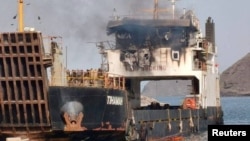
Three Pakistani citizens were among six people killed in strikes by Iran-backed Houthi rebels on an Egyptian-owned cargo ship near the Bab el-Mandab Strait on August 11, Pakistani Foreign Minister Ishaq Dar confirmed on August 12.
"Pakistan strongly condemns the Houthi attack on a non-combatant commercial vessel," Dar wrote on X, adding that another Pakistani citizen had been injured in the attack.
Four sailors aboard the ship were killed in an initial strike that caused a fire and extensive damage to the vessel. A second strike hit the ship as rescue workers were evacuating it, killing two members of the rescue team.
"Such attacks endanger innocent lives, constitute a violation of international law, and pose a serious threat to freedom of navigation, maritime security, and the safety of commercial shipping in the Red Sea," Dar said.
The attack marks the first reported fatalities from Houthi strikes on shipping since the Iran war began in February. Yemen's Houthis declared in July that they were imposing a maritime blockade on Saudi Arabia as fighting in Yemen resumed following the collapse of a years-long truce.
Dar added that Islamabad was "in contact with the relevant Saudi authorities, as well as the internationally recognized Government of Yemen" as part of efforts to investigate the incident further.
US Energy Chief Says Daily Average Of 9 Million Barrels Of Oil Passing Through Hormuz Strait

US Energy Secretary Chris Wright has said that oil shipments from the Persian Gulf region had climbed to around 15 million barrels per day.
In a post on X on August 11, Wright said the seven-day average through the Strait of Hormuz had reached almost 9 million barrels per day, with another 5 million to 7 million barrels moving through pipelines and other export facilities.
Wright said that more than 20 million barrels left the wider Gulf region on August 9 alone.
Before the war, around 20 million barrels of oil and petroleum products passed through the Strait of Hormuz each day.
Despite the recent increase cited by Wright, tanker traffic through the strait remains well below prewar levels, according to ship-tracking data cited by Reuters.
Trump Says US Could Let Iran Economy Deteriorate Or 'Hit Them Really Hard'
US President Donald Trump has said his options in the war with Iran include allowing Tehran to continue deteriorating economically or hitting it "really, really hard," even as diplomatic efforts toward a possible deal continue.

In a phone interview with Real America's Voice News late on August 10, Trump accused Iran of being "very devious negotiators" and said he was still negotiating with the Islamic republic.
His comments came as Pakistan, which has played a mediating role between Washington and Tehran during the conflict, said the two sides were close to "some sort" of agreement, while Qatar said talks over managing the Strait of Hormuz were at an advanced stage.
Trump also dismissed concerns over depleted US munitions, saying they were being produced "like crazy."
Reuters reported last week that the US Army had used much of its stockpile of highly accurate long-range missiles during the conflict.
With reporting by Reuters
Iran's New Security Chief Demands US End War To Reopen Hormuz Strait
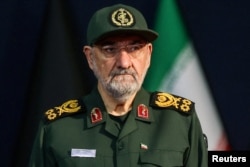
In his first public remarks since being appointed as the new secretary of Iran's Supreme National Security Council, Mohsen Rezaei, has said that the United States must end the war with his country and release frozen Iranian funds for the Strait of Hormuz to reopen.
According to Iranian media, Rezaei said during a meeting with the Chinese ambassador in Tehran that Tehran would not move to reopen the crucial waterway, which usually accounts for around one fifth of global oil and gas supplies, until the United States “changes its behavior and accepts Iran's conditions.”
He cited ending the war and releasing the frozen funds as two of the conditions.
Rezaei's remarks on August 11 came a day after US President Donald Trump told reporters that the United States had "mineswept" the entire Strait of Hormuz and had effectively taken control of it.
Rezaei's predecessor, Mohammad Baqer Zolghadr, had set out similar conditions last week.
Rezaei also commented on talks between the Islamic republic and Oman over passage through the Strait of Hormuz, which have been under way in recent weeks.
He said that if the two countries reach an agreement on the issue, “this agreement will be a matter separate from the closure of the Strait of Hormuz.”
Iran has severely restricted shipping through the strait since the conflict began, with daily traffic now a fraction of prewar levels.
With reporting by RFE/RL's Radio Farda
Iran's Khamenei Rebuilds A Command Structure Gutted By War
- By Kian Sharifi
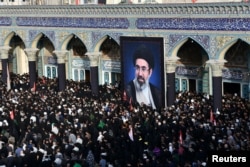
Iranian Supreme Leader Mojtaba Khamenei's decision to formalize six senior military and security postings within 48 hours is less a personnel story than the closing chapter of a five-month improvisation.
Read together, the appointments announced on August 10 show a new supreme leader moving to convert an emergency wartime chain of command, cobbled together after Israeli and US strikes killed much of Iran's senior military leadership, into a permanent structure built around his own circle of trust.
Read more here
At least 6 Killed In Red Sea Shipping Attack; US Fires On Cargo Vessel
At least six people were killed in strikes that Yemen's internationally recognized government blamed on Iran-backed Houthi rebels targeting an Egyptian-owned cargo ship near the Bab el-Mandeb strait on August 11, according to the country's coastguard.
Four sailors aboard the Tihamah -- three Pakistanis and one Indonesian -- were killed in an initial strike that caused a fire and extensive damage to the vessel, the coastguard said. A second strike hit as rescue workers were evacuating the ship, killing two members of the responding forces.
The coastguard said 10 people were injured in the strikes.
A Houthi media outlet later reported that the group's armed forces had targeted a ship in the Bab el-Mandeb strait that it said was carrying Saudi military equipment. The report did not identify the vessel as the Tihamah, and there has been no official Houthi statement claiming responsibility for the attack.
Yemen's Transport Ministry earlier blamed the Houthis for multiple strikes on the Tihamah but put the death toll at four.
The attacks would mark the first reported fatalities from a Houthi strike on shipping since the Iran war began in February. The Houthis declared that they were imposing a maritime blockade of Saudi Arabia in July as fighting in Yemen resumed following the collapse of a years-long truce.
Saudi Arabia has backed Yemen's government against the Houthis since leading a military intervention in 2015, although cross-border hostilities had largely subsided in recent years.
Separately, the US military said it fired on a Panama-flagged container ship that was trying to evade the US blockade of Iranian ports. In a post on X, US Central Command said its forces "disabled the steering gear" of the M/V Vela Nova as it "attempted to transit the Gulf of Oman" and sail toward an Iranian port.
"A U.S. Navy MH-60 helicopter fired two hellfire missiles into the Vela Nova’s engine room after the ship’s civilian crew ignored repeated warnings from American forces," it said. "The ship is no longer transiting to Iran in violation of the U.S. blockade, which remains in full effect."
The incident was initially reported by The Wall Street Journal.
Shipping traffic through key regional waterways has fallen sharply amid the conflict, with Bab el-Mandeb transits averaging 32 ships daily last week, while traffic through the Strait of Hormuz remains far below prewar levels.