




Report: Iran Still Denying US Atomic Agency Access To Nuclear Sites

Iran has continued to deny UN nuclear inspectors information about its stockpile of highly enriched uranium and access to more than 20 nuclear sites, according to a confidential quarterly report by International Atomic Energy Agency chief Rafael Grossi circulated to IAEA member states and seen by the AFP and dpa news agencuies.
The report said Tehran had again failed to cooperate with the IAEA in recent months, including by providing no information on around 440 kilograms of near-weapons-grade uranium.
Experts say the stockpile could provide enough material for several nuclear weapons if enriched further. Iran denies seeking nuclear arms.
Iran suspended cooperation with the IAEA after Israeli and US attacks damaged several of its nuclear facilities during a 12-day war in June 2025. After a new conflict erupted in February, Iran and Israel again struck Iranian nuclear facilities.
A US-Iran framework agreement reached in June envisaged diluting the highly enriched uranium under IAEA supervision, but that has yet to happen. Washington and Tehran have since accused each other of violating the deal.
Based on reporting by AFP and dpa
2 Filipino Sailors Killed In Attack On Saudi Oil Tanker
Saudi Arabia's national shipping company, Bahri, reported that two Filipino sailors from the crew of the supertanker Sidr, which was targeted in the Strait of Hormuz earlier this week, were killed.
The company said in a statement on September 2 that the Saudi-flagged vessel was involved in a "security incident" while transiting the Strait of Hormuz late on August 31, resulting in the deaths of two Filipino seafarers.
Bahri said the incident occurred at about 11:40 p.m. local time on August 31. The company did not provide details about the nature or cause of the incident, saying it remained in contact with the vessel, was coordinating with relevant authorities and maritime-industry stakeholders, and was monitoring developments.
Maritime security and intelligence companies had previously reported that the supertanker Sidr and another supertanker, the Liberian-flagged Senegal Prosperity, were struck by unidentified projectiles within minutes of each other as they were leaving the Strait of Hormuz.
Marisks reported that Sidr was struck about 16.6 nautical miles northeast of Khasab, Oman. The Senegal Prosperity was reportedly struck minutes later by three unidentified projectiles about 17 nautical miles east of Khasab. UK Maritime Trade Operations also reported that a tanker was struck by three unidentified projectiles in the same area.
Both vessels had loaded about 2 million barrels of Saudi crude oil at the Juaymah terminal the previous week, according to Reuters. The crew of the Senegal Prosperity was reported safe.
No party has claimed responsibility for the attacks, and Bahri has not publicly identified the cause of the incident involving Sidr.
The deaths announced by Bahri on September 2 are the first reported fatalities from the two closely timed tanker incidents.
US Lawmakers Examine Growing Russia, China Ties To Iran-Backed Houthis
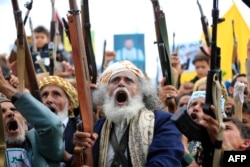
WASHINGTON -- Iran remains the Houthis' main foreign backer, but Russia and China are increasingly drawing scrutiny in Washington over their ties to the Yemeni militant group.
At a September 1 hearing of the US House Foreign Affairs Subcommittee on the Middle East and North Africa, lawmakers and experts focused on the Houthis' expanding operational, intelligence, and procurement ties with Moscow and Beijing.
The hearing, coming as Congress returned from its summer recess, put renewed focus on Tehran's regional network and the growing role of other powers in aiding the Yemen rebel group.
The Houthis control much of northern Yemen, including the capital, Sanaa, after more than a decade of civil war against forces aligned with the internationally recognized government. Saudi Arabia intervened against the group in 2015, but large-scale fighting eased after a UN-brokered truce in 2022 without a lasting political settlement.
To read the full report, click here.
Iran Says At Least 15 Killed In US Strikes
Iranian state and state-linked media said at least 15 people were killed in the latest US strikes on Iran on September 1, including civilians and military personnel.
State news agency IRNA, citing a local official, reported seven people killed and eight wounded in Khuzestan province after strikes around Ahvaz and Aghachari.
The IRGC said four air force personnel were killed in Kermanshah Province, according to the Tasnim news agency. Iranian media earlier reported four people killed at a wedding in Hormozgan Province.
The reported casualty figures could not be independently verified.
The US military did not immediately address the alleged wedding strike. US Central Command spokesman Tim Hawkins said "the US military never targets civilians, unlike the IRGC," referring to Iran's Revolutionary Guards.
With reporting by RFE/RL’s Radio Farda and dpa
Trump Says US Not Seeking To Force Iran Back To Talks
US President Donald Trump has said he was not seeking to force Iran back to negotiations, dismissing suggestions that renewed US strikes were aimed at bringing Tehran to the bargaining table.
"I couldn't care less if they sign a worthless, to them, agreement," Trump said in a post on Truth Social late on September 1.
Trump said the United States had "almost total control" of the Strait of Hormuz and described Iran's economy as collapsing, before asking: "When are the Iranian people going to rise up and fight?"
His comments came after the most significant exchange of attacks between the two countries in weeks. US forces struck IRGC targets in southern Iran, while Tehran retaliated with missile and drone attacks targeting US military facilities across the Middle East.
Iran Retaliates Against Renewed US Strikes With Missile And Drone Attacks Across Middle East
Iran launched missiles and drones against US military targets across the Middle East on September 2, vowing "severe" consequences for renewed American attacks on the Islamic republic.
Iranian state media said Tehran targeted US facilities in Jordan with ballistic missiles. Jordan's military said 13 Iranian missiles entered its airspace, 10 of which were intercepted, while three fell in remote areas. No casualties were reported.
Iranian missile and drone attacks were also reported in Kuwait and Bahrain. Kuwait's military said its air defenses were responding to hostile missiles and drones, while Bahrain said its air defenses intercepted and destroyed Iranian drones.
The IRGC said it also targeted US bases with missiles and drones in Iraq's autonomous Kurdistan region, claiming to have destroyed a maintenance center, warehouses and equipment. The claim, reported by Iran's state-run IRNA news agency, was not independently confirmed.
The latest round of fighting began when Washington struck Iranian targets on August 30, the first known US strikes in several weeks. Tehran subsequently targeted US forces in Jordan and the United Arab Emirates, while projectiles hit two oil tankers in unclaimed attacks in the Strait of Hormuz.
Iranian Military Vows Retaliation For US Strikes
Iran has vowed to retaliate after US strikes hit targets in the country on September 1, following what Washington says were attempts by Tehran to attack commercial shipping and US forces in the region.
According to Iran's state broadcaster, IRIB, the country's military warned that it would “deliver crushing and devastating blows” against the United States.
It added that “the more the US military persists in its aggression in the region, the greater and heavier the losses it will have to endure.”
The statement came after a social media post by US President Donald Trump, in which he said the US military had launched the strikes in response to an attempt by Iran to lay mines in the Strait of Hormuz and target a US military base in Jordan.
Trump threatened Iran with much heavier attacks if it retaliated.
Meanwhile, air-raid sirens have been activated in Jordan and Kuwait, the countries' militaries reported. The Jordanian military said that its air defenses engaged the missiles and shot down 10 of the 13 that were launched. It added that the other three fell in remote areas.
With reporting by Reuters and CNN
Report: Iran Still Denying US Atomic Agency Access To Nuclear Sites
Iran has continued to deny UN nuclear inspectors information about its stockpile of highly enriched uranium and access to more than 20 nuclear sites, according to a confidential quarterly report by International Atomic Energy Agency chief Rafael Grossi circulated to IAEA member states and seen by the AFP and dpa news agencuies.
The report said Tehran had again failed to cooperate with the IAEA in recent months, including by providing no information on around 440 kilograms of near-weapons-grade uranium.
Experts say the stockpile could provide enough material for several nuclear weapons if enriched further. Iran denies seeking nuclear arms.
Iran suspended cooperation with the IAEA after Israeli and US attacks damaged several of its nuclear facilities during a 12-day war in June 2025. After a new conflict erupted in February, Iran and Israel again struck Iranian nuclear facilities.
A US-Iran framework agreement reached in June envisaged diluting the highly enriched uranium under IAEA supervision, but that has yet to happen. Washington and Tehran have since accused each other of violating the deal.
Based on reporting by AFP and dpa
Trump Says US Striking Iran, Threatens Heavier Attacks If Tehran Retaliates
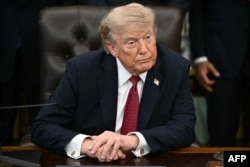
President Donald Trump says that the United States is striking Iranian targets near the Strait of Hormuz, warning of much heavier attacks if Tehran retaliates.
Trump said on his Truth Social platform that renewed US strikes on September 1 were in response to what he described was a "failed attempt" by Iran to place mines in the waterway and target a US military base in Jordan.
He added that the Strait of Hormuz "currently has no mines" because they "have been completely removed or detonated," and said that all eight missiles fired by Iran at the US base were successfully shot down.
Trump warned that if Iran retaliated for what he called a “very justified attack,” it would be hit again “at a much harder and higher level.” He added that an even larger attack was “waiting in the wings” and threatened that, when it was over, “there will be very little left of the Islamic Republic of Iran.”
Earlier in the day, the US military said it had launched strikes on targets in Iran, while Iranian media reported that explosions had been heard in two of its port cities.
Putin, Pezeshkian Reaffirm Moscow-Tehran Alliance Amid US-Iran War
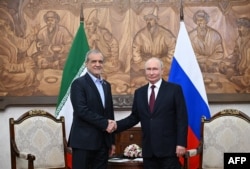
Iranian President Masud Pezeshkian thanked Russian President Vladimir Putin for Moscow’s position on the war in the Middle East, in their first meeting since the conflict broke out in February.
Russia has supplied Iran with satellite images and other intelligence, helping Tehran target US facilities in the Persian Gulf in recent months, according to reports. The two allies have also expanded military and economic ties in recent years.
“We appreciate and thank you for your positions at every stage, both during the period when the fighting and acts of aggression were taking place and under normal circumstances, when the United States was imposing sanctions on us, both at the United Nations and in international forums,” Pezeshkian told Putin at a meeting on the sidelines of the Shanghai Cooperation Organization (SCO) summit in Kyrgyzstan on September 1.
Pezeshkian described Iran’s relationship with Russia as “strategic” and said Tehran and Moscow can work together to resist what he called US “unilateralism.”
The meeting came after a new flareup in the six-month war. The United States said it attacked Iranian rocket launchers on a small island in the Strait of Hormuz on August 30, prompting Tehran to retaliate by hitting US military targets in Jordan.
Read more here
US Launches Fresh Strikes On Iran After Attempted Attacks, Military Says
The United States has launched strikes on targets in Iran, the US military said, following what it described as attempted Iranian attacks on commercial shipping and American forces in the region.
"Today at 12 p.m. ET, US forces began striking Islamic Revolutionary Guard Corps (IRGC) targets in Iran," US Central Command (CENTCOM) said in a post on X on September 1.
CENTCOM said the strikes followed recent attempted attacks by the IRGC against commercial shipping in the Strait of Hormuz and US service members.
The US military did not immediately provide details on the targets struck or the scale of the operation.
Shortly before CENTCOM's announcement, Iranian media reported that explosions had been heard in the port cities of Bandar Abbas and Sirik as well as on Qeshm Island.