




Trump Says Houthi Rebels Agree Not To Fight The US
US President Donald Trump on September 20 said Yemen's Houthi rebels have agreed not to attack US-linked sites, even as the Iran-allied militant group intensifies its fight against US ally Saudi Arabia, a Fox News reporter quoted the president as saying.
Fox reporter Trey Yingst, who often talks to Trump, quoted the president saying Washington is "in constant communication with the Houthis and that they've agreed not to fight the United States."
It wasn't stated if Trump had given any promises to the rebel group regarding possible US strikes.
Trump's comments reflect an earlier statement Trump made regarding the Houthi rebels.
"The Houthis called us and they don't want to fight with us," Trump said while visiting Ireland on September 12. "They don't want us to go after them."
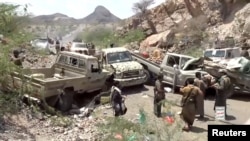
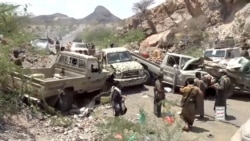
The rebels in recent weeks have launched an offensive against the international recognized, Saudi-backed government of Yemen and have also intensified missile and drone strikes inside Saudi Arabia.
Meanwhile, Fox News reported that Trump is in "deciding mode" on Iran. Yingst said the president told him that "big things will be happening in the not-so-distant future" and that "Iranians better behave, and he is making this decision as to whether or not to blow up their nation."
Trump unexpectedly cut short a weekend at Camp David to return to the White House on September 19 amid the rising tensions in the Middle East.
With reporting by AFP
Trump Says Houthi Rebels Agree Not To Fight The US
US President Donald Trump on September 20 said Yemen's Houthi rebels have agreed not to attack US-linked sites, even as the Iran-allied militant group intensifies its fight against US ally Saudi Arabia, a Fox News reporter quoted the president as saying.
Fox reporter Trey Yingst, who often talks to Trump, quoted the president saying Washington is "in constant communication with the Houthis and that they've agreed not to fight the United States."
It wasn't stated if Trump had given any promises to the rebel group regarding possible US strikes.
Trump's comments reflect an earlier statement Trump made regarding the Houthi rebels.
"The Houthis called us and they don't want to fight with us," Trump said while visiting Ireland on September 12. "They don't want us to go after them."
The rebels in recent weeks have launched an offensive against the international recognized, Saudi-backed government of Yemen and have also intensified missile and drone strikes inside Saudi Arabia.
Meanwhile, Fox News reported that Trump is in "deciding mode" on Iran. Yingst said the president told him that "big things will be happening in the not-so-distant future" and that "Iranians better behave, and he is making this decision as to whether or not to blow up their nation."
Trump unexpectedly cut short a weekend at Camp David to return to the White House on September 19 amid the rising tensions in the Middle East.
With reporting by AFP
Iran Says Economy Has Contracted 10 Percent Since Start Of War
Iran's Statistical Center said the country's economy contracted by more than 10 percent during the Middle East war, which began on February 28 with US-Israeli attacks on Iranian military and economic sites.
Iran's gross domestic product (GDP) declined 10.1 percent year-on-year from late March to late June, a period in Iran representing the first quarter of the Persian calendar, the statistical agency reported on September 20.
Because of reporting difficulties, it is impossible to verify the GDP figures, which some analysts have suggested are likely much worse.
Even before the war, Iran's economy had suffered through years of Western sanctions, with hyperinflation and currency devaluation hitting hard.
Ahmad Alavi, an Iranian economics professor based in Sweden, last month told RFE/RL that, along with heightened US sanctions, Iran’s economy suffers from ineffective policymaking, poor governance, and a wartime environment.
With reporting by AFP
Iran's Foreign Minister Heads To NY For UN General Assembly After Qatar Stop
Iran’s foreign minister is traveling to New York to attend the upcoming UN General Assembly, Iranian state media reported on September 20, with President Masud Pezeshkian also expected to attend the event.
Foreign Minister Abbas Araqchi’s trip to the US follows a quick visit to Qatar, a key mediator in the US-Iran war, media reports stated.
Araqchi "left Tehran on Sunday [September 20] evening bound for New York...and will make a brief stop in Doha to hold consultations on the latest developments in the region," state news agency IRNA reported.
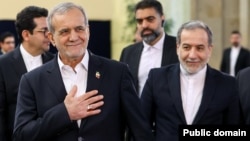
Flight-tracking services indicated the minister’s plane had arrived in Doha before departing about an hour later.
The stop in Qatar came as Iranian officials said they had again turned over to mediators their conditions for restarting US talks and to allow free transit through the important Strait of Hormuz.
The US State Department said it had approved visas for the Iranian delegation -- expected to be headed by Pezeshkian and Araqchi-- to attend the UNGA, although travel restrictions will be put in place for the delegation while in the US.
US President Donald Trump told Fox News reporters that he "probably" would be open to meeting Pezeshkian at the UN.
With reporting by Reuters
Pact-Member Turkey Says Saudis May Have 'Military Needs' After Houthi Attacks
Turkey's foreign minister said Saudi Arabia may have military needs because of the ongoing attacks by Yemen's Iran-allied Houthi rebels and that Ankara was prepared to help under a trilateral defense pact.
"We see there are very serious attacks on Saudi Arabia's territorial integrity, sovereignty. We have an alliance agreement in our pact. We are in serious solidarity on this point...They may have some military needs, especially on some technical issues. We would have no issues in meeting these," Foreign Minister Hakan Fidan told broadcaster NTV.
The joint defense pact, called the Mecca Joint Defense Agreement, was signed last month, with Pakistan joining as the third member. The pact stipulates that an armed attack on any one of the three countries will be regarded as an attack on all of them.
Pakistan did not immediately comment.
As part of a recent military offensive, the Houthis have gained control of the most populous parts of Yemen, pushing back the internationally recognized, Saudi-backed Yemeni government.
The rebels have also been launching attacks on Saudi Arabia and have declared a naval blockade against Riyadh.
On September 19, the Houthis said they attacked "sensitive" sites in the Saudi capital, Riyadh, with missiles and drones. Flames and plumes of smoke were later seen near the city's main airport.
With reporting by Reuters
Blasts Heard In Saudi Capital After Iran-Backed Houthis Claim Attack
Flames and smoke were seen near the international airport in Riyadh as Yemen's Iran-backed Houthi rebels said they had carried out strikes in the Saudi capital and on oil infrastructure on the coast.
AFP journalists reported that firefighters had managed to put out a blaze on a fuel tank with the logo of the Saudi oil giant Aramco at a fuel depot near the airport.
Residents also told AFP they heard what appeared to be explosions echoing through parts of the Saudi capital.
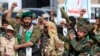
The Houthi rebels have intensified attacks in recent weeks and have captured swathes of Yemeni territory from the internationally recognized, Saudi-backed Yemeni government.
Saudi Arabia has responded with scores of strikes on Houthi-held areas but has not managed to halt the rebels' offensive.
The Houthi rebels have seized nearly all of Yemen’s Red Sea coastline, giving the Iran-aligned militant group control of the Bab al-Mandab Strait, a key chokepoint for global trade.
Saudi authorities said a ballistic missile fire at Riyadh at dawn was intercepted and destroyed.
"The Houthis also attempted to target civilians and civilian infrastructure in Bisha, Taif, Farasan, and Yanbu," a spokesperson said, adding that the attacks "were thwarted by the Gulf monarchy's air defenses."
The UN Security Council on September 18 said it "condemned in the strongest terms continued Houthi attacks against the Kingdom of Saudi Arabia, including attacks impacting civilian and energy infrastructure, which have resulted in the injury of civilians, including women and children."
War inbroke out in poverty-stricken Yemen in 2014 when the Houthis seized control of the capital, Sanaa, and other areas, leading to Saudi-led military intervention in March 2015. A fragile truce reached in 2022 collapsed.
(This item was updated with Saudi comment)
With reporting by AFP and Reuters
Iran Repeats Long-Standing Demands Before Any Restart Of US Talks
Tehran has repeated many of its long-standing conditions to restart peace talks with Washington, including ending the fighting on all fronts, the unfreezing of Iranian funds, and ending the US naval blockade against Iran.
Iran security chief Mohsen Rezaei told Al-Jazeera in an interview published on September 19 that consultations were continuing with mediators Qatar and Pakistan and that Tehran was awaiting a response from US President Donald Trump.
Tehran has often insisted on such demands in previous statements and has also claimed that it has a right to control ship passage through the important Strait of Hormuz, through which some 20 percent of the world's crude oil and natural has supplies transited prewar.
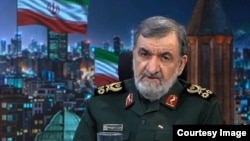
Trump on September 17 said he is approaching a major decision over whether the United States should resume large-scale attacks against Iran.
Speaking to Axios, Trump said: "I have a big decision coming up. Do I want to go in and annihilate them [the Iranian regime] or do I not? It's a big decision. Anything could happen with me."
Trump has also said Iran contacted his government and was "very keen" to reach an agreement, and expressed hope that the war was nearing an end. Rezaei, however, rejected talks on September 15, saying: "No talks until Iran's conditions are met. Period!"
The latest comments came ahead of a planned meeting between Trump and leaders of the six Gulf states -- Saudi Arabia, the United Arab Emirates, Qatar, Bahrain, Kuwait, and Oman -- on September 22 on the sidelines of the UN General Assembly in New York.
Axios reported that the meeting could help shape the next phase of the war, including whether diplomacy resumes or military action escalates. Trump said he wanted to hear directly from regional leaders about the next steps.
In the Al-Jazeera interview, Rezaei -- who is Iran's Supreme National Security Council secretary -- claimed it was is in Washington’s interest to accept Iran’s conditions for ending the war and that Trump’s threats would not yield results. He added that Iran is prepared for a "decisive war."
Meanwhile, fighting has continued in Lebanon, where Israel has targeted the Hezbollah militant group after it launched rockets into Israel. Tehran has insisted that Israel must end its attacks as part of any US peace deal.
Iran-backed Hezbollah, a militant group and political party that controls much of southern Lebanon, is considered a terrorist organization by the US, while the European Union has blacklisted its armed wing but not its political branch.
Iran Says Man Executed Over Alleged Links To Mossad

Iranian news reports said a man accused of spying for Israeli intelligence has been executed.
The Mizan News Agency, which is affiliated with Iran’s judiciary, said on September 19 that Hossein Pedaran was put to death following a Supreme Court ruling.
The agency did not say when and where it took place.
Mizan said Pedaran had allegedly provided the Israeli spy agency Mossad with information about sensitive military sites.
The agency also alleged that he had sought contact with the CIA for financial reasons, and that information he provided may have been used in attacks during the 12-day war.
The Tasnim news agency, another semiofficial news agency, said authorities allegedly found a notebook containing "top secret" missile information, encrypted memory cards, and secret imaging equipment.
The reports could not be independently confirmed.
Iran has sharply increased the number of executions it has carried out in recent years. The Abdorrahman Boroumand Center, a US-based human rights group, recorded at least 2,113 executions in 2025, the highest known annual figure since the late 1980s.
This year, at least 448 people have been executed, according to verified data as of August; many were sentenced to death in connection with the January protests where thousands were killed by security forces and tens of thousands more detained.
With reporting by RFE/RL's Radio Farda
Yemen Conflict Intensifies, Reverberating Beyond the Region
- By Frud Bezhan
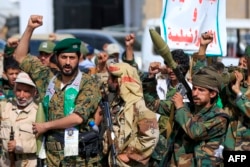
A conflict that has simmered in Yemen for years has flared in recent weeks, with consequences that could reach far beyond the Middle East.
The Houthi rebels have seized nearly all of Yemen’s Red Sea coastline, giving the Iran-aligned militant group control of the Bab al-Mandab Strait, a key chokepoint for global trade.
The Houthis have also intensified attacks on energy facilities in Saudi Arabia, the group’s foe and the world’s biggest oil exporter. Riyadh has been forced to temporarily shut down a crucial oil pipeline after a drone attack that it blamed on a pro-Iranian militia in Iraq.
The escalation in the Houthi-Saudi conflict has contributed to a recent surge in oil prices, which rose to $110 on September 15, the highest in months, before falling slightly.
Experts warn that a prolonged shutdown of Saudi Arabia’s critical East-West pipeline or a Houthi attempt to block the Bab al-Mandab Strait, which accounts for around 6 percent of the world’s seaborne-traded oil, could send shockwaves around the world.
Read more here
White House Rejects UN Report Alleging US War Crimes In Iran
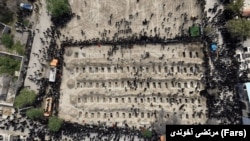
The White House has rejected a report by a UN independent fact-finding mission that said there were reasonable grounds to believe the United States had committed war crimes during two air strikes in Iran.
The Independent International Fact-Finding Mission on Iran said in a report released on September 17 that there were reasonable grounds to believe US forces committed the war crime of launching indiscriminate attacks during strikes on a school in Minab and a sports facility in Lamerd on February 28.
The two strikes killed at least 178 civilians, including women and children, according to the mission. The Minab strike hit the Shajareh Tayyebeh Primary School and killed more than 150 people, including about 120 schoolchildren.
A separate strike on a sports complex and surrounding residential area in Lamerd killed 22 civilians.
In a scathing written response to the report, White House Deputy Press Secretary Anna Kelly rejected the findings, saying: "The only party in this conflict that has committed war crimes is the Iranian regime, which has murdered thousands of its own people, killed Americans overseas, executed acts of terrorism in the Strait of Hormuz, and launched indiscriminate attacks against its neighbors in the region."
Kelly also said the UN Human Rights Council had "accomplished nothing for human rights while spouting unserious nonsense for decades."
US officials have repeatedly said military operations are conducted in accordance with the law of armed conflict and that an investigation is ongoing.
The report is scheduled to be formally presented to the 47-member UN Human Rights Council in Geneva on September 21.
The mission also found reasonable grounds to believe that Iranian authorities committed crimes against humanity during their crackdown on nationwide protests in December-January. It cited unlawful killings, arbitrary detention, torture, and other inhumane acts committed as part of a widespread and systematic attack against civilians.
IRGC Says It Struck Another Oil Tanker In Strait of Hormuz
Iran's Islamic Revolutionary Guards Corps (IRGC) Navy said on September 18 that it had struck another oil tanker in the Strait of Hormuz, setting the vessel on fire and forcing it to stop.
In a statement, the IRGC identified the tanker as the Trend, sailing under the Togolese flag. It said the vessel was struck on the night of September 17 while attempting what Iran described as an "illegal" passage through the vital waterway.
The IRGC said the tanker caught fire and was stopped. It did not provide information about the vessel's crew, cargo, possible casualties, or its current condition.
There was no immediate independent confirmation of the reported strike or fire.
Within the past 24 hours, the UK Maritime Trade Operations Organization (UKMTO) has issued three reports of security incidents involving vessels transiting the Strait of Hormuz, including one involving "a tanker being hit by an unknown projectile causing a fire onboard which has since been extinguished."
"All crew are reported safe and environmental impact is unconfirmed at present," the UKMTO added.
It remains unclear whether any of the UKMTO incidents involved the same vessel identified by the IRGC as the Trend.
The IRGC Navy said it maintains control of the Strait of Hormuz and warned that vessels attempting what it considers illegal passage would face destruction.
The United States has disputed Iran's claims of control over the waterway and has been assisting commercial vessels navigating the strait amid the conflict.