




Iranian Police Officer Killed In Attack In Restive Southeast
Iranian police said on November 3 that an officer had been killed by unidentified gunmen in the southeastern province of Sistan-Baluchistan, state media reported.
The officer, Hojat Vafakardeh, was attacked in Saravan county. Police said efforts were underway to identify and arrest those responsible.
Sistan-Baluchistan, one of Iran's poorest provinces, borders Pakistan and Afghanistan and has long been plagued by an insurgency involving separatist and Islamist militants.
Armed groups, including Jaish al-Adl, have stepped up attacks on security forces amid longstanding grievances among the predominantly Sunni Baluch minority, analysts say.
Iran's Islamic Revolutionary Guards Corps also reported killing one suspected militant and arresting several others in a separate operation on November 2.
With reporting by AFP
Iran Says It’s 'Not Waiting' For US Midterm Results
- By Kian Sharifi
A senior Iranian diplomat said on November 3 that Tehran is not waiting for the results of the US midterm elections and would not adjust its foreign policy based on the outcome.
“We do not tie our policies or the country’s foreign policy to the state of elections in other countries. That is a matter for the American people,” Deputy Foreign Minister Kazem Gharibabadi told reporters in Tehran as Americans voted.
But Iranian President Masud Pezeshkian has previously suggested that the timing of the vote matters to Tehran. Addressing the UN General Assembly in September, he expressed hope for a deal before Americans went to the polls, saying, “We don’t want it to get to the midterm elections.”
The vote has loomed over the eight-month war.
US President Donald Trump has said the conflict would end “immediately” after the elections and accused Tehran of trying the outcome. Last month, he said the United States would not attack Iran before the vote, though he authorized strikes on the Iranian island of Qeshm on the eve of the election.
Gharibabadi, who oversees legal and international affairs at the ministry, said Iran would adopt “whatever we think is in the interest of the nation” without being influenced by other countries.
Iran Hangs 2 Teens Over Deadly Isfahan Protest
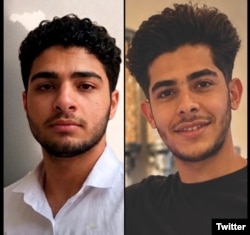
Iran executed two teenage men early on November 3 over the deaths of four security officers during antiestablishment protests in the central city of Isfahan in January, the Iranian judiciary said.
Amirhossein Maleki, 19, and Amirhossein Ebrahimi, 18, were among 14 defendants in what is known as the Alikhani Square case. The case is named after the site where four special unit officers were killed on the night of January 8 at the height of the nationwide unrest.
The judiciary's news agency, Mizan, described the pair as “main agents” of that night’s violence. It claimed they were armed and at the scene, and based this on their “confessions” and those of co-defendants.
Several other defendants in the case have already been executed, including Alireza Sepahi and Alireza Raisi.
The authorities have offered no evidence beyond confessions, some of which were broadcast on state TV. Rights groups consider such confessions and the trials that rely on them unreliable.
Shahrzad Shahbazi, Sepahi’s lawyer, said in a statement on October 10 that the defendants were never informed of any charge of killing the officers and that murder was not among the charges they faced.
Iranian Police Officer Killed In Attack In Restive Southeast
Iranian police said on November 3 that an officer had been killed by unidentified gunmen in the southeastern province of Sistan-Baluchistan, state media reported.
The officer, Hojat Vafakardeh, was attacked in Saravan county. Police said efforts were underway to identify and arrest those responsible.
Sistan-Baluchistan, one of Iran's poorest provinces, borders Pakistan and Afghanistan and has long been plagued by an insurgency involving separatist and Islamist militants.
Armed groups, including Jaish al-Adl, have stepped up attacks on security forces amid longstanding grievances among the predominantly Sunni Baluch minority, analysts say.
Iran's Islamic Revolutionary Guards Corps also reported killing one suspected militant and arresting several others in a separate operation on November 2.
With reporting by AFP
US Strikes Iranian Island As Trump Downplays Prospect Of Renewed Conflict
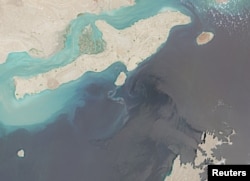
WASHINGTON -- The United States struck Iran's strategic Qeshm Island on November 2, US officials confirmed, in the latest in a series of previously undisclosed military operations against Iran that have continued even as President Donald Trump plays down the prospect of renewed large-scale fighting.
The strikes come just hours before the November 3 US midterm elections and follow a shift in Trump’s public rhetoric.
After weeks of warning that Washington could resume a major military campaign against Tehran after the vote, the president on Monday ruled out an immediate attack and pointed to the possibility of a diplomatic breakthrough. Asked whether he was considering striking Iran after the midterms, Trump told reporters, "No."
But administration officials told The Wall Street Journal (WSJ) that the president was still weighing his options, underscoring the contrast between his public assurances and the military operations continuing behind the scenes.
Read more here.
Trump Says Iran Wants A Deal ‘And It Could Happen’
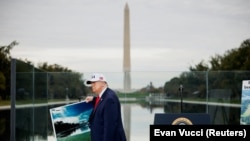
WASHINGTON -- President Donald Trump repeated his assertion that the United States is winning the war with Iran and said that Tehran wants a deal, adding: “It could happen.”
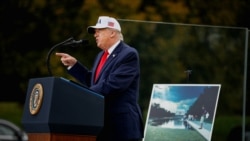
“We’re winning with Iran – easily winning,” Trump said in a speech in Washington on the eve of the November 3 elections that will determine which party controls the Senate and House of Representatives for the second half of his four-year term.
Later in the appearance at the Reflecting Pool in front of the Lincoln Memorial, Trump said that “we won” the war and that it is no longer a war: “We’ve done very little fighting” lately.
He said that much of Tehran’s military capability has been destroyed in the war that began with US and Israeli strikes in late February, and that Iran’s economy is in ruins.
“They want to make a deal, and it could happen,” Trump said, without going into detail.
Later, Vice President JD Vance told reporters that he and Trump "both feel pretty good about the prospects for potentially coming to a negotiated settlement.... We've certainly made some progress. We'll see if we can make some more."
A day earlier, Trump had said that the US would have to "hammer" Iran again at some point, but he made no mention of a new offensive in his address on November 2. As he concluded his remarks, a reporter shouted a question about whether he would resume strikes on Iran after the elections, and he replied: "No."
Diplomatic efforts have heated up in recent days. Iranian officials left Qatar following discussions with mediators seeking an end to the war with the United States, while a draft agreement is being circulated and another meeting remains possible, an official familiar with the negotiations said on November 2.
Listing a few domestic and foreign-policy priorities in his address, Trump singled out Iran, saying, “We’re not going to allow them to have a nuclear weapon.”
The war with Iran has contributed heavily to high energy prices globally and high US gasoline prices, adding to an array of challenges Trump’s Republican Party faces as it seeks to maintain control of both chambers of Congress in the midterm elections.
Opinion polls indicate the Democratic Party is likely to gain control of the House and has a chance to capture a majority of seats in the Senate.
With reporting by AFP
Russia, Iran Stress Need To Avoid Resumption Of Heavy Fighting, Moscow Says
Russian and Iranian diplomats held consultations in Moscow and stressed what they said was the need to avoid a new flare-up of fighting in the Middle East, the Russian Foreign Ministry said.
At the same time, Iranian media outlets reported that Russian President Vladimir Putin spoke by phone on November 2 with Mohsen Rezaei, secretary of Iran's Supreme National Security Council. The reports said the conversation focused on the Middle East but gave few details, and there was no immediate confirmation from the Kremlin.
The discussions came amid a renewal of diplomatic efforts to end the US-Iran war that began in February, and a day after US President Donald Trump said that “at some point we’re going to have to give them the hammer.” That remark suggested the US might launch new strikes on Iran sometime after the November 3 elections, in the which the Democrats are seeking to win control of both houses of Congress from Trump's Republican Party.
Pezeshkian Says Khamenei Authorized Government To Negotiate With US
Iranian President Masud Pezeshkian said on November 2 that Supreme Leader Mojtaba Khamenei had given his government the authority to pursue negotiations with the United States, amid renewed diplomatic efforts to end the war.
Speaking at a meeting with provincial governors, Pezeshkian stressed the importance of overcoming what he described as challenges and crises created by Iran's enemies.
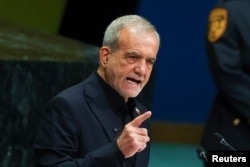
"We are trying to solve the problem through dialogue," he said.
Pezeshkian also said Khamenei had authorized the government to advance the negotiations, but did not elaborate on the scope of that authority.
The statement comes amid renewed questions over Khamenei's position on negotiations with Washington.
On June 18, following the signing of the Islamabad Memorandum of Understanding between Iran and the United States, Khamenei issued a message saying he had initially held a different view of the agreement but had authorized it after receiving assurances from Pezeshkian and other members of the Supreme National Security Council.
"I had a different opinion," Khamenei said in the message, adding that he had given permission based on their commitment to protect the rights of the Iranian nation and the Resistance Front.
The wording of the message subsequently became a subject of dispute among Iranian media outlets. Some outlets close to the supreme leader's office claimed that the phrase "in principle" in the published version did not appear in the original written text.

The 14-point Islamabad MoU established a framework for ending military operations, reopening the Strait of Hormuz and beginning a 60-day period of negotiations toward a broader agreement. The arrangement subsequently collapsed.
Khamenei, who succeeded his father, Ali Khamenei, after the latter was killed in US-Israeli strikes in February, has not appeared publicly since taking office, although Pezeshkian has previously said he met him privately.
The latest statement comes amid intensified diplomatic contacts involving Qatar and other regional mediators, as Tehran and Washington explore the possibility of renewed negotiations.
China Says Persian Gulf At 'Critical Crossroads Between War and Peace'
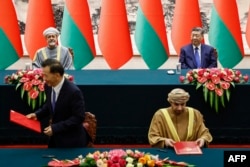
Chinese Foreign Minister Wang Yi said on November 2 that the Persian Gulf region had once again reached a "critical crossroads between war and peace," calling on all parties to end hostilities through negotiations.
Wang made the remarks during a meeting in Beijing with Saudi Arabia's national-security adviser, Musaed bin Mohammed Al-Aiban.
He said China hoped all parties would prioritize political solutions over further military action and work to protect regional energy security and the safety of shipping routes.
According to a summary of the meeting released by China's Foreign Ministry, Wang also said Beijing was ready to work with Riyadh to make further progress in bilateral relations.
Wang also met with Iranian security official Ali Bagheri Kani in Beijing on November 2, as China held discussions with representatives of both sides of the conflict amid efforts to end the war. Chinese President Xi Jinping also met Oman's Sultan Haitham bin Tariq, with Beijing announcing that its Middle East special envoy would visit Iran, Oman, and Saudi Arabia this month.
Tanker Struck By Projectiles Near Saudi Arabia, Says Maritime Monitor
A tanker was struck by two unidentified projectiles in the Persian Gulf, about 72 nautical miles east of Ras al-Khafji, Saudi Arabia, the United Kingdom Maritime Trade Operations Center (UKMTO) reported on November 2.
The tanker was traveling southeast when it was hit on its port side. The incident occurred late on November 1, at 23:47 UTC, according to reports citing the UKMTO advisory.
All crew members were accounted for, and no environmental impact had been reported, the maritime security agency said. Authorities were investigating the incident, and vessels were advised to transit the area with caution.
The attack came amid a series of incidents involving commercial shipping in the Persian Gulf.
On November 1, Qatar's state-owned shipping company Nakilat confirmed that its liquefied natural gas (LNG) carrier, Al Mayeda, had been struck by unidentified objects while sailing in the Gulf on October 30. The vessel remained operational, and none of its crew members were injured.
Gulf Cooperation Council Secretary-General Jasem Mohamed Albudaiwi condemned the attack, describing the targeting of energy tankers as a "dangerous escalation" that threatens regional security and global energy supplies.
Is Europe In Iran's Crosshairs? Tehran Hints At Wider Military Reach
- By Kian Sharifi
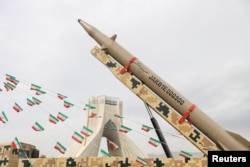
Iran and the United States have traded threats for weeks even as they pursue diplomacy, with the possibility of military escalation after the US midterm elections still looming.
A statement attributed to Supreme Leader Mojtaba Khamenei on October 31 directed the armed forces to be ready to respond to an attack "immediately, effectively, and with no geographical restriction."
That last point has fueled speculation in Iran about what it could entail and whether Tehran has the capability to deliver on its threat.
When the United States and Israel first attacked Iran on February 28, Tehran responded by striking military and civilian sites in Arab states across the Persian Gulf, insisting it was targeting US interests in the region.
Analysts say the Islamic republic hoped that regionalizing the conflict and striking the territory of US allies would pressure Washington into halting its attacks.
To read the full report, click here.