



US Offers $20 Million Reward For Information On Iran Nuclear Program
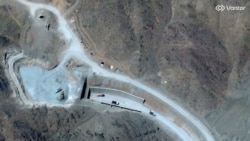
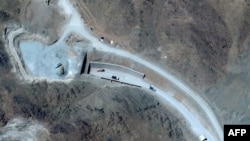
The US State Department is offering a $20 million reward for information on Iran's nuclear program, including intelligence on its "facilities, equipment, and associated personnel," it announced late on November 6.
A statement by the State Department's Rewards for Justice (RFJ) program said information on personnel included "those in the scientific community."
"In 2025, the International Atomic Energy Agency (IAEA) reported that Iran is enriching uranium to 60 percent purity, a level that is a short technical step from the 90 percent required for a nuclear weapon," the statement said.
"Iran is the only nonnuclear-weapon state to produce uranium at such a high enrichment level. Experts estimate this quantity, if enriched further, could be enough for several nuclear weapons."
US President Donald Trump has often said that preventing Tehran from acquiring a nuclear weapon was the key goal of the war launched, along with Israel, against Iran on February 28.
Trump has also often insisted that Iran's nuclear program has been destroyed in US and Israeli air strikes.
Earlier, Trump also included other goals, such as eliminating Iran's ability to conduct military operations and to reopen the strategic Strait of Hormuz to ship traffic.
The State Department's RFJ program was established in 1984 to combat international terrorism, its website says. It has expanded to also include information on foreign interference in US elections, malicious cyberactivity, and on North Korea.
We are now closing the live blog for the day. We'll be back at 9:30 a.m. Central European time to cover the latest events across the Middle East.
US Offers $20 Million Reward For Information On Iran Nuclear Program
The US State Department is offering a $20 million reward for information on Iran's nuclear program, including intelligence on its "facilities, equipment, and associated personnel," it announced late on November 6.
A statement by the State Department's Rewards for Justice (RFJ) program said information on personnel included "those in the scientific community."
"In 2025, the International Atomic Energy Agency (IAEA) reported that Iran is enriching uranium to 60 percent purity, a level that is a short technical step from the 90 percent required for a nuclear weapon," the statement said.
"Iran is the only nonnuclear-weapon state to produce uranium at such a high enrichment level. Experts estimate this quantity, if enriched further, could be enough for several nuclear weapons."
US President Donald Trump has often said that preventing Tehran from acquiring a nuclear weapon was the key goal of the war launched, along with Israel, against Iran on February 28.
Trump has also often insisted that Iran's nuclear program has been destroyed in US and Israeli air strikes.
Earlier, Trump also included other goals, such as eliminating Iran's ability to conduct military operations and to reopen the strategic Strait of Hormuz to ship traffic.
The State Department's RFJ program was established in 1984 to combat international terrorism, its website says. It has expanded to also include information on foreign interference in US elections, malicious cyberactivity, and on North Korea.
US Slaps Sanctions On 8 Canada-Based Firms For Iran Transactions
US authorities said they had slapped financial sanctions on eight Canada-based money services firms that they allege have facilitated transactions with sanctioned Iranian entities.
The sanctions will cut the firms off from the dollar-based financial system, freezing any assets the firms hold in the US and ban any transactions with US persons or entities.
The US Treasury has moved against firms outside the US that it says help Tehran get around US sanctions, as Washington keeps up pressure on Iran.
"Canada cannot be a safe haven for illicit financial facilitators that provide sanctions evasion services to the Iranian regime and its proxies,” Treasury chief Scott Bessent said.
US State Department spokesman Tommy Pigott said that Washington had "coordinated this action closely with Canada, including Canada's financial intelligence unit, FINTRAC."
"It reflects our shared commitment to protecting the North American financial system from abuse," he added.
With reporting by Reuters
US Tells Iranians: 'Safest Place' Is Inside Your Home
A US official has warned Iranian civilians that the "safest place" for them is "inside their home" as tensions rise again in the region following the US midterm elections.
"This is important information to help keep Iranian civilians safe," a US official told RFE/RL on November 6.
The official said that Iran's Islamic Revolutionary Guards Corps (IRGC) "has been placing military assets like weapons and command centers inside civilian neighborhoods and near homes."
"The Islamic regime does not care about the people of Iran, as evidenced by regime leaders and the IRGC using innocent civilians as human shields while they hide. They are hiding in fortified facilities and underground bunkers."
The official added that if "military tensions escalate, Iranian civilians should take appropriate precautions by remaining indoors and staying far away from the IRGC.:
"The safest place for Iranian civilians during heightened tensions is inside their home," the official warned.
The US government later issued a travel advisory for citizens in the Middle East.
"Americans currently in the Middle East should exercise heightened vigilance due to the increased threat of armed attacks by Iranian-supported Houthis and Iranian efforts to target US government officials in the region. Be aware of potential flight cancellations, airspace closures, and travel disruptions," it read. Similar warnings have been issue in the past.
Speculation has increased that US President Donald Trump could launch fresh strikes against Iran following the US midterm elections, which went strongly against Trump's Republican party in favor of the opposition Democratic party.
Before the election, Trump predicted that the war with Iran would end "right after the election."
While saying he wanted to give peace negotiations a chance to succeed, he also threatened fresh attacks, saying the US might have to give Iran "the hammer."
On November 6, Trump, in brief comments to reporters, said that his team was talking to representatives from Tehran, adding "we are doing very well with Iran," without elaborating.
Meanwhile, Iran's semiofficial Tasnim news agency early on November 7 reported that two missiles had struck Qeshm Island, an often recent target of US forces protecting shipping in the Strait of Hormuz.
No details were available. US Central Command (CENTCOM) did not immediately comment as to whether its forces were involved.
Iran Says It’s 'Not Waiting' For US Midterm Results
- By Kian Sharifi
A senior Iranian diplomat said on November 3 that Tehran is not waiting for the results of the US midterm elections and would not adjust its foreign policy based on the outcome.
“We do not tie our policies or the country’s foreign policy to the state of elections in other countries. That is a matter for the American people,” Deputy Foreign Minister Kazem Gharibabadi told reporters in Tehran as Americans voted.
But Iranian President Masud Pezeshkian has previously suggested that the timing of the vote matters to Tehran. Addressing the UN General Assembly in September, he expressed hope for a deal before Americans went to the polls, saying, “We don’t want it to get to the midterm elections.”
The vote has loomed over the eight-month war.
US President Donald Trump has said the conflict would end “immediately” after the elections and accused Tehran of trying the outcome. Last month, he said the United States would not attack Iran before the vote, though he authorized strikes on the Iranian island of Qeshm on the eve of the election.
Gharibabadi, who oversees legal and international affairs at the ministry, said Iran would adopt “whatever we think is in the interest of the nation” without being influenced by other countries.
Iran Hangs 2 Teens Over Deadly Isfahan Protest
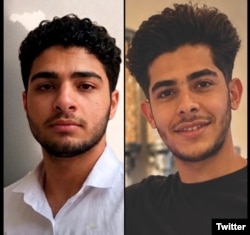
Iran executed two teenage men early on November 3 over the deaths of four security officers during antiestablishment protests in the central city of Isfahan in January, the Iranian judiciary said.
Amirhossein Maleki, 19, and Amirhossein Ebrahimi, 18, were among 14 defendants in what is known as the Alikhani Square case. The case is named after the site where four special unit officers were killed on the night of January 8 at the height of the nationwide unrest.
The judiciary's news agency, Mizan, described the pair as “main agents” of that night’s violence. It claimed they were armed and at the scene, and based this on their “confessions” and those of co-defendants.
Several other defendants in the case have already been executed, including Alireza Sepahi and Alireza Raisi.
The authorities have offered no evidence beyond confessions, some of which were broadcast on state TV. Rights groups consider such confessions and the trials that rely on them unreliable.
Shahrzad Shahbazi, Sepahi’s lawyer, said in a statement on October 10 that the defendants were never informed of any charge of killing the officers and that murder was not among the charges they faced.
Iranian Police Officer Killed In Attack In Restive Southeast
Iranian police said on November 3 that an officer had been killed by unidentified gunmen in the southeastern province of Sistan-Baluchistan, state media reported.
The officer, Hojat Vafakardeh, was attacked in Saravan county. Police said efforts were underway to identify and arrest those responsible.
Sistan-Baluchistan, one of Iran's poorest provinces, borders Pakistan and Afghanistan and has long been plagued by an insurgency involving separatist and Islamist militants.
Armed groups, including Jaish al-Adl, have stepped up attacks on security forces amid longstanding grievances among the predominantly Sunni Baluch minority, analysts say.
Iran's Islamic Revolutionary Guards Corps also reported killing one suspected militant and arresting several others in a separate operation on November 2.
With reporting by AFP
US Strikes Iranian Island As Trump Downplays Prospect Of Renewed Conflict
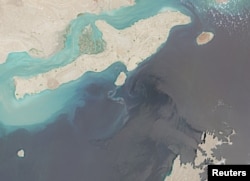
WASHINGTON -- The United States struck Iran's strategic Qeshm Island on November 2, US officials confirmed, in the latest in a series of previously undisclosed military operations against Iran that have continued even as President Donald Trump plays down the prospect of renewed large-scale fighting.
The strikes come just hours before the November 3 US midterm elections and follow a shift in Trump’s public rhetoric.
After weeks of warning that Washington could resume a major military campaign against Tehran after the vote, the president on Monday ruled out an immediate attack and pointed to the possibility of a diplomatic breakthrough. Asked whether he was considering striking Iran after the midterms, Trump told reporters, "No."
But administration officials told The Wall Street Journal (WSJ) that the president was still weighing his options, underscoring the contrast between his public assurances and the military operations continuing behind the scenes.
Read more here.
Trump Says Iran Wants A Deal ‘And It Could Happen’
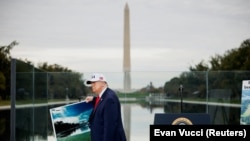
WASHINGTON -- President Donald Trump repeated his assertion that the United States is winning the war with Iran and said that Tehran wants a deal, adding: “It could happen.”
“We’re winning with Iran – easily winning,” Trump said in a speech in Washington on the eve of the November 3 elections that will determine which party controls the Senate and House of Representatives for the second half of his four-year term.
Later in the appearance at the Reflecting Pool in front of the Lincoln Memorial, Trump said that “we won” the war and that it is no longer a war: “We’ve done very little fighting” lately.
He said that much of Tehran’s military capability has been destroyed in the war that began with US and Israeli strikes in late February, and that Iran’s economy is in ruins.
“They want to make a deal, and it could happen,” Trump said, without going into detail.
Later, Vice President JD Vance told reporters that he and Trump "both feel pretty good about the prospects for potentially coming to a negotiated settlement.... We've certainly made some progress. We'll see if we can make some more."
A day earlier, Trump had said that the US would have to "hammer" Iran again at some point, but he made no mention of a new offensive in his address on November 2. As he concluded his remarks, a reporter shouted a question about whether he would resume strikes on Iran after the elections, and he replied: "No."
Diplomatic efforts have heated up in recent days. Iranian officials left Qatar following discussions with mediators seeking an end to the war with the United States, while a draft agreement is being circulated and another meeting remains possible, an official familiar with the negotiations said on November 2.
Listing a few domestic and foreign-policy priorities in his address, Trump singled out Iran, saying, “We’re not going to allow them to have a nuclear weapon.”
The war with Iran has contributed heavily to high energy prices globally and high US gasoline prices, adding to an array of challenges Trump’s Republican Party faces as it seeks to maintain control of both chambers of Congress in the midterm elections.
Opinion polls indicate the Democratic Party is likely to gain control of the House and has a chance to capture a majority of seats in the Senate.
With reporting by AFP
Russia, Iran Stress Need To Avoid Resumption Of Heavy Fighting, Moscow Says
Russian and Iranian diplomats held consultations in Moscow and stressed what they said was the need to avoid a new flare-up of fighting in the Middle East, the Russian Foreign Ministry said.
At the same time, Iranian media outlets reported that Russian President Vladimir Putin spoke by phone on November 2 with Mohsen Rezaei, secretary of Iran's Supreme National Security Council. The reports said the conversation focused on the Middle East but gave few details, and there was no immediate confirmation from the Kremlin.
The discussions came amid a renewal of diplomatic efforts to end the US-Iran war that began in February, and a day after US President Donald Trump said that “at some point we’re going to have to give them the hammer.” That remark suggested the US might launch new strikes on Iran sometime after the November 3 elections, in the which the Democrats are seeking to win control of both houses of Congress from Trump's Republican Party.