



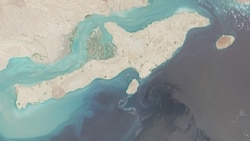

Trump Confirms US Strikes On Iran's Qeshm Island
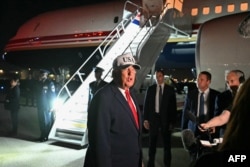
US President Donald Trump confirmed late on November 6 that American forces had carried out limited strikes against an Iranian air-defense system on Qeshm Island in the Strait of Hormuz.
Speaking to reporters in West Palm Beach, Florida, Trump described the operation as "minor," saying US forces had destroyed a small Iranian anti-aircraft system within minutes.
"They knocked it out in about 15 minutes, maybe 5," he told reporters, without disclosing the precise location of the target or providing further operational details.
His remarks followed media reports of explosions on Qeshm Island.
Iran's semiofficial Tasnim news agency reported preliminary indications that two missiles had struck Qeshm Island, while state news agency IRNA cited local witnesses reporting two projectiles hitting the Suza area after an aircraft was heard overhead.
Iranian media also claimed that the country's air defenses had intercepted and destroyed a US MQ-1 Predator drone over Qeshm.
Meanwhile, Trump said Washington continued to be in contact with Tehran. Speaking to reporters in Florida, he said, "We are talking to Iran. We have been. They desperately want a deal."
The strategic Qeshm Island sits at the mouth of the Strait of Hormuz, one of the world's most important maritime routes for energy shipments.
The island is home to a large underground missile facility, a naval base, and a major desalination plant, according to The Wall Street Journal. It has been targeted by US forces in previous rounds of fighting, and US officials have also discussed the possibility of seizing it.
Iran Executes Baluch Prisoner Amid Concerns Over Unfair Trials
Iranian authorities executed Mohammad Aref Shahbakhsh, a 27-year-old Baluch man, at Zahedan Central Prison on November 7, according to rights groups and Iranian media.
Judicial officials accused Shahbakhsh of being a member of the Jaish al-Adl militant group and involvement in an armed assault on the Qaleh Bid police station in Khash, located in the southeastern Sistan and Baluchestan Province. State media claimed the attack left several police officers dead or wounded, resulting in Shahbakhsh's conviction on charges of armed rebellion and "enmity against God."
ranian human rights groups reported Shahbakhsh had been held in state custody for more than two years while being systematically denied access to an independent lawyer or a transparent trial. According to monitors, the execution was carried out secretly at dawn on November 7 without prior notification or final visitation rights granted to his family.
A recent report by RFE/RL's Radio Farda highlighted severe procedural violations in the separate Isfahan Shohada Square case, where 10 death sentences were handed down against anti-government protesters.
Citing informed sources, Radio Farda reported that several judges signed those final execution orders despite never attending the courtroom sessions, reviewing the defense files, or hearing arguments from the defendants. The report also emphasized a broader reliance on allegedly coerced confessions and the mishandling of foundational evidence, fueling widespread criticism over the total absence of due process.
CENTCOM Announces Task Force To Target Iran's Military Supply Routes
The US Central Command (CENTCOM) has announced the creation of a new task force that will work to disrupt the delivery of advanced weapons, dual-use technology, and sanctioned materials into Iran through land routes and the Caspian Sea.
Task Force Iron Gate, which will coordinate with other US government agencies, comprises around 20 military and civilian personnel and is based in Tampa, Florida, CENTCOM said in a statement on X.
CENTCOM Commander Admiral Brad Cooper said the team would also reinforce the US naval blockade of Iran's ports, in order to "further constrain Iran's ability to finance terrorism, rebuild weapons factories, and replenish their military."
Cooper added that the blockade had prevented Iran from exporting more than $25 billion in crude oil in recent months. CENTCOM said enforcement at sea would continue against all ships entering or departing Iranian ports.
The announcement comes amid a series of warnings from Iranian military officials.
On November 7, Iranian media reported that IRGC spokesman Brigadier General Hossein Mohebbi had announced the lifting of Iran's previously self-imposed 2,000-kilometre missile-range limit. He said the country's capabilities would be demonstrated in practice.
The previous day, IRGC Aerospace Force adviser Brigadier General Ali Balali warned that countries assisting a potential US attack on Iran could themselves become targets.
Iran Reiterates Terms For Reopening Strait Of Hormuz, Warns Of Military Response
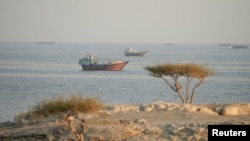
Iran says the United States must accept its seven conditions before the Strait of Hormuz can reopen, warning further military action will not change its position.
Speaking on November 6, Iranian Army spokesman Brigadier General Mohammad Akraminia told the semiofficial Tasnim News Agency that accepting Tehran's demands was the only way to reopen the strategic waterway. He warned that any renewed aggression would prompt an immediate Iranian response, potentially targeting US military assets without geographical restrictions.
Those demands reportedly include lifting US sanctions, releasing frozen Iranian assets, and paying war reparations.
Washington has not publicly responded directly to Akraminia's statement. The United States has maintained that Iran's nuclear program must be addressed in any initial negotiations.
The Islamic Revolutionary Guards Corps Navy also reiterated on November 6 that the Strait of Hormuz would remain closed until Iran's conditions were met.
The Iranian warnings came amid continued reports of attacks and other security incidents involving commercial shipping in and around the vital waterway.
The IRGC Navy claimed two oil tankers had struck naval mines while attempting to use unauthorized routes through the strait. Both vessels caught fire and were stopped, according to the statement. The claims have not been independently verified.
Separately, the United Kingdom Maritime Trade Operations (UKMTO) reported an explosion aboard a tanker approximately 16 nautical miles east of Khasab, Oman, on November 6. All crew members were safe, and the vessel continued under its own power, according to UKMTO.
UKMTO reported 11 attacks on commercial vessels across the Strait of Hormuz and the Arabian Gulf in the seven days to November 4.
Meanwhile, Greek shipping company Velos Tankers confirmed on November 6 that one crew member had died following an explosion aboard its Marshall Islands-flagged tanker MT Velos Sapphire in the Persian Gulf on November 5. The remaining crew members were unharmed, and the fire was extinguished by the crew, according to the company.
Trump Confirms US Strikes On Iran's Qeshm Island
US President Donald Trump confirmed late on November 6 that American forces had carried out limited strikes against an Iranian air-defense system on Qeshm Island in the Strait of Hormuz.
Speaking to reporters in West Palm Beach, Florida, Trump described the operation as "minor," saying US forces had destroyed a small Iranian anti-aircraft system within minutes.
"They knocked it out in about 15 minutes, maybe 5," he told reporters, without disclosing the precise location of the target or providing further operational details.
His remarks followed media reports of explosions on Qeshm Island.
Iran's semiofficial Tasnim news agency reported preliminary indications that two missiles had struck Qeshm Island, while state news agency IRNA cited local witnesses reporting two projectiles hitting the Suza area after an aircraft was heard overhead.
Iranian media also claimed that the country's air defenses had intercepted and destroyed a US MQ-1 Predator drone over Qeshm.
Meanwhile, Trump said Washington continued to be in contact with Tehran. Speaking to reporters in Florida, he said, "We are talking to Iran. We have been. They desperately want a deal."
The strategic Qeshm Island sits at the mouth of the Strait of Hormuz, one of the world's most important maritime routes for energy shipments.
The island is home to a large underground missile facility, a naval base, and a major desalination plant, according to The Wall Street Journal. It has been targeted by US forces in previous rounds of fighting, and US officials have also discussed the possibility of seizing it.
IRGC Says Iran Expanding Missile Range, Signals Possible Nuclear Doctrine Shift
Brigadier General Hossein, spokesman for Iran's Islamic Revolutionary Guards Corps (IRGC), said Iran is continuing to increase the range of its missiles, stressing the process will not stop.
Speaking on November 7 at a press conference for IRGC Aerospace Force Week, Mohebbi referred to Supreme Leader Mojtaba Khamenei's directive to confront adversaries without geographical limitations, saying Iran is constantly upgrading its missile capabilities.
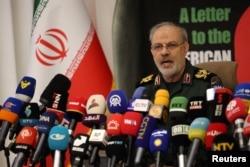
Addressing calls for a revision of Iran's nuclear doctrine, he said that if the country's leadership deems such a change is necessary, Iran will prepare to respond to threats from hostile Western countries.
However, a change in Iran's nuclear doctrine has not been officially announced. Just days earlier, Supreme National Security Council Secretary Mohsen Rezaei said no formal decision had been made to revise the country's nuclear posture.
According to Iranian media reports, Mohebbi also announced that the IRGC Aerospace Force had transferred missile and drone production lines underground, establishing what he described as "missile production cities." He said domestic expertise, Iran's geographical size, and flexible production infrastructure would allow weapons manufacturing to continue despite heavy bombardment.
On November 6, BBC Verify's satellite imagery analysis documented ongoing construction and reconstruction at several Iranian military sites, including facilities linked to the country's missile program, indicating continued efforts to restore damaged military infrastructure.
US Offers $20 Million Reward For Information On Iran Nuclear Program
The US State Department is offering a $20 million reward for information on Iran's nuclear program, including intelligence on its "facilities, equipment, and associated personnel," it announced late on November 6.
A statement by the State Department's Rewards for Justice (RFJ) program said information on personnel included "those in the scientific community."
"In 2025, the International Atomic Energy Agency (IAEA) reported that Iran is enriching uranium to 60 percent purity, a level that is a short technical step from the 90 percent required for a nuclear weapon," the statement said.
"Iran is the only nonnuclear-weapon state to produce uranium at such a high enrichment level. Experts estimate this quantity, if enriched further, could be enough for several nuclear weapons."
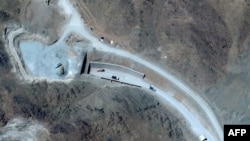
US President Donald Trump has often said that preventing Tehran from acquiring a nuclear weapon was the key goal of the war launched, along with Israel, against Iran on February 28.
Trump has also often insisted that Iran's nuclear program has been destroyed in US and Israeli air strikes.
Earlier, Trump also included other goals, such as eliminating Iran's ability to conduct military operations and to reopen the strategic Strait of Hormuz to ship traffic.
The State Department's RFJ program was established in 1984 to combat international terrorism, its website says. It has expanded to also include information on foreign interference in US elections, malicious cyberactivity, and on North Korea.
US Slaps Sanctions On 8 Canada-Based Firms For Iran Transactions
US authorities said they had slapped financial sanctions on eight Canada-based money services firms that they allege have facilitated transactions with sanctioned Iranian entities.
The sanctions will cut the firms off from the dollar-based financial system, freezing any assets the firms hold in the US and ban any transactions with US persons or entities.
The US Treasury has moved against firms outside the US that it says help Tehran get around US sanctions, as Washington keeps up pressure on Iran.
"Canada cannot be a safe haven for illicit financial facilitators that provide sanctions evasion services to the Iranian regime and its proxies,” Treasury chief Scott Bessent said.
US State Department spokesman Tommy Pigott said that Washington had "coordinated this action closely with Canada, including Canada's financial intelligence unit, FINTRAC."
"It reflects our shared commitment to protecting the North American financial system from abuse," he added.
With reporting by Reuters
US Tells Iranians: 'Safest Place' Is Inside Your Home
A US official has warned Iranian civilians that the "safest place" for them is "inside their home" as tensions rise again in the region following the US midterm elections.
"This is important information to help keep Iranian civilians safe," a US official told RFE/RL on November 6.
The official said that Iran's Islamic Revolutionary Guards Corps (IRGC) "has been placing military assets like weapons and command centers inside civilian neighborhoods and near homes."
"The Islamic regime does not care about the people of Iran, as evidenced by regime leaders and the IRGC using innocent civilians as human shields while they hide. They are hiding in fortified facilities and underground bunkers."
The official added that if "military tensions escalate, Iranian civilians should take appropriate precautions by remaining indoors and staying far away from the IRGC.:
"The safest place for Iranian civilians during heightened tensions is inside their home," the official warned.
The US government later issued a travel advisory for citizens in the Middle East.
"Americans currently in the Middle East should exercise heightened vigilance due to the increased threat of armed attacks by Iranian-supported Houthis and Iranian efforts to target US government officials in the region. Be aware of potential flight cancellations, airspace closures, and travel disruptions," it read. Similar warnings have been issue in the past.
Speculation has increased that US President Donald Trump could launch fresh strikes against Iran following the US midterm elections, which went strongly against Trump's Republican party in favor of the opposition Democratic party.
Before the election, Trump predicted that the war with Iran would end "right after the election."
While saying he wanted to give peace negotiations a chance to succeed, he also threatened fresh attacks, saying the US might have to give Iran "the hammer."
On November 6, Trump, in brief comments to reporters, said that his team was talking to representatives from Tehran, adding "we are doing very well with Iran," without elaborating.
Meanwhile, Iran's semiofficial Tasnim news agency early on November 7 reported that two missiles had struck Qeshm Island, an often recent target of US forces protecting shipping in the Strait of Hormuz.
No details were available. US Central Command (CENTCOM) did not immediately comment as to whether its forces were involved.
Iran Says It’s 'Not Waiting' For US Midterm Results
- By Kian Sharifi
A senior Iranian diplomat said on November 3 that Tehran is not waiting for the results of the US midterm elections and would not adjust its foreign policy based on the outcome.
“We do not tie our policies or the country’s foreign policy to the state of elections in other countries. That is a matter for the American people,” Deputy Foreign Minister Kazem Gharibabadi told reporters in Tehran as Americans voted.
But Iranian President Masud Pezeshkian has previously suggested that the timing of the vote matters to Tehran. Addressing the UN General Assembly in September, he expressed hope for a deal before Americans went to the polls, saying, “We don’t want it to get to the midterm elections.”
The vote has loomed over the eight-month war.
US President Donald Trump has said the conflict would end “immediately” after the elections and accused Tehran of trying the outcome. Last month, he said the United States would not attack Iran before the vote, though he authorized strikes on the Iranian island of Qeshm on the eve of the election.
Gharibabadi, who oversees legal and international affairs at the ministry, said Iran would adopt “whatever we think is in the interest of the nation” without being influenced by other countries.
Iran Hangs 2 Teens Over Deadly Isfahan Protest
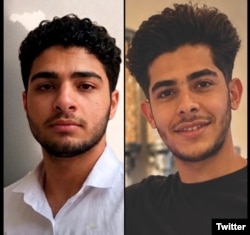
Iran executed two teenage men early on November 3 over the deaths of four security officers during antiestablishment protests in the central city of Isfahan in January, the Iranian judiciary said.
Amirhossein Maleki, 19, and Amirhossein Ebrahimi, 18, were among 14 defendants in what is known as the Alikhani Square case. The case is named after the site where four special unit officers were killed on the night of January 8 at the height of the nationwide unrest.
The judiciary's news agency, Mizan, described the pair as “main agents” of that night’s violence. It claimed they were armed and at the scene, and based this on their “confessions” and those of co-defendants.
Several other defendants in the case have already been executed, including Alireza Sepahi and Alireza Raisi.
The authorities have offered no evidence beyond confessions, some of which were broadcast on state TV. Rights groups consider such confessions and the trials that rely on them unreliable.
Shahrzad Shahbazi, Sepahi’s lawyer, said in a statement on October 10 that the defendants were never informed of any charge of killing the officers and that murder was not among the charges they faced.