


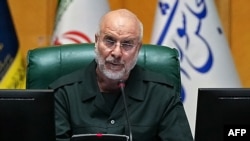
Media reports emerged this week of the Trump administration quietly exploring conservative parliament speaker Mohammad Baqer Qalibaf as a potential negotiating partner -- and possibly a future Iranian leader.
Washington, which has not confirmed the reports carried by CNN, Politico, and Fox News among other outlets, has been seeking a point of contact for negotiations ever since the death of Supreme Leader Ayatollah Ali Khamenei on the first day of US-Israeli air strikes on Iran.
Khamenei's son has been named as a successor, but he hasn't been seen since the day his father died and was reportedly also injured in the attack.
Enter talk of Qalibaf as the person reportedly seen by at least some in the White House as a workable partner.
The 64-year-old has flatly denied the rumors, posting on X that "no negotiations have been held with the US" while calling the claims "fake news" designed to manipulate financial and oil markets.
Whether or not back-channel contacts exist, his emergence as the most visible senior figure in a system experiencing a structural breakdown of decision-making authority has made him, for the first time in a career of near-misses, the man that matters.
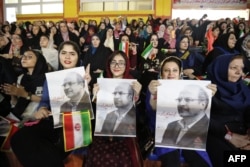
Qalibaf is a conservative politician and former military commander who spent decades cultivating ties to Iran's supreme leadership and the Islamic Revolutionary Guards Corps (IRGC), only to find himself -- after a career overshadowed by corruption scandals and failed presidential bids -- as arguably the most powerful figure left standing in the Islamic republic.
Born in 1961, Qalibaf joined the IRGC at 18 and rose through the ranks during the 1980-88 Iran-Iraq War to become a unit commander. He later served as commander of the IRGC's Air Force (before it was renamed Aerospace Force), a post handed to him directly by then-Supreme Leader Ayatollah Ali Khamenei -- a sign of the trust that would define his political trajectory for the next three decades.
Crackdowns And Corruption
That trust manifested early and violently. In 1999, Qalibaf was among the IRGC commanders who co-signed a letter warning reformist President Mohammad Khatami that student protests threatened national security and could force the IRGC to intervene unilaterally.
In 2000, Khamenei appointed the then-39-year-old as head of Iran's national police force. His tenure as police chief was marked by brutality: A leaked recording later revealed him boasting about ordering gunfire used against student demonstrators during the 2003 protests and personally beating up students in the 1999 crackdown.
In 2005, Qalibaf quit the police force and entered electoral politics, finishing a distant fourth in that year's presidential race. But the election of populist Mahmud Ahmadinejad opened the Tehran mayor's office, which Qalibaf secured.
He went on to become the longest-serving mayor in Tehran's history, remaining in office until 2017. His tenure oversaw the expansion of the city's subway system and the construction of major high-rise developments. But it was also plagued by corruption allegations, including a 2022 expose by RFE/RL's Radio Farda revealing Qalibaf had offered to cover up millions of dollars missing from an IRGC-affiliated foundation.
Qalibaf fortified his hard-line reputation at the start of this year when security forces launched a deadly crackdown -- thousands of Iranians died in unrest sparked by the country's poor living conditions.
In a live broadcast at a parliament session during the upheaval, Qalibaf applauded police and the IRGC, especially its Basij paramilitary forces, for having "stood firm" in what he called a "war against terrorists."
German-based political analyst Hossein Razzaq notes that Qalibaf's entanglements are not simply a liability; the Islamic republic has historically relied on figures compromised by corruption precisely because their financial interests are "bound to the system's survival."
Qalibaf made further presidential runs in 2013, finishing second, and in 2017, when he dropped out and endorsed hard-liner Ebrahim Raisi.
Razzaq describes these candidacies, particularly the 2017 withdrawal, as part of a pattern of loyalty-signaling to the supreme leadership rather than genuine bids for power. The pattern repeated in the June 2024 snap election following Raisi's death, when Qalibaf ran a fourth time and lost to reformist Masud Pezeshkian.
In 2020, after running for parliament in elections that saw the mass disqualification of moderate and reformist candidates, Qalibaf finished first in Tehran and was elected speaker by his fellow lawmakers. Under his speakership, parliament passed a bill accelerating Iran's nuclear program expansion.
Close To Supreme Leader's Office
A significant thread running through Qalibaf's career is his closeness to Mojtaba Khamenei, Ali Khamenei's son, a relationship that became visible in the 1980s and grew more consequential over time. In successive presidential elections, signs of support from Mojtaba's inner circle and sections of the IRGC aligned with him repeatedly surfaced around Qalibaf's candidacies.
That relationship has taken on new significance in the context of war, in particular after Ali Khamenei was killed on February 28 in the opening US-Israeli strikes.
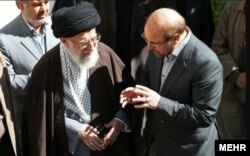
The decapitation of Iran's senior leadership -- which also killed the IRGC commander-in-chief, the defense minister, the armed forces chief of staff, and numerous other senior figures -- created an acute crisis of political authority.
Mojtaba Khamenei was named as the new supreme leader but has maintained a total public absence, with no images, no voice recordings, and only a handful of written statements attributed to him, fueling contradictory accounts even about his physical condition.
Into that vacuum, Qalibaf has stepped with growing visibility. With Ali Larijani -- who had taken charge of political management after Ali Khamenei's death -- killed in an Israeli strike on March 17, Qalibaf has emerged as the single most prominent and trusted figure connecting Iran's political, security, and clerical power centers.
Razzaq described Qalibaf as having always been "the approved piece of the beit [the household and inner circle of the supreme leader]," adding that with key figures eliminated, "the role he plays for the system has become more prominent."