



Trump: Iran Wants To Make A Deal
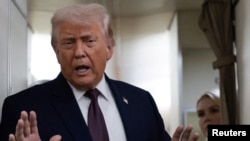
In an interview with the Axios website, US President Donald Trump said the situation with Iran is "in flux" because the US has sent a big "armada" but thinks that Tehran wants to cut a deal.
In the interview, which took place on January 26, the US president declined to discuss the options his national-security team presented to him regarding Iran or which option he preferred.
At the same time, Trump said that diplomacy was still an option, adding: "They want to make a deal. I know so. They called on numerous occasions. They want to talk."
The US president reportedly came close to ordering strikes on targets inside Iran earlier this month after thousands of Iranian protesters were killed. Ultimately, Trump postponed the decision and ordered a boost in the US military presence in the region.
According to Axios, a senior US official told reporters that the White House "is open for business" when it comes to negotiations with Iran. "If they want to contact us and they know what the terms are, then we're going to have the conversation," the US official said. The US conditions for a deal have been conveyed to Iran many times over the past year, the official added.
Regarding a potential deal, Axios reports that:
U.S. officials say any deal would have to include the removal of all enriched uranium from Iran, a cap on Iran's stockpile of long-range missiles, a change in Iran's policy of supporting proxies in the region and a ban on independent uranium enrichment in the country. The Iranians have said they're willing to talk but have not signaled any willingness to accept those terms.
According to Axios, "sources with knowledge of the situation say Trump hasn't made a final decision" on a potential strike against Iran.
With the arrival of the USS Abraham Lincoln aircraft carrier and supporting warships in the US Central Command area of responsibility -- spanning Northeast Africa, the Middle East, Central Asia, and portions of South Asia -- Trump "will likely hold more consultations this week and be presented with additional military options."
Middle East Flights Continue To Face Widespread Disruptions
With regional tensions rising and a European Aviation Safety Agency (EASA) warning to avoid Iranian airspace, many international airlines have changed or canceled their flight schedules in the Middle East.
The Aerospace Global News website wrote on January 26 that so far these changes have affected routes to Israel, cities in the Gulf Cooperation Council countries, Jordan, and parts of Central Asia and the South Caucasus.
According to the report, United Airlines and Air Canada have suspended flights to Tel Aviv. Indian airline IndiGo has also suspended flights to Almaty, Baku, Tashkent, and Tbilisi. The Lufthansa Group has canceled flights to Tehran until the end of March and has limited its services to Tel Aviv and Amman to daytime hours only so that crews do not have to spend layovers overnight.
Flydubai has canceled flights to Tehran, Mashhad, and Shiraz, but is continuing other routes with rerouting. Air France, KLM, and British Airways have cautiously resumed operations after short-term suspensions.
Regional giants, including Emirates and Qatar Airways, are continuing to operate by rerouting and increasing flight times. In addition, Israel's El Al has introduced flexible cancellation policies to ease passengers' concerns.
From the US State Department's account in Persian:
"Recently, Iran's Foreign Minister, Araqhchi, labeled peaceful protests as 'terrorist operations' on social media. It takes a great deal of audacity to accuse peace-loving Iranians of terrorism, while the Islamic Republic itself resorts to violence and intimidation to suppress its people and simultaneously supports actual terrorists abroad."
Lindsey Graham Praises Trump, Warns On Iran
Lindsey Graham, the Republican senator for South Carolina, has warned against abandoning the Iranian people:
Good morning.
According to the latest aggregated data compiled by the US-based human rights agency HRANA, as of January 26, the total number of confirmed deaths in Iran has reached 6,126. Of these, 5,777 were protesters, 86 were children under the age of 18, 214 were forces affiliated with the government, and 49 were non-protesters or civilians. The number of deaths still under investigation stands at 17,091, according to the human rights group.
German MEP Hannah Neumann, the chair of the European Parliament's delegation for relations with Iran, addressed the assembly on January 26. "We're witnessing a systematic destruction of lives in Iran. The regime violently erases an entire generation of young people," she said.
US President Donald Trump told Axios in a January 26 interview that the situation with Iran is "in flux" because he sent a "big armada" to the region but thinks Tehran genuinely wants to cut a deal.
We are now closing the live blog for today. We'll be back again tomorrow morning at 7:30 a.m. Central European time to follow the latest developments in Iran.
Iran's Health Ministry Acknowledges Protesters' Fear Of Visiting Hospitals
An official from the Iranian Health Ministry has acknowledged that injured protesters are afraid to visit medical centers in the country following a brutal crackdown that has seen security forces targeting hospitals.
The Tasnim news agency, which is close to the Islamic Revolutionary Guards Corps, quoted the official, named as Hossein Kermanpour, head of public relations for the minstry, as saying on January 26 that protesters who were injured should not worry about seeking medical treatment.
"Our advice to people is that if they suffer any type of injury, they should not stay home and should not worry about visiting medical centers," the official was quoted as saying.
Kermanpour also claimed following this "announcement" by the Health Ministry, "more than 3,000 people who had suffered various types of injuries have recently visited medical centers."
In the recent round of widespread protests in Iran there have been multiple reports of security forces raiding hospitals to arrest protesters, which has led to a significant number of the injured preferring to stay at home despite their serious injuries.
Kermanpour also said that nearly 13,000 "surgeries have been performed on those injured in recent events."
CCTV Video Shows Woman Kicked And Beaten By Iranian Security Forces
Video footage has emerged on social media that appears to show a woman in Iran being kicked and beaten by security forces on January 8. More than 5,800 deaths in a brutal crackdown on nationwide protests have been verified, according to the US-based human rights agency HRANA. But one report indicates the real number may exceed 30,000. (WARNING: Viewers may find the content of this video disturbing)


Internet Blackout Costing Iran's Economy $36 Million A Day, Says Official
The ongoing Internet and telecommunications blackout across Iran is costing the Iranian economy as much as 50 trillion rials ($35.7 million) a day, according to an Iranian official.
In an article published on January 26, Communications Minister Sattar Hashemi was quoted by Etemad Online as saying, "Estimates show that the average resilience of Internet companies and businesses is about 20 days, and the country is approaching this point."
Hashemi did not specify his source for this estimate or the criteria for measuring the "resilience" of businesses against Internet shutdowns.
Ali Hakim Javadi, the head of the country's Computer Guild Organization, said on January 25 that the economic toll from the shutdown was between 20 trillion and 20 trillion rials a day.
Meanwhile, many business owners have spoken out on social media about the overwhelming pressure of this outage, and a significant number have reported the "destruction" of their businesses or having to file bankruptcy.
January 26 marks with the 18th day of Internet blackout in Iran, which the authorities instituted as part of their crackdown on mass protests that spread throughout the country. The wave of protests began at Tehran's bazaars on December 28 as a criticism of the economic situation.
The policies of the Islamic republic over the past three weeks have not only hindered people's ability to make money but have also led to the increased prices of basic goods.

Likelihood Of US Strikes On Iran 'Very High' Amid Military Buildup, Drills
The United States is deploying jet fighters, air defenses, and an air carrier with thousands of troops to the Middle East, in a move that has heightened tensions with Iran and increased the likelihood of military action, experts say.
US President Donald Trump threatened military strikes against Iran after the authorities killed thousands of people in a brutal crackdown on anti-government protests. Trump recently backed away, although he has not ruled out an attack on the Islamic republic.
Experts say the military buildup along with planned US naval exercises in the region increases the pressure on Iran and provides more offensive military options if Washington chooses to attack Iran.
"This can be a message to Iran that we're ready, our capabilities are in place," Farzin Nadimi, a senior fellow at the Washington Institute for Near East Policy, told RFE/RL's Radio Farda.
To read the full report by RFE/RL's Kian Sharifi and Radio Farda, click here.