



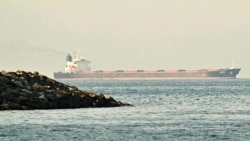
Agency Says Container Ship Hit By 'Unknown Projectile'
The UKMTO maritime security agency, which issues alerts for commercial shipping, said on April 18 that it had received a report of a container ship 25 nautical miles northeast of Oman being "hit by an unknown projectile which caused damage."
Open, Then Closed: Few Ships Sail Amid Hormuz Uncertainty
- By RFE/RL
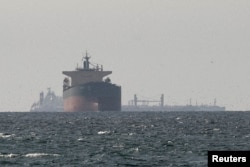
Hopes that shipping would resume through the Strait of Hormuz proved short-lived on April 18, with Iran's announcement that it was reopening the vital waterway being reversed just hours later and only a handful of vessels daring to attempt a passage.
Oil prices had plunged following the initial reopening announcement the previous day, and shipping tracking data showed several vessels passing through the strait.
Some of these were shadow fleet tankers on the US sanctions list, including two liquefied petroleum gas (LPG) tankers: the Gardian and the Rain.
These were seen heading through the strait and onwards towards open seas -- where the US naval blockade could potentially interdict them.
Other ships seeking to take advantage of the reopening of the strait were not sanctioned vessels. These included liquefied natural gas (LNG) tankers.
"What began as a cautious trickle yesterday is building into a steadier flow today," noted maritime intelligence company Windward in a social media post.
But the optimism dissolved as Iranian state media announced that the decision to open the strait had now been reversed, in response to US President Donald Trump's decision to keep his country's naval blockade of Iran in place.
“As long as the passage of vessels from Iranian origin [or] to Iranian destination remains under threat, the status of the Strait of Hormuz will remain in its previous state,” said a statement by the command of the Islamic Revolutionary Guards Corps (IRGC).
Soon afterwards, some vessels that had set sail through the strait turned around and headed back.
Read our latest news round here.
Iran's Internet Shutdown Enters 50th Day, Says Monitor
The Netblocks Internet connectivity monitor says that Iran's near-total digital blackout has entered its 50th day "to the detriment of most Iranians' livelihoods and human rights."
CENTCOM Says US Blockade Is Being Enforced
United States Central Command (CENTCOM), the US military command responsible for the Middle East, said 23 ships have been turned back since Washington began enforcing its maritime blockade on vessels entering or leaving Iranian ports and coastal waters.
Tanker Incident Reported Near Oman
United Kingdom Maritime Trade Operations (UKMTO), a British maritime security agency that issues alerts for commercial shipping, said on April 18 that it had received a report of a tanker being approached by "two IRGC gunboats” 20 nautical miles northeast of Oman and then being “fired upon.”
The captain of the tanker said the Islamic Revolutionary Guards Corps' gunboats opened fire without issuing a radio challenge, according to the UKMTO statement, which added that the vessel and its crew were reported safe.
Iranian Lawmaker Claims War Will Continue Until Complete Defeat Of US And Israel
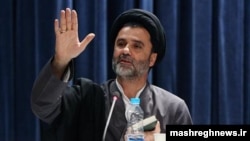
Mahmud Nabavian, a member of the Iranian parliament's national security and foreign policy commission, said negotiations between Iran and the United States will lead nowhere and that Tehran will continue the war until the “complete defeat of Trump and Netanyahu.”
Nabavian, who accompanied the Iranian negotiating delegation in Islamabad, said in a speech in Arak addressing “certain officials” late on April 17 that “responsibility for controlling the Strait of Hormuz lies solely with the IRGC Navy, and no one will have the right to interfere.”
The lawmaker did not name the officials he was referring to, but he has previously made statements in media outlets close to the Islamic Revolutionary Guards Corps and on social media whose tone and content differed from those of the main members of Iran’s negotiating team with the United States.
Since Iranian Foreign Minister Abbas Araqchi announced that the Strait of Hormuz would reopen on April 17, a wave of opposition and criticism from hardline factions within the government has emerged against the negotiating team and the announced developments and decisions, widening internal political divisions.
Iran later reversed its decision to reopen the strait, state media reported on April 18.
In another part of his speech, Nabavian said a measure had been approved in the parliamentary security commission under which Iran would block the passage of US military ships through the Strait of Hormuz.
He added that vessels from any country that “gives bases to the enemy” would also be barred from transiting the strait.
Measures approved by parliamentary commissions must still be voted on in a full parliamentary session, then sent to the Guardians Council, and after final approval formally promulgated by the president before becoming law.
Iran Reverses Decision To Reopen Strait Of Hormuz
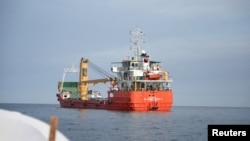
Iran has reversed its decision to reopen the Strait of Hormuz, citing the continued United States naval blockade of Iranian ports, according to the Fars News Agency, which is close to the Islamic Revolutionary Guards Corps.
A spokesman for Khatam-al Anbiya central headquarters, which is the unified command structure of Iran's military, said control of the strait had “returned to its previous state” and was again under strict military management.
Ebrahim Zulfaqari said Tehran had earlier agreed “with good intentions” to allow limited passage for oil tankers and commercial ships during the cease-fire, but "unfortunately, the Americans... continue to engage in piracy...under the so-called 'blockade.'"
Iran had reopened the route on April 17 after weeks of near-total disruption, a move welcomed by US President Donald Trump, who nevertheless said his country's naval blockade of Iranian ports would remain in place.
Iran State Broadcaster Says Strait Of Hormuz 'Now Closed Again'
An X account affiliated with Iran's state broadcaster says that the Strait of Hormuz is "now closed again," after Tehran allowed "a limited number of ships to pass through."
The Islamic Republic of Iran Broadcasting account said that any subsequent transit now "requires IRAN approval" as the United States "did not fulfill their obligations."
It has not yet provided any further details.
Iran Partially Reopens Airspace After Weeks of War
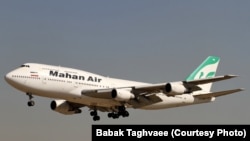
More than seven weeks after the start of the United States and Israel's conflict with Iran, the Iranian Civil Aviation Authority (CAA) announced in a statement on April 18 that part of the country’s airspace has been reopened to international flights.
According to the notice, “air routes in the eastern section of the country’s airspace are open for international flights transiting through Iran.”
Over the past two months, Iran was attacked mainly from the west and south, while the east remained largely calm apart from Mashhad and its international airport, which were targeted at least twice.
The CAA also said that "a number of airports" had been "reopened."
The statement did not specify which airports were included, and international airlines have not yet reacted to the announcement.
The CAA added that “flight operations at the country’s airports will gradually resume from today, based on technical and operational readiness in the military and civilian sectors to provide passenger services.”
During the period when many parts of Iran were under sustained attack by the United States and Israel, several airports -- including Mehrabad Airport -- were struck repeatedly.
Iranian lawmaker Mohammadreza Rezaei Kouchi said recently that around 50 aircraft in Iran were damaged during the war, of which about 10 were “destroyed” in direct attacks.
The CAA announcement came with only four days remaining in the current two-week cease-fire between Iran and the United States, while the two countries continue negotiations aimed at ending the war.
Several Ships Tankers Moving Through Strait Of Hormuz
A group of vessels were moving through the Strait of Hormuz on April 18, according to data from shipping tracking service Marine Traffic.
The data said there were liquefied petroleum gas (LPG) carriers and several oil product and chemical tankers moving through Iranian waters south of Larak Island.
The ships were heading out of the Persian Gulf, with more tankers following from the Gulf.
On April 17, Iranian Foreign Minister Abbas Araqchi said Tehran has opened the strait to commercial shipping traffic for the remainder of the 10-day cease-fire between Israel and Lebanon.
US President Donald Trump welcomed the move but said the US naval blockade would remain in place. It targets vessels “entering or departing Iranian ports and coastal areas.”