


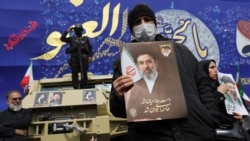
Here's a video recap of last night's events as protesters took to the streets of Tehran on January 9 for the 13th consecutive night of anti-government demonstrations that have spread across the country. News of the latest protests was limited by a nationwide Internet blackout, a move Amnesty International said was intended to conceal human rights violations by Iran’s regime. (Video by RFE/RL's Radio Farda and Margot Buff)
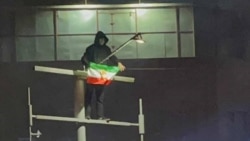


Good morning. As widespread anti-government protests enter their 14th day, there doesn't seem to be any end to the digital blackout in Iran, according to the independent Internet monitoring organization NetBlocks.
We are now closing the live blog for today, but we'll be back again tomorrow morning at 09:00 Central European Time to follow events as they happen.
Latest Comments From President Trump On Iran
Speaking at a meeting with oil and gas executives at the White House on January 9, US President Donald Trump said that "Iran is in big trouble. It looks to me that the people are taking over certain cities that nobody thought was really possible just a few weeks ago."
"We're watching the situation very carefully. I’ve made the statement very strongly that if they start killing people like they have in the past, we will get involved. We will be hitting them very hard where it hurts. That does not mean boots on the ground, but it does mean hitting them very, very hard where it hurts."
Here's our latest news wrap.
A 13th Night Of Protests Begins In Iran
Protesters are taking to the streets in Iran for their 13th night. Videos from social media and sent to RFE/RL's Radio Farda are showing crowds massing in various parts of the capital, Tehran, and in the major cities of Shiraz and Mashhad.
All eyes internationally are on Iran. US President Donald Trump has reiterated how Washington would not stand by if the Iranian authorities kill protesters.
In a January 8 interview with conservative radio host Hugh Hewitt, Trump said that Iranian authorities have been told "very strongly -- even more strongly than I’m speaking to you right now -- that if they do that [kill protesters], they’re going to have to pay hell.”
Here is a recap of the main events over the last 24 hours:
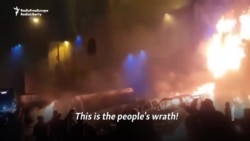
European Leaders Condemn Killing Of Protesters
German Chancellor Friedrich Merz, French President Emmanuel Macron, and British Prime Minister Keir Starmer condemned the killing of protesters in Iran and urged the Iranian authorities to refrain from violence in a joint statement.
"We are deeply concerned about reports of violence by Iranian security forces and strongly condemn the killing of protesters. The Iranian authorities have the responsibility to protect its own population and must allow freedom of expression and peaceful assembly without fear of reprisal," the statement released by Merz's office said.
"We urge the Iranian authorities to exercise restraint, to refrain from violence, and to uphold the fundamental rights of Iran's citizens," it added.
Iran's Internet Shutdown Hides Violations, Amnesty International Says
A day after the Iranian authorities began restricting access to the internet, Amnesty International warned that the regime has used the blackout "to hide the true extent of grave human rights violations and crimes."
"This blanket internet shutdown not only hides human rights violations but amounts to a serious human rights violation in itself," Rebecca White, a researcher at Amnesty International's Security Lab, wrote in a press release on January 9.
"Amnesty International reiterates its calls for urgent global diplomatic action, warning of the risk of further bloodshed amid the internet blackout, which provides cover for security forces who commit grave violations," she added.
The statement came amid a mounting death toll from the regime’s brutal crackdown on nationwide protests against Iran's clerical rulers.
Iran Human Rights NGO: 51 Dead So Far
The Norway-based Iran Human Rights organization has said that over the last 13 days of protests in Iran, "at least 51 protesters, including nine children" have been killed and hundreds more injured.
The organization also says it is investigating reports of dozens of protesters being killed in cities such as Tehran, Mashhad, and Hamedan, which have not yet been included in the NGO's count.
Due to the internet outage and difficulties reporting on the ground in Iran, RFE/RL's Radio Farda can not confirm these numbers.
"The nationwide internet shutdown is reminiscent of the bloody crackdown on the November 2019 protests when several hundred protesters were killed," said Iran Human Rights director Mahmud Amiri-Moghaddam.
"Over the past 13 days, the extent of the government’s use of force against protesters has been increasing, and the risk of intensified violence and the widespread killing of protesters after the internet shutdown is very serious."
'I Am Asking You To Help': Iran's Former Crown Prince To Trump
Reza Pahlavi, the exiled Iranian opposition figure and the eldest son of the former shah, has asked US President Donald Trump to be ready to intervene "to help the people of Iran."
In a public letter to Trump, posted on X, Pahlavi warned that the Iranian regime planned to use an internet blackout in the country to "murder" protesters. Earlier, Trump outlined that the killing of peaceful protesters would be decisive in the US reaction to the situation.
"[Iranian Supreme Leader] Ali Khamenei, fearing the end of his criminal regime at the hands of the people and with the help of your powerful promise to support the protesters, has threatened the people on the streets with a brutal crackdown. And he wants to use this blackout to murder these young heroes," Pahlavi wrote on X.
"Last night, you saw the millions of brave Iranians in the streets facing down live bullets. Today, they are facing not just bullets but a total communications blackout. No Internet. No landlines," he said. The NetBlocks cyber watchdog reported on January 9 that Iran had been "offline" for 24 hours.
"Mr. President, this is an urgent and immediate call for your attention, support, and action," Pahlavi said. "Please be prepared to intervene to help the people of Iran."
'We Saw Blood On The Sidewalks'
A 25-year-old female protester in Mashhad, a city in northeast Iran, spoke to RFE/RL's Radio Farda on January 9. She said she managed to get online via Starlink.
“The crowd in Mashhad’s Vakil Abad [neighborhood] was so large that security forces were afraid to show up. People had dressed in dark colors. We had been told to wear dark clothes and wear black masks. Before the internet was shut down, everyone was talking about it on Instagram. The protesters chanted against the clerics [in power] and also 'Long live the shah.'"
"In Haft Tir [Street], the crowd was so large that security forces would use tear gas from the rooftops. We heard from some they had managed to take control of the police station in Haft Tir, there was shooting. we saw blood on the sidewalks, but we didn’t see anyone bloody though."
"I didn’t see any security forces even though I walked for 12 kilometers and, as I said, the crowd was so large that there weren’t any security forces in Vakil Abad. We couldn’t enter Haft Tir Street because of the crowd."
"The morale was high. When security forces would use tear gas, people would chant: 'Dishonorable, dishonorable.' They would shout: 'Don’t be afraid.' They would tell each other to stay close together. People were really not afraid.... The crowd that was there will not not give in. Young and old had come out to protest, some elderly people could hardly walk but they were protesting. There was an old man who kept cursing at [Iran’s Supreme Leader Ali] Khamenei. We’re tired of the high prices and the [forced ] hijab and everything else. It’s not just one or two things -- we want the [whole] establishment to change."