

'He Deeply Cared About Bread, Inequality': Iranian Exile Mourns Uncle Lost in Tehran Protests
With the Internet blackout, it is incredibly hard to get information from inside Iran. And for Iranians living abroad, desperate for news of their loved ones inside the country, that can mean a tortuous wait.
For Maedeh Soltani, the daughter of a well-known human rights lawyer Abdolfatah Soltani and civil rights activist Masoumeh Dehghan, the news, when it finally came, was not good.
In an interview with RFE/RL's Radio Farda, Soltani, who lives in Germany, confirmed the killing of her uncle, Ali Dehghan Joghan. She said that there were so many bodies in Tehran that it took her relatives four to five days to find her 55-year-old uncle.
“My uncle was a resident of Shahr-e Rey, in the south of Tehran, but it is not clear to me where he was shot or where his body was found," Soltani said. "I believe my family searched for his body in places such as Behesht-e Zahra, Tehran’s main cemetery, as well as other locations in the south of the city."
“I cannot say with certainty exactly what happened. However, relatives who contacted us from Iran said that the body of my uncle (her mother’s brother), who was killed on Thursday [January 8] or Friday [January 9], was not found until the morning of January 13," the exiled Iranian said.
'Thousands Of Bodies'
Soltani said that she had heard from a "trusted source, someone reliable to both me and my family" that the number of people killed and being kept in Tehran’s morgues and cemeteries is extremely high. "This person spoke of thousands of bodies," she said.
At least 648 protesters have been killed and thousands injured amid the ongoing protests, according to the Norway-based NGO Iran Human Rights. Rights groups warn the true death toll could be significantly higher, potentially reaching into the thousands.
“My uncle was around 55 years old. He had two daughters, approximately 20 and 15 years old. He was not necessarily politically active, but he deeply cared about bread, inequality, and the catastrophe we are witnessing in social justice.
"This is what brought him to the streets. I am certain that his grieving daughters and his family will not remain silent at home. They will rise and make their voices heard."
Iran To Execute First Protester
Rights groups say Iran is set to execute the first anti-government protester charged in a recent wave of unrest as leaders from around the world voice concerns about the violent crackdown.
The groups, including Norway-based Iran Human Rights, quoted sources as saying that 26-year-old Erfan Soltani, charged with "waging war against God" due to his role in protests that have rocked the country since late last month, would be executed on January 14, six days after his arrest.
Read the rest of the story here.
Foreign Minister: Internet Shutdown Was Implemented With 'God's Help'
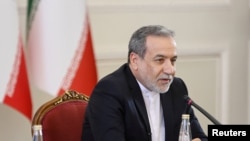
Iranian Foreign Minister Abbas Araghchi has defended the country's Internet shutdown, saying it was "carried out with God’s help" to cut off communications from what he called "terrorists."
Araghchi also claimed that as a result of the Internet blackout, which is now in its fifth day, the situation in the country is "under control" and "calm."
Officials of the Islamic republic, including Supreme Leader Ali Khamenei and Iranian President Masud Pezeshkian, have described the protesters as "terrorists" and "rioters." The judiciary, following suit, has threatened them with harsh and merciless treatment.
In an interview with Al Jazeera, the full text of which was published on his Telegram channel, Araghchi described the day of January 8 -- when the protests intensified -- as the "13th day of the 12-day war between Iran, America, and Israel."
"Our security forces had to intervene and decided to cut off the Internet. That's why their communications had to be cut off and coordination between them had to be prevented. This was done with the help of God," he said.
Araghchi also claimed that "after three days, the situation was brought under control and the main elements of these terrorist groupings were arrested."
The Risks Of The Conflict Spreading
As the United States weighs military action against Iran, an important factor is how Tehran might respond.
Marina Miron, a postdoctoral researcher in defense studies at King's College London, told RFE/RL that among key risks would be the conflict spreading "if Iran closes the Strait of Hormuz or activates the Houthis. And that is an important one because there is also a conflict between Saudi Arabia and the UAE now in Yemen."
Another issue would be Iran's ballistic missile stocks. Israeli Prime Minister Benjamin Netanyahu lobbied US President Donald Trump for strikes on these last month.
Iran's air defenses were much depleted by US-Israeli strikes in June 2025, but Miron noted that missiles kept in deep silos would be hard to destroy.
"Israel is really concerned about this because they're preparing for a potential escalation, and of course, US military bases in the Middle East [could be targeted], knowing that in some countries such as Iraq, the US forces are not very welcome," she said.
But the missiles would, she added, likely be kept in reserve for as long as possible.
"I assume those will be kept away, even if everything fails, to give Iran the capability…if the regime is falling. Then they have nothing to lose. Then they will use whatever they have," she said.
Morning Rundown
Good morning from our live-blogging team at RFE/RL.
Here's a brief rundown of some of the key developments overnight:
US President Donald Trump has announced a 25 percent tariff on any country doing business with Iran.
"Effective immediately, any Country doing business with the Islamic Republic of Iran will pay a Tariff of 25% on any and all business being done with the United States of America. This Order is final and conclusive. Thank you for your attention to this matter!"
In response to President Trump's announcement on the tariff, US Senator Lindsey Graham (Republican-South Carolina) wrote: "Mr. President: I believe the Iranian regime has crossed red lines. They are killing their people in large numbers and mocking your leadership. It is now time to take decisive military action -- no boots on the ground -- going after those who do the killing."
At least 648 protesters, including nine children under 18, have been killed and thousands injured in Iran, according to the Norway-based NGO Iran Human Rights (IHR) on January 12. IHR warned that the death toll was likely much higher -- "according to some estimates more than 6,000."
On Iran, Ukrainian President Volodymyr Zelenskyy posted on X in Persian: "It is important that the world does not miss this moment, when change is possible. And every leader, every country, international organizations must now get involved and help the people eliminate those who are responsible, which unfortunately Iran has been in this way."
In a January 12 report, the New York-based Human Rights Watch said that the Iranian authorities have intensified their lethal crackdown on protesters since January 8, with credible reports that security forces are carrying out large-scale killings across the country.
Live Blog Closing For The Day
We are closing the live blog for now, but we'll be back again tomorrow at 7:30 a.m. Central European time.
State Media Claims 3 Million At Pro-Regime Rally In Tehran
The Fars news agency, which is close to the Islamic Revolutionary Guards Corps, has reported that "3 million people" took part in the government march against the protesters, which took place in the capital Tehran today.
The rallies were backed by the police and aired live on Iran’s state-run television channels.
Take those claims with a grain of salt, though, as Fars, along with other media outlets close to or run by the state, publishes narratives approved by the regime.
Fars claimed that "based on aerial images, the geographical area leading to Tehran's Enqelab (Revolution) Square, namely Roshandalan Bridge from the east, Keshavarz Boulevard from the north, the Navab highway from the west, and Jomhuri Street from the south, was filled with people."
Given that independent media outlets, including RFE/RL's Radio Farda, are unable to operate in Iran and most communication channels between Iranians and the outside world have been severed, it is impossible to verify the news agency's claim.
Khamenei Says Pro-Government Rallies Are A Warning To US
Supreme Leader Ayatollah Ali Khamenei called today's pro-government rallies against the protesters a "warning" to American politicians, saying they must "stop their deception and not rely on traitorous mercenaries."
The rallies were organized by pro-government forces, supported by the police, and broadcast live on Iranian state television.
Participants chanted and raised banners criticizing the United States, Israel, and the protesters, who Iranian officials have described as "armed terrorists."
"You did a great job today and created a historic day," Khamenei said.
Our Senior International Correspondent Ray Furlong looks at what the US options are on Iran, from limited strikes to a Maduro-like operation.
Iranian Diplomats Banned From European Parliament
Roberta Metsola, the president of the European Parliament, announced on X that all Iranian diplomats and other representatives of the Iranian government are now banned from entering the offices and premises of the parliament.
“It cannot be business as usual," Metsola wrote. "As the brave people of Iran continue to stand up for their rights and their liberty, today I have taken the decision to ban all diplomatic staff and any other representatives of the Islamic Republic of Iran from all European Parliament premises.”
On January 11, Metsola called on Iranian protesters to continue their protests despite the brutal reaction of the country's security forces.
Metsola also urged EU member countries to increase their pressure on Tehran, while at the same time calling on the leaders of the Iranian regime to "change course and end the killing and repression of innocent people."