




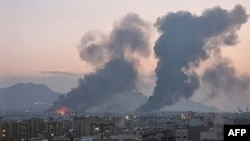
US President Donald Trump said that although much of Iran’s strategic Kharg Island was destroyed in a US air strike, he may order further attacks, while US-allied Arab states in the region reported disruptions to their own petroleum industries amid Iranian retaliatory attacks.
Trump told NBC News on March 14 that the US strikes had "totally demolished" most of Kharg Island-- which lies a couple of dozen kilometers off the Iranian mainland -- but he added that "we may hit it a few more times just for fun."
Immediately following the strike, Trump said US forces had "totally obliterated" Iranian military targets on the island but left oil infrastructure untouched. However, he threatened to hit those sites as well if Iran disrupted traffic in the Strait of Hormuz.

Iranian officials claimed crude exports were flowing uninterrupted from the Kharg Island terminal after what Trump described as “one of the most powerful bombing raids” in Middle East history.
Separately, Iranian media reported a deadly strike inside the country. The Fars news agency, which is close to Iran’s Islamic Revolutionary Guards Corps, said at least 15 people were killed when a missile hit a factory in the central city of Isfahan on March 14. The US and Israeli militaries did not immediately comment on the report.
The strike on Kharg Island marked a major development in the conflict, which began on February 28 after large-scale US-Israeli strikes on Iranian military and nuclear facilities.
Kharg Island is Iran’s main oil export outlet, serving as the terminal for about 90 percent of its oil exports. It is located about 24 kilometers off the Iranian coast and some 480 kilometers north off the Strait of Hormuz.
Trump 'Surprised' But Not Ready For Deal
Trump told NBC he was "surprised" that Tehran decided to attack other Middle East countries in retaliation for the US-Israeli strikes on Iran.
He also claimed that Tehran is seeking to make a deal to end the conflict but that the terms the Iranians are offering don't stack up to his demands.
“Iran wants to make a deal, and I don’t want to make it because the terms aren’t good enough yet,” he said.
He didn't specify what terms he was looking for but added that they would need to be “very solid” and would have to include a commitment for Tehran to abandon any nuclear ambitions.
Fears Of Price Rises
Trump played down any consumer worries about energy costs.
“I think they’ll go lower than they were before, and I had them at record lows,” Trump said about gas prices, saying they would come down soon after the war in Iran ends.

Iran has vowed to keep the strait closed and has said oil prices could reach $200, about double the current, already elevated, prices.
After saying a day earlier that the US Navy would soon begin escorting ships through the strait, Trump appeared to back off that statement.
“I don’t want to tell you anything about that,” he said in the interview but added that “it’s possible.”
In a social media post earlier, Trump said: "The Countries of the World that receive Oil through the Hormuz Strait must take care of that passage, and we will help — A LOT!"
"The U.S. will also coordinate with those Countries so that everything goes quickly, smoothly, and well," he added.
US Regional Allies Hit
Regional allies of the United States also reported attacks on petroleum-industry sites, raising fears even further of massive disruptions to the world’s energy supplies.
Authorities in the semiautonomous Iraqi Kurdistan region said operations at the Lanaz refinery in the city of Irbil remained suspended early on March 15, although a fire that broke out after a drone strike was contained.
Iran will target the facilities of US companies in the region if its energy facilities are attacked, Foreign Minister Abbas Araghchi was quoted as saying by state television, after the US strikes on Kharg Island.


Iran appeared to turn its fury toward the United Arab Emirates (UAE), claiming the Kharg Island attack by US forces originated from the emirates.
An Iranian military spokesman warned people in the UAE to evacuate ports, docks, and "American hideouts."
UAE officials denied that the US military launched the attack from bases in the country but said it reserved the right to take defensive action.
"The UAE has the right to defend itself against this imposed terrorist aggression, but it is still prioritizing reason and logic, continuing to exercise restraint and seeking a way out for Iran and the region," presidential adviser Anwar Gargash said on X.
The UAE "made sincere efforts until the very last moment to mediate between Washington and Tehran to avoid this war," he added.
The UAE Consulate in the autonomous Kurdish region of Iraq was attacked for the second time within a week on March 14. Two security personnel were injured and the building also sustained damage, officials said.
Flames In Fujairah
Some oil-loading operations have been suspended in the UAE's Fujairah emirate, an important global ship-refueling hub, after the emirate media office said a drone was intercepted but that falling debris ignited a large fire.
Drone strikes hit Fujairah's energy sites earlier this month, with falling debris from an intercepted drone sparking a blaze, authorities said.
Located on the Gulf of Oman, Fujairah is some 100 kilometers from the Strait of Hormuz, which is largely closed to traffic -- increasing Fujairah's importance in getting energy flows to the world markets through its ports.
In the Abu Dhabi emirate, ADNOC shut its Ruwais refinery in response to a fire at a facility within the complex following a drone strike, Reuters reported.
Iran's hard-line Islamic Revolutionary Guards Corps (IRGC) said late on March 14 that it had launched a missile strike at US forces stationed at the Prince Sultan base in Saudi Arabia.
The IRGC said the base was being used to service "F-35 and F-16 fighter jets and is the storage place for fuel tankers."
Early on March 15, the Saudi Defense Ministry said it intercepted and destroyed 10 drones over Riyadh and eastern regions of the country.
Kuwait's civil aviation authority said the country's international airport was targeted by several drone attacks, damaging its radar system and forcing it to close its airspace.