



Putin Talks With Pezeshkian
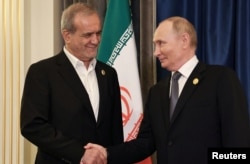
Russian Vladimir Putin has been talking by phone with his Iranian counterpart, Masud Pezeshkian. The Kremlin said on January 16 that during the call the Iranian president briefed Putin on Tehran's "sustained efforts to normalize the situation" in Iran amid a violent and deadly state crackdown on widespread anti-government protests that has left thousands dead, according to human rights groups,
The Kremlin said the two leaders also "confirmed their mutual commitment to further strengthening the strategic partnership between Russia and Iran and implementing joint economic projects in various fields."
And on that point, here are a couple of recent articles on the impact recent events in Iran might have on Moscow's complicated relationship with Tehran:
A little bit of background and context now: RFE/RL's graphics department has produced an interactive timeline of anti-regime demonstrations in Iran since deadly student protests in 1999.
Rights Watchdog Says 'Growing Evidence Of A Countrywide Massacre'

Human Rights Watch says there is growing evidence of mass killings of protesters by Iran’s security forces after nationwide demonstrations escalated on January 8.
The group reported that “security forces scaled up their deadly crackdown in a coordinated manner … resulting in large-scale killings and injuries of protesters and bystanders across the country.” It also said severe restrictions on communications have limited independent verification of the full scale of the atrocities.
HRW said it reviewed multiple forms of evidence, including verified photographs and videos, interviews with witnesses and relatives of victims, and analyses by forensic experts. The organization found many protesters were killed or injured by gunshot wounds to their heads and torsos and noted that Iranian officials cited by media outlets have acknowledged that the number of deaths has reached the “thousands.”
Lama Fakih, program director at Human Rights Watch, said the mass killings “are unprecedented in the country and a stark reminder that rulers who massacre their own people will keep committing atrocities until they are held to account.” She urged United Nations member states to convene a special session of the UN Human Rights Council to put human rights and accountability in Iran “front and center of the international response.”
Read HRW's full report here.
US Slams South Africa Over Iran's Role In Naval Drills
In other news, the United States has been taking South Africa to task for allowing Iran to take part in naval drills, saying it was "particularly unconscionable" that Pretoria has "welcomed Iranian security forces as they were shooting, jailing, and torturing Iranian citizens engaging in peaceful political activity South Africans fought so hard to gain for themselves."
Bloomberg later reported that While local news media said South Africa had persuaded Iran to withdraw from exercises, even though, the country's National Defense Force’s had posted images of captains of participating vessels docked at a South African naval base with Iranian officials present.
The Will for Peace 2026 war games, which included the participation of Russia and China alongside Iran and South Africa, started on January 9 and were due to end on January 16, bringing together warships from several BRICS Plus countries in South African waters.
Filterbaan, an Iran-focused digital rights group tracking online censorship and communications restrictions in the country, says the current Internet shutdown in the country reflects a policy that has not been adopted solely to contain protests, but "is designed structurally to eliminate the ability to record, document, and disseminate violence."
New Zealand Temporarily Shuts Embassy In Tehran
New Zealand says it has temporarily closed its embassy in Tehran because of the "deteriorating security situation" in Iran.
The country's Foreign Ministry said on January 16 that diplomatic staff had left Iran safely on commercial flights overnight, and that the Tehran embassy's operations had been moved to Ankara in neighboring Turkey.
"We continue to advise against all travel to Iran. Any New Zealanders currently in the country should leave now," a spokesperson said.
On January 15, New Zealand Foreign Minister Winston Peters said his country was "appalled" by Tehran's violent clampdown on widespread anti-government protests.
"We condemn the brutal crackdown being carried out by Iran's security forces, including the killing of protesters," he said in a statement. "Iranians have the right to peaceful protest, freedom of expression, and access to information -- and that right is currently being brutally repressed."
He added that Wellington had expressed its "serious concerns" directly to the Iranian Embassy in New Zealand, and would continue to do so.
With reporting by Reuters
Masih Alinejad, an Iranian journalist and women’s rights activist living in exile, was among those speaking at the UN yesterday.
The HRANA right organizations says its confirmed death toll in the Iran protests is now 2,677 and that the "latest statistical data indicates a continued upward trend in fatalities, arrests, and forced confessions."
Good morning. We'll start the live blog with the news that Iran's Internet blackout has now lasted 7 1/2 days, according to the digital rights watchdog NetBlocks. That's longer than the digital shutdown that occurred during the protests of 2019.
We are now closing the live blog for today. We'll be back again tomorrow morning to follow all the ongoing developments in Iran at 7:30 a.m. Central European time.