


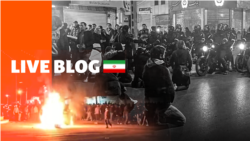
Iranians Mourn Family Members Killed In Mass Protests
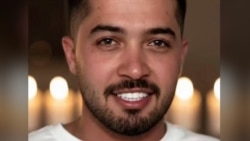
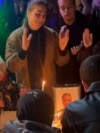
Family and friends of Alireza Rahimi lit candles and played his favorite music on what would have been his birthday following weeks of a deadly state crackdown on protesters throughout Iran. Rahimi was killed, along with more than 4,900 others in Iran according to the HRANA human rights organization, during recent protests over a dire economy and the repressive theocracy headed by Supreme Leader Ayatollah Ali Khamenei.

Iranian Parliament Speaker: Internet Blackout Prevented Threats To Officials
On Thursday, February 20, the deputy speaker of Iran's parliament defended the nationwide Internet blackout, which has now surpassed two weeks, claiming the measure prevented threats against "sensitive sites" and the residences of Iranian officials.
Hamidreza Haji Babaei did not provide further details. He added that cutting off the Internet succeeded in to "locking the American sword and warship" inside mobile phones.
Reports by monitoring organizations such as NetBlocks indicate that in recent days a small number of people, under what has been described as a "whitelist," have gained Internet access, while millions still do not have this possibility.
As Iran has plunged into a digital blackout, reports indicate that thousands of people have been killed in the government's brutal crackdown on nationwide protests.
EU To Target Iranian Officials Over Deadly Crackdown On Protesters
The European Union has proposed sanctions against Iran's interior minister and 14 other senior officials for their role in a violent crackdown on nationwide protests that erupted in late December, documents obtained by RFE/RL show.
The bloc's foreign ministers could adopt the measures, which include asset freezes and visa bans, when they meet in Brussels on January 29. All member states must vote in favor for the sanctions to be adopted.
The proposal, dated January 20 and circulated within the EU Council, targets Interior Minister Eskandar Momeni, who oversees Iran's Law Enforcement Forces (LEF), and security units of the Islamic Revolutionary Guards Corps (IRGC) that are blamed for hundreds of protester deaths.
Prosecutor-General Mohammad Movahedi-Azad faces designation for threatening demonstrators with death penalties on charges of "enmity against God" during the unrest.
Momeni, also deputy commander-in-chief, commanded forces that "suppressed street protests," which saw thousands of casualties, according to the EU document.
Regional IRGC commanders including Heydar Olfati in Ilam Province and Ahmad Ali Feyzollahi of the IRGC Ground Forces elite Saberin Brigade are accused of ordering troops to open fire on peaceful crowds.
To read the whole news story, click here.
European Parliament Condemns 'Chilling Shift' In Repression In Iran
- By RFE/RL
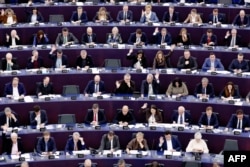
The European Parliament has adopted a resolution expressing “outrage at the repression and mass murders being perpetrated by the Iranian regime against protesters in Iran.”
The resolution adopted on January 22 demands that Iran’s leadership under Supreme Leader Ayatollah Ali Khamenei “immediately end violence against peaceful protesters, halt all executions, and cease the murder and repression of civilians,” while declaring full solidarity with what it called Iran’s “brave and legitimate protest movement.”
Adopted by 562 votes in favor, nine against and 57 abstentions, the resolution warns that the killing of thousands of protesters signals a "chilling shift" in repression “from deterrence to strategic elimination.”
European lawmakers called for the “immediate and unconditional release of all protesters, human rights defenders, and journalists,” currently in custody, urged the EU to designate the Islamic Revolutionary Guards Corps as a terrorist organization, and condemned efforts to censor protests through Internet shutdowns.
They also welcomed the assembly's president Roberta Metsola’s decision to bar Iranian regime representatives from European Parliament premises.
Call For Iranian Celebrities To Pay For The Damage Caused By Protests
Fars News Agency, which is closely affiliated with the Islamic Revolutionary Guard Corps, has released a video asserting that Iranian celebrities and public figures who supported the recent protests should be held financially responsible for the resulting "damages."
Titled Will the Treatment of Celebrities Be Different This Time?, the video centers on a statement from the Tehran prosecutor's office announcing that "cases have been filed against certain celebrities and groups accused of inciting unrest, and the property of some defendants has already been seized."
The video does not specify individuals by name, but it opens with images of female artists and filmmakers who publicly opposed mandatory hijab rules during the 2022 Women, Life, Freedom protests.
It highlights the case of Voria Ghafouri, the former captain of Tehran's Esteghlal FC soccer team, whose chain of cafes was closed on January 8 and January 9, days when exiled former Crown Prince Reza Pahlavi had called for Iranians to demonstrate. According to the video, this "led to the martyrdom of security forces and extensive damage to public and private property."
Without providing further evidence or details, the video claims that "preliminary judicial reviews have concluded some riot supporters must compensate for a portion of the damages."
The video comes shortly after several state-affiliated outlets --including the Hamshahri newspaper -- reported that the assets of Mohammad Saedinia, owner and manager of the popular Saedinia cafe chain, were valued at approximately the same amount as the "losses suffered by the capital" during the unrest. Both Fars and Hamshahri suggested seizing Saedinia's assets as compensation for the alleged damages to the city.
The narrative carries clear historical echoes: it recalls the Iranian government's post-1979 Islamic Revolution treatment of entrepreneurs who were prominent during the Pahlavi era.
Watchdog Warns Of Coordinated Wikipedia Editing Amid Iran Crackdown
Neutral Point of View (NPOV), a UK-based investigative outlet focusing on the coordinated manipulation of digital knowledge platforms, says that as Iran's authorities violently suppress nationwide protests, a group of editors supporting the Islamic republic have been simultaneously engaged in efforts "to control how these events, and Iranian history more broadly, are recorded on Wikipedia."
"The dual strategy is deliberate," the watchdog says in its report. "Kinetic violence silences dissent at home. Digital propaganda shapes the narrative abroad. Together, they form what Supreme Leader Ali Khamenei calls “vindication jihad” -- a soft war in the information space designed to rewrite reality itself."
NPOV says that Wikipedia's page for the latest protests in Iran, which erupted last month, "remains well-sourced" but the pattern established in previous cases is clear: once protests fade from headlines -- once internet blackouts prevent real-time documentation and bodies are quietly buried—coordinated editors move in to reshape the historical record."
"This is what authoritarian information warfare looks like in 2026," the organization warns, adding that the Islamic republic "isn't just killing protesters. It's erasing the evidence that they existed at all."
NPOV also noted that in a previous investigation it identified editing patterns on Wikipedia consistent with a coordinated, multiyear campaign to whitewash the Islamic republic’s human-rights record.
A Wikipedia editor RFE/RL's Radio Farda spoke to said that they had not observed such activity on the Persian-language edition of the online encyclopedia, suggesting instead that the effort was likely focused on English-language or other foreign-language Wikipedia pages.
Iran Among 'Worst Jailers Of Journalists,' Says Media Watchdog
The Committee to Protect Journalists has included Iran on its list of the "world's worst jailers of journalists" in a special report published on January 21.
The media rights watchdog also said that "nearly one-third of imprisoned journalists’ profiles included reports of mistreatment, including 20% with claims of torture or beatings" and that the "greatest number of torture and beating claims since 1992 have occurred in Iran."
Elsewhere, the NetBlocks digital rights watchdog says the Internet blackout in Iran had now passed the two-week mark.
It also had this point to make about The Wall Street Journal's decision to publish an op-ed from Iranian Foreign Minister Abbas Araqchi on Tuesday, defending Iran's crackdown on protesters.
Read more on Iran's ongoing nationwide blackout here.
Good morning. We'll start the live blog today with the news that the US-based rights organization HRANA says the death toll in the Iranian protests has now passed 4,900 and that there are more than 9,000 more cases under review.
We are now closing the live blog for today. We'll be back again tomorrow morning at 7:30 a.m. Central European time to follow the latest developments in Iran.