

Trump Threatens Tariffs On Countries Importing From Iran
US President Donald Trump signed an executive order that may impose secondary tariffs on countries that import goods from Iran, a statement released by the White House said on February 6.
The order described the move as "necessary and appropriate" after receiving additional information from senior officials regarding the "actions and policies" of the Iranian government.
The development occurred hours after The Wall Street Journal and Reuters reported that Iran has rejected US calls to halt the enrichment of nuclear fuel during talks in Oman with the United States.
Earlier in the day, the US State Department announced new sanctions on Iran's oil exports, targeting 15 entities and 14 shadow fleet vessels.
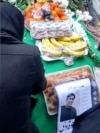
Iranian Bodybuilder Gunned Down From Behind Amid Protests, Says Family
The family of Iranian bodybuilder Mehdi Chooghadi says he was shot by security forces on January 9 in the city of Shahreza amid a crackdown on nationwide protests.
Chooghadi's wounds indicated he was shot from behind after a large crowd had gathered in the streets -- many others were also killed while trying to flee snipers, according to witnesses who spoke to RFE/RL's Radio Farda.


BREAKING: Citing sources familiar with the discussions in Oman, The Wall Street Journal and Reuters separately reported that Iran has rejected US calls to halt enrichment of nuclear fuel.
Reza Pahlavi: Only 'Acceptable Deal' Is Where Iran 'Surrenders To The People'
Before Iran-US talks began in Oman, Iran’s former Crown Prince Reza Pahlavi posted on X: "The only acceptable deal is one in which the Islamic Republic surrenders to the people of Iran."
He added that "we are ready for such a deal and it will bring peace to the region and the world."
Along with Iranian political activists, several US political figures have warned that negotiations should not be limited to Iran's nuclear program.
The United States says Iran's missile program, its handling of protesters, and the regime's regional proxies are also focal points of the talks.
Tehran insists it will negotiate only on the nuclear issue.
Sunni Imam Says 'Vast Majority' Of Iranians Are Dissatisfied
Molavi Abdolhamid, the imam of Sunni Friday Prayers in Zahedan, the capital of the Sistan and Baluchestan Province in southeastern Iran near the borders with Afghanistan and Pakistan, says the "vast majority" of Iranians are dissatisfied and that "no scholar who is on the path of moderation" would consider the January "massacre" of protesters permissible.
The province is home to Iran's largest Sunni Muslim community in the predominantly Shi'a country.
In his Friday Prayer sermon on February 7, he described the recent regime crackdown on protesters as "very heartbreaking and shocking."
Abdolhamid said that the "root of Iran's problems" were in the country's constitution, adding that after the 1979 Islamic revolution, "religious and ethnic views" became dominant in the country.
The imam, citing the “narrow-mindedness” and “tough decisions” behind parliamentary and governmental constraints, noted that even reforms in Iran ultimately lead nowhere.
He noted that the country’s atmosphere has gradually shifted toward “security” and “militarization,” stressing that even “religion” in the Islamic Republic has become securitized.
US Sanctions Iran's Oil Sector As Oman Talks End
The United States announced new sanctions on Iran's oil exports, targeting 15 entities and 14 shadow fleet vessels as US and Iranian negotiators wrapped up a day of indirect talks in Oman.
"The United States will continue to act against the network of shippers and traders involved in the transport and acquisition of Iranian crude oil, petroleum products, and petrochemical products," State Department spokesman Tommy Pigott said in a statement released on February 6.
The statement added that the United States would order a block of any transactions with 14 vessels said to transport Iranian oil, including ships flagged from Turkey, India, and the United Arab Emirates.
Earlier, Iranian Foreign Minister Abbas Araqchi said a round of talks in Oman was a good start as the two sides looked to overcome a "wall of mistrust" to reduce rising tensions that have sparked fears of a major military escalation in the Persian Gulf.
The current confrontation between Tehran and Washington was sparked by more than two weeks of unrest in Iran that saw authorities launch a deadly crackdown that rights groups say killed thousands of civilians.
US officials have yet to comment on the talks and Araqchi gave few details other than to say the session focused solely on the issue of Tehran's nuclear program.
To read our latest news wrap on Iran, click here.
The Iran-US nuclear negotiations have officially started in Muscat, Oman.
The talks are being chaired by Iranian Foreign Minister Abbas Araqchi and US Special Envoy Steve Witkoff, with Oman acting as mediator, according to the Iran state-affiliated Mehr news agency.
Araqchi Meets Omani FM Ahead Of US Talks
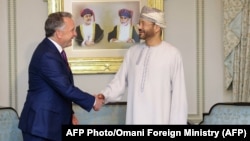
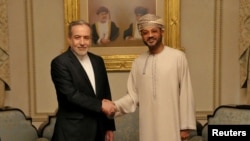
Iranian Foreign Minister Abbas Araqchi has met his Omani counterpart, Badr Albusaidi, in Muscat ahead of the US-Iran talks.
According to Iran's Mehr News Agency, the two discussed bilateral and regional issues.
Araqchi and his team are now reportedly heading to the venue for the talks with the United States.
IRGC Showcases Ballistic Missile Ahead Of Talks With US
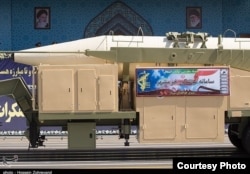
Hours before the start of a new round of negotiations with the United States set to take place on February 6, the Aerospace Force of Iran's Islamic Revolutionary Guards Corps (IRGC) showcased the Khoramshahr 4 missile as "one of Iran's most advanced hypersonic ballistic missiles."
According to Iranian media, the missile was displayed at the "unveiling ceremony of a new missile city affiliated with the Aerospace Force, in the presence of the Chief of Staff of the Iranian Armed Forces and the commander of this force, Majid Mousavi."
The IRGC's latest move came as new talks between Iran and the United States are scheduled to take place in Muscat, the capital of Oman, this morning.
Good morning.
Iranian and US officials are set to meet in Oman on February 6 for a round of high-stakes diplomacy seen as a last-chance effort to avert a major military escalation in the Persian Gulf.
The US Virtual Embassy for Iran issued an updated travel alert on February reiterating previous calls for Americans to immediately depart Iran. The alert calls on US citizens to "Leave Iran now. Have a plan for departing Iran that does not rely on US government help."
Iranian Foreign Minister Abbas Araqchi called for "mutual respect" ahead of talks with the United States in Muscat. "Iran enters diplomacy with open eyes and a steady memory of the past year. We engage in good faith and stand firm on our rights. Commitments need to be honored. Equal standing, mutual respect and mutual interest are not rhetoric -- they are a must and the pillars of a durable agreement," Araghchi wrote on X.
According to its latest aggregated data on February 5, the US-based rights group HRANA reports the number of confirmed deaths as 6,941, including 6,495 protesters, 171 children, 214 military–government forces, and 61 civilian nonprotesters. In addition, 11,630 cases remain under review. The number of seriously injured civilians stands at 11,021, the total number of arrests at 50,921, student arrests at 109 cases, forced confessions at 307 cases, and summonses at 11,047 cases.