



US, Arab Allies 'Strongly Condemn' Iranian Attacks On Gulf States
In a joint statement, the United States, Bahrain, Jordan, Kuwait, Qatar, Saudi Arabia, and the United Arab Emirates "strongly" condemned what it called Iran's "indiscriminate and reckless missile and drone attacks against sovereign territories across the region."
"These unjustified strikes targeted sovereign territory, endangered civilian populations, and damaged civilian infrastructure," the statement said.
Earlier, the Saudi-led Gulf Cooperation Council (GCC) condemned Tehran for its attacks against member states and asserted their "right to respond" to the actions. The GCC consists of Bahrain, Kuwait, Oman, Qatar, Saudi Arabia, and the United Arab Emirates.
The joint statement of Washington and its Arab allies said Iran's "actions represent a dangerous escalation that violates the sovereignty of multiple states and threatens regional stability. The targeting of civilians and of countries not engaged in hostilities is reckless and destabilizing behavior."
Following massive US and Israeli air strikes, Iran has retaliated against Gulf nations hosting US military bases by firing rockets that have caused casualties and damages in most of the regional countries.
Early on March 2, the Israeli Defense Forces said it had resumed attacks targeting the Iranian capital, Tehran. The Israeli military did not immediately provide the attacks targeting what it called "the heart of Tehran."
Gulf Countries Assail Attacks By Iran, Assert 'Right To Respond'
- By RFE/RL
The Gulf Cooperation Council (GCC) has condemned Tehran for its attacks against member states and asserted their "right to respond" to the actions.
The group on March 1 said its ministerial council, "in light of this unjustified Iranian aggression against GCC countries...will take all necessary measures to defend their security and stability and to protect their territories, citizens, and residents, including the option of responding to the aggression."
The Saudi-led GCC also consists of Qatar, Oman, the United Arab Emirates, Bahrain, and Kuwait. The countries have all reported Iranian attacks on their territories following the US and Israeli air strikes against Iran beginning on February 28.
Iran has attacked the GCC states -- which host US military assets -- along with Israel in retaliation for the US and Israeli attacks against its territory.
"Despite the numerous diplomatic efforts undertaken by the GCC countries to avoid escalation, and despite their affirmation that their territories would not be used to launch any attacks against the Islamic Republic of Iran, the latter has continued to carry out military operations targeting GCC countries, affecting numerous civilian and residential facilities," it said following an extraordinary videoconference meeting.
Trump: We Will Continue at 'Full Force' Until Mission Completed
US President Donald Trump vowed on March 1 to press ahead with military operations against Iran at "full force," saying the campaign would continue until Washington achieves all of its objectives.
In a six-minute video address posted on Truth Social, Trump acknowledged that more American casualties are likely following the deaths of three US service members in what he described as a war launched to counter Iran's nuclear aspirations.
“Sadly, there will likely be more [casualties] before it ends,” Trump said. “That’s the way it is.”
He added that the United States would “avenge their deaths and deliver the most punishing blow to the terrorists who have waged war against, basically, civilization."
To read the full report, click here.
Iran Military Strikes Could Take 4 Weeks, Says Trump
US President Donald Trump has said in an interview with the British Daily Mail newspaper that the military operation against Iran, which has been launched with the participation of Israel, could last up to four weeks.
"It's always been a four-week process. We figured it will be four weeks or so," he said in a telephone interview from his Florida residence.
Noting that Iran is a large country, Trump added that military strikes will “take four weeks -- or less."
UAE Closes Embassy In Tehran
The United Arab Emirates Foreign Ministry has announced that it has closed its embassy in Tehran and withdrawn its ambassador and all members of its diplomatic staff from Iran in response to Tehran's attacks on its territory.
A statement released by the ministry described the Islamic republic's "aggressive actions" against civilian targets, including residential areas, airports, ports, and service facilities, which endangered the lives of civilians, as a "dangerous and irresponsible escalation of tension" and a violation of international law.
Abu Dhabi has also warned that Iranian attacks are "pushing the region down very dangerous paths."
In response to US and Israeli attacks, Iran targeted the UAE and other Persian Gulf countries with missile and drone attacks on February 28 and March 1.
Zelenskyy: Kyiv 'Ready' To Share Experience In Countering Iran's Missiles And Drones
- By RFE/RL
Ukrainian President Volodymyr Zelenskyy said his country is ready to share its experience in countering Iranian ballistic missiles and Shahed drones with countries that helped Kyiv to repel Russia's invasion, as Tehran continued to attack countries in the Gulf region.
"The situation in the Middle East shows how difficult it is to provide 100 percent protection against missiles and Shahed drones," he said in a video statement on March 1, as Iran has launched air attacks on Israel, United Arab Emirates, and other countries throughout the day.
"Everyone can now see that our experience in defense is, in many respects, irreplaceable. We are ready to share this experience and help those nations that helped Ukraine," Zelenskyy added.
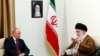
Tehran has long been an ally of Russia, supplying it with military equipment and technology and fueling Moscow's war effort against Ukraine. Zelenskyy said earlier that Russia's military had used at least 57,000 Shahed drones in attacks on his country, including against its civilian and energy infrastructure.
Now, the Iranian authorities should blame themselves for the consequences, including for killing "tens of thousands of their own citizens just in recent months" and "fueling" wars in the region, Zelenskyy said.
"The Iranian people have long effectively been alone against violence -- against the Iranian regime.... It is important that American determination -- the determination of everyone in the world -- truly works."
How The Middle East Conflict Could Affect The War In Ukraine

Attacks by the United States and Israel on Iran and the death of Ayatollah Ali Khamenei will likely have little effect on the battlefield in Ukraine, but it may make Russian President Vladimir Putin “even more adamant that he has to come out on top” in the full-scale war he launched four years ago, Hanna Notte, an expert on Russian-Iran ties, told Radio Free Europe/Radio Liberty.
Read the interview here.
Israel And Iran Exchange New Strikes After Khamenei Death
- By RFE/RL
Footage shows smoke rising across Tehran as Israel reportedly targeted central locations of the capital with strikes. Iran retaliated with missile strikes against US and Israeli targets.
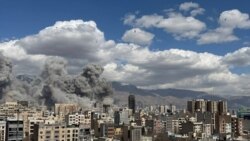

Before And After Strikes On Iranian Missile Base
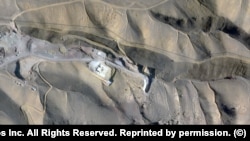
Satellite Images Show Iranian Missile Base Before And After Strikes
Satellite images taken by Planet Labs PBC reveal the damage inflicted on an Iranian missile base in northwestern Tabriz. The base was hit on February 28 as the United States and Israel launched attacks against Iran, killing the country's supreme leader and top military figures.
Check out the before and after satellite images.
Iran's Naval Headquarters 'Largely Destroyed,' Trump Says
US President Donald Trump said the United States "largely destroyed" Iran's naval headquarters and sank nine of Tehran's navy ships.