



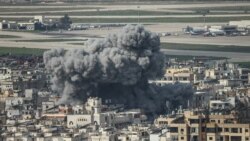
Double 'Shock And Awe' -- US Pounds Iran With Massive Assets
WASHINGTON -- The United States has destroyed 17 Iranian naval vessels -- including a submarine -- and struck nearly 2,000 targets across Iran in less than four days, according to the commander of US Central Command.
In a video statement posted on X on March 3, Admiral Brad Cooper said the sweeping military campaign -- dubbed Operation Epic Fury -- represents the largest US buildup in the Middle East in a generation.
“Today, there is not a single Iranian ship under way in the Arabian Gulf, Strait of Hormuz, or Gulf of Oman,” Cooper said, describing what he called an unprecedented effort to eliminate Iran’s ability to threaten US forces.
Massive Firepower Deployed
More than 50,000 US troops, over 200 fighter aircraft, two aircraft carrier strike groups, and long-range bombers are participating in the operation, Cooper said. He described the opening phase as nearly double the scale of the 2003 “shock and awe” campaign in Iraq.
US forces, operating alongside Israel, have conducted continuous strikes “from seabed to space and cyberspace,” he said.
According to Cooper, American forces have:
- Struck nearly 2,000 targets with more than 2,000 munitions;
- Severely degraded Iran’s air defenses;
- Destroyed hundreds of ballistic missile launchers and drones;
- Sunk 17 Iranian ships, including what he described as Tehran’s most operational submarine.
US B-2 and B-1 bombers carried out deep strikes on missile facilities inside Iran, while B-52 bombers targeted ballistic missile infrastructure and command centers, he said.
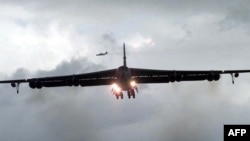
Naval forces launched waves of cruise missiles from two carrier strike groups, while US Army units fired long-range precision strike missiles -- known as PrSM -- in combat for the first time, although it was not clear from where they were launched.
A drone task force, dubbed “Task Force Scorpion,” also deployed one-way attack drones originally based on Iranian designs, Cooper said.
Iranian Retaliation
Tehran has responded by launching more than 500 ballistic missiles and over 2,000 drones, Cooper said, accusing Iran of “indiscriminately targeting civilians.”
Despite the retaliation, he asserted that Iran’s ability to strike US forces and regional partners is diminishing.
“We’re focused on shooting all the things that can shoot at us,” Cooper said, adding that US forces are now hunting Iran’s remaining mobile ballistic missile launchers.
Calling the campaign “immensely complex and historic,” Cooper praised US service members across all military branches and expressed confidence that American and allied forces would meet their objectives.
“We’ve just begun,” he said. “But I have the utmost confidence that we, alongside our partners, will absolutely achieve our military objectives.”
Pentagon Identifies First US Soldiers Killed In Iran War
The Pentagon on March 3 identified four of the first US soldiers killed in the war against Iran during an attack by unmanned aircraft in Kuwait.
The soldiers "died on March 1, 2026, in Port Shuaiba, Kuwait, during an unmanned aircraft system attack. All soldiers were assigned to the 103rd Sustainment Command, Des Moines, Iowa," a statement said.
"The incident is under investigation," it added. No other details were made public
It named the soldiers as Captain Cody A. Khork, 35, of Florida; Sergeant 1st Class Noah L. Tietjens, 42, of Nebraska; Sergeant 1st Class Nicole M. Amor, 39, of Minnesota; and Sergeant Declan J. Coady, 20, of Iowa.
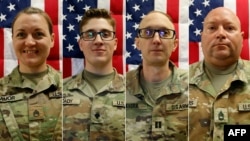
Two other American service members died during Iran's initial retaliatory attacks but not yet been publicly identified. Several others remain seriously injured.
US President Donald Trump warned the American public shortly after announcing major military operations against Iran that there were likely to be US casualties in the effort.
Trump Vows To Protect Shipping In Strait Of Hormuz
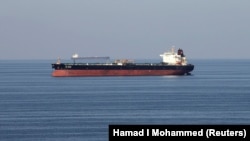
US President Donald Trump has vowed to offer military and financial security for shipping traffic in the crucial Strait of Hormuz, which is being threatened by Iran amid its retaliatory action following US and Israeli air strikes.
"If necessary, the United States Navy will begin escorting tankers through the Strait of Hormuz, as soon as possible," he posted on his Truth Social platform on March 3.
Trump also said he has instructed the US International Development Finance Corporation (DFC) to offer risk insurance and guarantees for all maritime trade in the Gulf region. The action is directed at energy transport but will be available to all shipping companies, he said.
"No matter what, the United States will ensure the FREE FLOW of ENERGY to the WORLD."
"More actions to come," he said.
Oil prices had surged and stock markets globally had tumbled amid concerns that Iran could attack shipping in the strait, which lies between Iran and Oman.
It is considered one of the most important shipping routes in the world, being the only connection from the Gulf to the world's seas.
Markets recovered some of the losses after Trump's announcement.
With reporting by dpa
Fire Contained After Drone Strike Near US Consulate in Dubai
A fire was contained near the US Consulate in Dubai on March 3 after a drone strike, US authorities confirmed, as regional tensions intensify amid ongoing US-Israeli military operations against Iran.
The Dubai Media Office said emergency crews responded immediately to a blaze caused by a "drone-related incident" in the vicinity of the diplomatic compound. No injuries were reported, and the fire was brought under control.
Videos circulating on social media showed flames and thick black smoke near at least one building inside the compound.
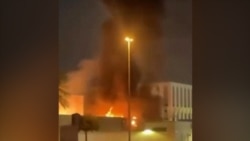

Iran’s semiofficial Tasnim news agency reported that a Shahed drone hit the consulate compound. The Islamic Revolutionary Guards Corps (IRGC) claimed responsibility, framing the strike as part of Tehran's expanding retaliatory campaign across the Gulf targeting US government facilities.
US Secretary of State Marco Rubio confirmed that a drone had struck near the consulate and said all American personnel were safe and accounted for.
Authorities said investigations into the attack are ongoing.
Speaking in Washington, Rubio said airspace closures across the region were complicating evacuation efforts.
"If a country closes their airport -- in some cases the airports have been hit -- we can have the planes lined up to go but we can't get them to land," he said. He added that "a little over 1,500, maybe closer to 1,600 Americans" have requested assistance, and he expressed confidence they would be helped despite delays.
The incident in Dubai came hours after two drones sparked a small fire at the US Embassy in Riyadh, according to Saudi authorities.
On Monday, the US Embassy in Kuwait City was also struck by drones, underscoring the widening scope of attacks on American diplomatic sites.
US Announces Iran War Objectives
The White House has outlined four objectives of its ongoing aerial assault against Iran, carried out in tandem with Israel, now in its fourth day.
Announcing the aims of Operation Epic Fury, as the campaign has been named, the White House wrote on X on March 3 that "America will win. The terrorist Iranian regime will be defeated."
It listed the steps to this goal as being to "destroy the Iranian regime's missiles," "Annihilate their Navy," Ensure their terrorist proxies can no longer destabilize the world," and "Ensure Iran can NEVER obtain a nuclear weapon."
To read the full report, click here.
Trump Says 'Something Had To Be Done' About Iran
Speaking at the White House alongside the visiting German Chancellor Friedrich Merz, US President Donald Trump said "Something had to be done" about Iran.
"I had a feeling Iran would have attacked us first," he told journalists on March 3.
"They are even attacking countries, which were kind of friendly with them and were doing nothing hoping to sit it out," Trump continued, noting that Iranian drones and missiles have hit the UAE, Qatar, Saudi Arabia, and Oman -- which had been mediating talks between Washington and just days before the aerial campaign began on February 28.
To read the full report, click here.

Fear And Hope In Iran Amid US-Israeli Bombardment
Iranians are gripped by fear -- and hope -- as the United States and Israel wage a massive bombardment designed to cripple the country's clerical rulers.
The air strikes since February 28 have decimated much of Iran's leadership, including killing Supreme Leader Ayatollah Ali Khamenei. But they have also resulted in the deaths of hundreds of civilians, according to local humanitarian groups, and destroyed schools and hospitals.

"We were happy with the news of Khamenei's death," a 56-year-old man in Tehran, speaking on condition of anonymity for security reasons, told Radio Farda. "But now these heavy bombings are worrying me. Iran should not be destroyed and disintegrated. I hope the future is bright."
The death of Khamenei, an autocrat who ruled the country with an iron fist for nearly 40 years, was celebrated by some on the streets of Iran. But for many, attention has quickly turned to what comes next.
To read the full report by RFE/RL's Radio Farda, click here.
Iran War Descends Into Regional Conflict With Global Spillovers
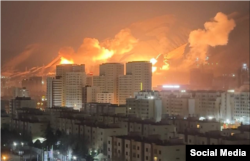
In just a few days, the United States and Israel's massive bombardment of Iran has sprawled into a regional war that has dragged in key America allies in the Middle East and sent global energy prices soaring.
Iran has responded to the joint US and Israeli campaign, which killed Supreme Leader Ayatollah Ali Khamenei on February 28, by unleashing unprecedented barrages of missiles and drones at US military and diplomatic facilities and striking key energy infrastructure in the Persian Gulf.
Fighting an existential threat, experts say, Tehran is aiming to raise the economic, political, and military pain of the conflict for the United States and secure an end to hostilities.
"Tehran appears to be wagering on [US President] Donald Trump's reluctance to become entangled in messy and costly wars, seeking to demonstrate that it possesses the capability to prolong the conflict and make it increasingly complex and expensive," said Hamidreza Azizi, a fellow at the German Institute for International and Security Affairs.
To read the full report by Senior Regional Editor Frud Bezhan, click here.
Top Pentagon Official Defends Air Strikes
WASHINGTON -- The Pentagon's top policy official defended US military operations against Iran as a limited, US-directed campaign to blunt a growing missile threat, rejecting suggestions Washington was drawn into war at Israel's urging or pursuing open-ended regime change.
Testifying before the Senate Armed Services Committee on March 3, Under Secretary of Defense for Policy Elbridge Colby said the strikes were ordered by US President Donald Trump to degrade Iran's expanding arsenal of ballistic and cruise missiles and one-way attack drones, and to ensure Tehran cannot obtain a nuclear weapon.

Colby described the campaign as centered on curbing "the ability of the Islamic republic to project military power against US bases, our forces, etc., as well as our allies and partners in the region and beyond."
He said Trump had directed a military campaign with defined objectives: Degrade and destroy Iran's missile and drone capabilities and place the United States "in a position to deny Iran's ability to obtain a nuclear weapon."
Lawmakers questioned how the strikes align with the Trump administration's National Defense Strategy, which calls for allies and partners to shoulder more of the burden for collective security.
Colby acknowledged that direct US operations against Iran fall outside that typical burden-sharing framework. Still, he argued the action remains consistent with the broader strategic goals of restoring deterrence and protecting US forces.
While Israel is conducting significant operations of its own, Colby stressed that Washington acted based on its own threat assessment and national interests.
Pressed on whether Washington supported the killing of Iran's supreme leader, Ali Khamenei, Colby sought to draw a clear line.
"Those are Israeli operations," he said, distancing the United States from direct responsibility for Khamenei's death and narrowing the scope of US objectives to military degradation rather than leadership decapitation.
Colby did not directly interpret Trump's rhetoric encouraging the Iranian people to seize a "historic opportunity," but he emphasized that the US campaign is not a nation-building intervention.
Colby stressed the operation does not envision deploying US ground forces to reshape Iran's political system. Instead, he presented it as a limited effort to degrade military capabilities, prevent nuclear acquisition, and restore deterrence.
Iran's Assembly Of Experts Building In Qom Hit By Air Strike
The building that houses Iran's Assembly of Experts, the body that will elect the country's next supreme leader, has been severely damaged by air strikes.
Verified video from local media and witnesses posting online on March 3 showed the building in the holy city of Qom almost completely demolished.
The state-run IRIB news agency reported that a separate office belonging to the assembly in Tehran was struck late on March 2. The news agency said both facilities had been "evacuated in advance" and that no casualties were recorded.
Axios also quoted an unnamed Israeli official confirming that the Israeli Air Force had struck the building in Qom, 150 kilometers (90 miles) south of Tehran, to "to disrupt the process of appointing a new supreme leader."