



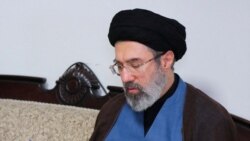
Trump Says Does Not Want Iranian Kurds To Launch Offensive
US President Donald Trump on March 7 said he did not want ethnic Kurds to launch a ground offensive against the regime in Iran, saying he did not want to see them “get hurt and killed.”
"We're not looking to the Kurds going in," he told reporters aboard Air Force One on March 7.
"We're very friendly with the Kurds, as you know, but we don't want to make the war any more complex than it already is."
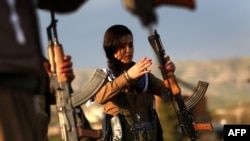
“Yeah, I have ruled that out. I don’t want the Kurds going in. I don’t want to see the Kurds get hurt and killed,” he added.
“They’re willing to go in, but I’ve told them I don’t want them going in. The war’s complicated enough without getting the Kurds involved.”
Two days earlier, Trump had told Reuters that he would be "all for" an offensive by Iranian Kurdish fighters in support of the US-Israeli war.
"I think it's wonderful that they want to do that. I'd be all for it,” he told the news agency at the time.
Several Iranian opposition Kurdish groups are based in Iraq's semi-autonomous Kurdish region and have been waging a low-level insurgency against Tehran for years. Some have demanded autonomy within Iran while others are fighting for secession from the Islamic republic.
Kurds make up around 10 percent of Iran's population and primarily live in the country's west along the border with Iraq. Iran has long been accused of suppressing and discriminating against the country's ethnic minorities, including Kurds.
US Forces Begin Using British Air Bases For 'Defensive Operations'
US forces have begun using bases in Britain for "defensive operations" in the Middle East as attacks on Iran by the United States and Israel enter their second week.
The British Defense Ministry said the United States has started utilizing the facilities for "specific defensive operations to prevent Iran firing missiles into the region."
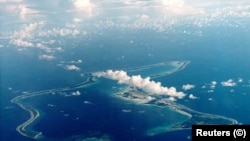
US President Donald Trump had expressed anger with British Prime Minister Keir Starmer for initially refusing to assist with offensive operations in the US-Israeli war with Iran.
Starmer defended his initial decision by saying any British action "must always have a lawful basis and a viable, thought-through plan."
He later granted a US request to use two British military bases for a "specific and limited defensive purpose" -- Fairford in southwestern England, and the UK-US Diego Garcia base in the Indian Ocean.
Air Chief Marshal Knighton, chief of the Defense Staff, indicated that Britain could play a more active role in the future, saying “campaigns and conflicts evolve over time.”
Trump Attends Return Of Slain Troops To US Soil
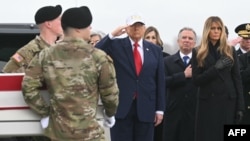
US President Donald Trump on March 7 attended the return of the remains of the first six US soldiers killed in Kuwait during the US and Israeli war against Iran.
Accompanied by several Cabinet members and Vice President J.D. Vance, Trump saluted as each flag-draped case was transported from military aircraft at Dover Air Force Base in Delaware.
The base is the traditional sites where the remains of US troops killed overseas are returned to United States.
The Pentagon said the soldiers were killed on March 1 when a drone struck a US command center in Kuwait, a day after the US and Israeli militaries launched a massive air campaign against Iran.
Israel Strikes Iran's National Oil Reserves, Igniting Massive Blaze
Israel's military on March 7 struck Iran's national oil reserves in Tehran for the first time, with the Israeli Defense Forces (IDF) saying the attack was part of measures targeting assets belonging to Iran's leadership.
An IDF spokesman said about 30 oil tanks were attacked. Video images from Iran shared on social showed massive flames bursting from the oil facility.
"The military forces of the Iranian terrorist regime make direct and frequent use of these fuel tanks to operate military infrastructure. Through them, the Iranian terrorist regime distributes fuel to various consumers, including military entities in Iran," the IDF said.
Iranian state broadcaster IRIB quoted the hard-line Islamic Revolutionary Guard Corps (IRGC) as confirming the bombing of an oil refinery near the capital.

The official IRNA news agency reported that "oil depot in southern Tehran was targeted by the US and Zionist regime."
The National Iranian Oil Refining and Distribution Company (NIORDC) said all necessary measures were being implemented to minimize damage to the country's oil reserves.
It added that fuel supply to Tehran and Alborz Provinces was being stabilized by produce from other sources.
Videos and images from Tehran showing massive flames were shared on social media.
The IRGC said it fired missiles at an Israel oil facility in the city of Haifa in retaliation.
Iranians Continue To Cross Into Armenia Amid Air Attacks
Iranians cross the border into Armenia as air strikes pound Tehran and other parts of the country. After entering Armenia, one woman said Iranians had "lost everything" amid the destruction and dwindling resources.



Netanyahu: Israel Has A Plan 'To Eradicate Iranian Regime'
Israeli Prime Minister Benjamin Netanyahu said his country would continue the war against Iran "with all our force," and that, together with the United States, it now has almost total control of the skies over Iran after a full week of the military campaign.
"We have a systematic plan to eradicate the Iranian regime and achieve many other objectives," Netanyahu said in a televised address on March 7, minutes after Iranian state media reported that joint US-Israeli air strikes hit an oil depot in Tehran.

Netanyahu's comments came amid a heated exchange between Tehran and Washington, with President Donald Trump announcing that the United States is considering expanding the range of targets inside Iran after its President Masud Pezeshkian rejected his demand for complete surrender.
In earlier comments on March 6, White House press secretary Karoline Leavitt said the United States expected to complete its achievable objectives in Iran in "four to six weeks."
Human Rights Watch Urges Investigation For Deadly Strike On Minab School In Iran
Human Rights Watch (HRW) says an attack on a girls' elementary school in Iran's southern city of Minab, which Tehran said killed scores, including schoolgirls and teachers, "should be investigated as a war crime."
The attack on the school in Minab occurred during the first waves of US and Israeli air strikes on February 28. As it may be the deadliest single incident in the war so far, the United States and Israel -- accused by Tehran of carrying out the attack -- have not publicly taken responsibility for it.
In a statement published on March 7, HRW urged the both countries to account for the air strikes and called on Iranian authorities to ensure the security of schools and other civilian infrastructure.
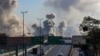
HRW added that its analysis showed that while the school was on the "interior border" of an Iranian military forces compound, it had a "separate entrance to the street from the rest of the compound," and was targeted by "highly accurate, guided munitions, rather than errant weapons."
"A prompt and thorough investigation is needed into this attack, including if those responsible should have known that a school was there and that it would be full of children and their teachers before midday," Sophia Jones, a researcher at the HRW said.
"Allies of the US and Israel should insist on accountability for the Shajareh Tayyebeh school attack and for an end to attacks on civilian infrastructure in all of their operations across the region," she added.
Earlier in the week, US Secretary of State Marco Rubio said the United States "would not deliberately target a school," adding that its military would have "no interest" in targeting civilian infrastructure.
In a separate statement, US Central Command spokesman Tim Hawkins said the country's military has taken the reports about the incident "seriously."
US Condemns Iranian Drone Strikes On Azerbaijan
The United States condemned Iranian drone strikes on Azerbaijan that targeted an airport and a school in its Nakhchivan autonomous region on March 5, describing the attack as a "needless escalation" of aggression by Tehran.
"These strikes are a flagrant violation of Azerbaijan's sovereignty and a needless escalation of Iran's aggression. The United States stands in full solidarity with Azerbaijan against these threats," the statement published by the State Department on March 7 said.
"Attacks on the territory of our partners in the region are unacceptable and will be met with resolute US support for those partners," it added.
A day earlier, Baku had accused Iran-linked operatives of plotting sabotage targeting a major oil pipeline and Jewish sites. Iran hasn't publicly responded to the accusations but said earlier this week, after a drone incident, that it is not seeking to target Azerbaijan.
Iran's Assembly Of Experts Expected To Convene To Pick New Leader
Iran's Assembly of Experts is set to meet to select a new supreme leader, one of its members said on March 7, as the White House said it was looking for an "acceptable" candidate to lead the country.
With Supreme Leader Ayatollah Ali Khamenei killed on the first day of a joint US-Israeli military campaign against Iran on February 28, it is the first time in 36 years that Tehran finds itself having to pick a new supreme leader.
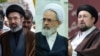
According to Fars, a semiofficial news agency that is close to Iran's Islamic Revolutionary Guards Corps, Hossein Mozafari, a member of the 88‑seat Assembly of Experts, said he had "strong hope" that a decision would be made within the next 24 hours.
Earlier, the United States has voiced its interest in being involved in the selection, with President Donald Trump saying the next leader should be "GREAT & ACCEPTABLE."
To read the full report, click here.
Zelenskyy, Macron Discuss Middle East In Phone Call
Ukrainian President Volodymyr Zelenskyy said he discussed the situation in the Middle East with his French counterpart, Emmanuel Macron, during a phone call on March 7.
Zelenskyy added that Macron supported Ukraine's efforts to assist the region with its expertise in countering Iranian-made drones.
"Emmanuel supported our work toward greater security in the region -- Ukraine has the most experience in defending against Shahed drones," Zelenskyy said.
Earlier in the week, Zelenskyy announced it had received a request from the United States for "specific support" and ordered officials to provide the necessary means and specialists to assist air defense in the region.
The idea was voiced by country's leadership since very first retaliatory attacks by Tehran that struck number of countries across the Gulf.
Iran has long been an ally of Russia, supplying it with military equipment and technology and fueling the Kremlin's war effort against Ukraine.