




Iranian Military Expanding Child Recruitment Efforts, Rights Group Says
A new report by Human Rights Watch (HRW) says Iran’s military is intensifying efforts to recruit children into its ranks, particularly amid the ongoing conflict.
According to HRW, the Islamic Revolutionary Guards Corps (IRGC) is actively enlisting children as young as 12 under a campaign promoting them as “homeland defending combatants.”
The report highlights that children are being drawn into roles such as patrols, checkpoints, and logistical support, raising serious concerns about their exposure to danger and potential participation in hostilities. HRW warns that such practices are in violation of international law, which prohibits the recruitment of children under 15 for armed conflict.
HRW also notes that the campaign appears to be expanding, reflecting a broader mobilization effort by Iranian authorities as the war escalates. The organization stresses that even noncombat roles can place children at risk and contribute to their militarization.
Rubio Says Iran Is At Its 'Weakest Point'
- By RFE/RL
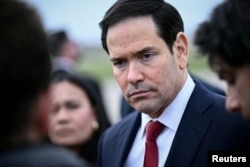
In two separate interviews with ABC News and Al Jazeera, US Secretary of State Marco Rubio said that the United States is making rapid progress in degrading Iran's military capabilities, and expects to achieve its objectives "in a matter of weeks, not months," while emphasizing that US President Donald Trump "prefers diplomacy."
"We’re going to wipe out their defense industrial base, meaning their ability to make new missiles and new drones in the future, because it posed a great threat to the region. This Iran that you’re seeing now, this is Iran at its weakest point," he told ABC News on March 30.
"We are on pace and in fact ahead of schedule" he added, saying that the United States is "going to achieve those things in a number of weeks, not in a number of months."
"I think the first point the president makes is he prefers diplomacy," Rubio said. "As I have said, those efforts are nascent. There is messages being relayed back and forth, some conversations going on, including through intermediaries."
Commenting on Iran's threats to control the Strait of Hormuz "in perpetuity," and introduce a tolling system, Rubio said that Washington would not allow that to happen.
"Not only is the sovereignty over the Straits of Hormuz not acceptable to us, it won’t be acceptable to the world," he said. "The president has a number of options available to him, if he so chooses, to prevent that from happening."
He stressed that the Iran's sovereignty over the Strait of Hormuz was "not acceptable" to the United States.
Speaking about Mojtaba Khamenei, the new supreme leader in Iran, Rubio said: "First of all, we don’t even know if he’s in power."
"I know they say he's in power. No one has seen him; no one has heard from him. It's very opaque right now. Its not quite clear how decisions are being made inside of Iran," Rubio told Al Jazeera on March 30.
With a number of European countries declining to support the conflict with Iran, Rubio answered a question about whether he believed EU and NATO countries betrayed the United States at this crucial moment by saying "it was very disappointing."
"Without the United States, there is no NATO," he warned the European allies, adding "If we decided tomorrow that we were going to remove our troops from Europe, that would be the end of NATO. So they know that."
Energy Markets Could Take Months To Stabilize After War Ends, Expert Says
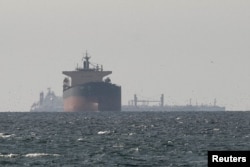
WASHINGTON -- Even if hostilities with Iran were to stop immediately, global energy markets will take a long time to recover, Mark P. Mills, executive director of the National Center for Energy Analytics, told RFE/RL.
Speaking during a briefing hosted by the State Department New York Foreign Press Center on March 30, Mills -- who served in the White House Science Office under President Ronald Reagan -- said markets would react quickly to an end in fighting but take longer to return to stability.
“Prices will relax immediately…but the trail to the equilibrium we had before is probably at least six months -- that might be a year…we’re certainly into months, not weeks,” he said.
Mills said the current crisis underscores a deeper structural reality: the global economy remains tightly bound to oil. Despite years of investment aimed at reducing dependence on fossil fuels, global oil consumption has remained largely unchanged on a per capita basis since 2000.
“Every product and service is linked to oil,” he said, noting that as much as 95 percent of global transportation still depends on it. Even rapid growth in electric vehicles has made only a marginal dent in overall demand.
The conflict has also revived concerns about supply vulnerabilities, particularly in key chokepoints such as the Strait of Hormuz and the Red Sea. In response, countries are already rerouting shipments, tapping strategic reserves, and even reverting to coal in some regions to ease pressure on oil and gas markets.
According to Mills, these emergency measures could buy the world “two to three months” before more severe shortages emerge if disruptions persist.
Beyond the immediate crisis, the longer-term impact may reshape global energy strategy.
Governments and investors are increasingly likely to prioritize diversifying oil supply sources -- boosting production in regions such as the United States, South America, and Africa -- to reduce reliance on geopolitically sensitive areas, he said.
We are now closing the live blog for the day. We'll be back tomorrow at 7:30 a.m. Central European time to cover the latest events across the Middle East.
Iran Advances A Plan To Tighten Control Of The Strait Of Hormuz
Iranian parliament's National Security Commission approved a plan on March 30 elaborating how Tehran would manage the Strait of Hormuz. The document covers a range of proposed actions from passage tolls for ships to a complete ban on vessels belonging to Israel and the US. Ships from countries that participate in international sanctions regime against Iran are to be restricted.
According to Iranian state media, this way Iran sees itself as exercising its "sovereign right," and is also envisaging cooperation with Oman to establish "the legal regime of the strait."
Over the past weeks, Alladin Borujerdi, a member of the parliament's National Security Commission, floated an idea of a $2-million fee for some ships passing through Hormuz.
The White House reiterated on March 30 that any attempts by Iran to regulate traffic through Hormuz or charge for passage are unacceptable.
The Strait of Hormuz is one of the key energy transport routes, with about a fifth of the world's crude oil and LNG passing through it under normal circumstances. Since the start of US and Israel's war with Iran on February 28, this volume dropped by about 95 percent with Iran blocking the passage as its retaliatory measure.
White House: US May Ask Arab States To Help Pay For War
White House Press Secretary Karoline Leavitt told a briefing on March 30 that US President Donald Trump may consider asking Arab nations to help pay for the Iran war.
"I think it's something the president would be quite interested in calling them to do," she said. "I won't get ahead of him on that, but certainly it's an idea that I know that he has and something that I think you'll hear more from him on."
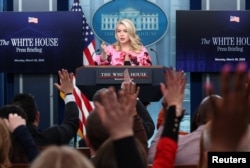
Arab countries in the Persian Gulf have repeatedly come under Iranian attack since US and Israeli air strikes on Iran on February 28. They have not joined the war on Iran. However, the attacks coupled with Iran's blockage of the Strait of Hormuz have caused them substantial economic losses as well as civilian casualties.
Leavitt also repeated the US position that talks with Iran were continuing and were going well, which Iran has denied.
"Despite all of the public posturing you hear from the regime and false reporting, talks are continuing and going well. What is said publicly is, of course, much different than what's being communicated to us privately," Leavitt said.
Iranian And Israeli Oil Facilities In Flames As Strikes Continue
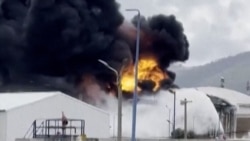
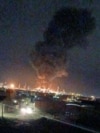
Iran and Israel continued to trade attacks that left a petrochemical plant in the Iranian city of Tabriz in flames, according to Iran's state media on March 30. It was followed by a strike on an Israeli refinery in Haifa. An Iraqi Air Force transport plane was also targeted by Iran-backed militias at Baghdad International Airport as the conflict in the region entered its fifth week.

Syrian President Condemns Iran's Attacks On Persian Gulf Countries
Syrian President Ahmed al-Sharaa, who is in Germany, expressed sympathy for the Arab countries of the Persian Gulf in a press conference on March 30, in which he condemned Iran's attacks on these countries.
Al-Shara stressed that Iran's neighboring Arab countries to the south "did not want" to enter the war, but Iran was attacking them.
The Syrian president, who visited Germany for the first time in his capacity and met with the country's chancellor on March 30, said that the current war, which has just entered its fifth week, "poses a great danger" to global energy supplies.
He also emphasized that the parties to the conflict must "reach an agreement based on a specific formula" as soon as possible, otherwise the continuation of the war would be fraught with potential dangers.
Turkey Says Fourth Iranian Missile Intercepted
The Turkish Defense Ministry announced on March 30 that a ballistic missile launched from Iran had been intercepted and destroyed.
According to a statement from the ministry, the missile was intercepted by NATO air and missile defenses based in the eastern Mediterranean.
This is the fourth Iranian ballistic missile to be intercepted in or en route to Turkish airspace.
Egyptian President Calls On Trump To Stop War
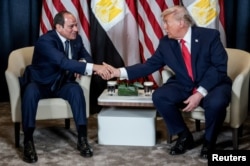
Egyptian President Abdel Fattah al-Sisi has called on US President Donald Trump to stop the war in the region.
Speaking at the opening ceremony of the Egyptian Energy Exhibition, Al-Sisi said: "I say to President Trump: No one but you can stop the war in our region in the Persian Gulf."
The foreign ministers of Egypt, Pakistan, Saudi Arabia, and Turkey met in Islamabad at the end of last week to find a way to end the US-Israeli war with Iran, but the outcome of these talks is still unclear.
Egyptian Foreign Minister Badr Abdel Ati also contacted his US counterpart, Secretary of State Marco Rubio, in recent days and called for a diplomatic solution to end the conflicts in the region.