



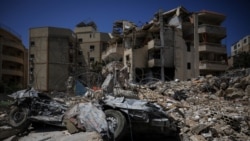
Delays And Rising Costs: Central Asia Feels Fallout From Iran War
In Dubai, rows of cars bound for Kyrgyzstan are sitting idle. Aktilik Alipbay uulu, a Kyrgyz importer based in the city, isn’t sure when they'll move.
“We haven’t received clear information like ‘load now, it will arrive in 35–40 days,’” he says. “So, we are keeping the cars in garages. These are entrusted goods. If something happens at the port, it would mean losses for us.”
Previously, cars shipped by ferry across the Persian Gulf to Iranian ports then traveled overland to Bishkek. With the war in Iran, that supply chain has slowed significantly.
“The strait is not completely closed, cars are still moving, but they are being held in ports for 15–20 days or even up to a month. We are trying to get them out to Kyrgyzstan, but there are serious delays. They are stuck in Iranian ports,” says Alipbay uulu.
“People at the ports are afraid to release shipments because missiles are being fired across the Persian Gulf. That’s why the cargo is being held up. That’s why everything is being held up.”
To read the full report, click here.
We are now closing the live blog for the day. We'll be back tomorrow at 7:30 a.m. Central European time to cover the latest events across the Middle East.
Vance Says Ball In Tehran's Court After 'Progress' In Peace Talks In Islamabad
- By RFE/RL
US Vice President JD Vance says the ball is now in Iran's court after peace talks last weekend in Islamabad made "a lot of progress."
Speaking to Fox News in an interview on April 13, Vance said that during the peace talks, which lasted around 20 hours, "we actually made very clear what our red lines were."
"I really think the ball is in the Iranian court, because we put a lot on the table," Vance said.
He added that during the talks, it was made clear that US President Donald Trump had no flexibility with regard to Iran's enriched uranium, which Washington must have, and the verification mechanism that would ensure Tehran does not develop nuclear weapons in the future.
"It's one thing for the Iranians to say that they're not going to have a nuclear weapon. It's another thing for us to put in place the mechanism to ensure that's not going to happen," Vance said.
Toll Booths and Tankers: How the US Navy and Economic Sanctions Aim To Squeeze Tehran
WASHINGTON -- A US naval blockade on ships entering Iranian ports and coastal areas took effect on April 13 as Washington increasingly turns to "economic statecraft" to force Tehran to agree on a peace deal after weeks of air strikes.
RFE/RL spoke with Max Meizlish, a research fellow at the Foundation for Defense of Democracies (FDD) and a former official at the US Treasury’s Office of Foreign Assets Control (OFAC), on the intersection of naval blockades and financial warfare.
Meizlish argues that while kinetic air strikes grab headlines, the real battle is being fought against the Chinese financial lifelines and clandestine trade networks that keep the Iranian regime afloat.
To read the full interview, click here.
Touting US Oil Reserves, Trump Says 'We Don't Need The Strait' As Blockade Begins
- By EBU
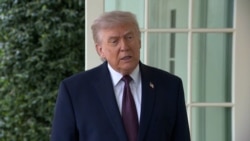
Telling reporters that a US naval blockade on Iranian ports in the Strait of Hormuz had started, US President Donald Trump said other countries are turning to US oil and gas to compensate.
Speaking at the White House on April 13, Trump also that "the appropriate people" want to strike a deal to end the standoff.

Iran Chamber Of Commerce Official, Says Internet Shutdown Causing '$80 Million' A Day In Losses
The X account of the Iranian Chamber of Commerce has published a video in which an official criticizes the continued Internet shutdown and points to its heavy economic cost.
"We suffer about $80 million in direct and indirect losses every day from Internet outages," said Afshin Kolahi, head of the knowledge-based-economy commission at the chamber, who likened the damage to the destruction of several bridges or power plants.
In Iran, especially since the cease-fire began, criticism of the ongoing Internet shutdown has increased, but so far there has been no response from key decision-makers in the government.
Despite the recent cease-fire, the Internet blackout remains largely in place, leaving millions of Iranians in digital darkness for more than six weeks.
Several Government Employees Arrested On 'Treason' Charges
State media in Iran reported on April 13 that a number of government employees in Lorestan Province have been arrested on charges of “treason.”
The reports did not specify the number of those detained or their identities, nor did they define the charge of “treason.”
However, the reports said the detainees were employees of various institutions, including Lorestan University, the Medical Sciences University, the Tax Administration, the School Renovation Department, the Engineering Organization, and a number of teachers working in the province’s education sector.
The Tasnim News Agency, which is close to the Islamic Revolutionary Guards Corps, said the charges include “treason and cooperation with hostile networks.”
Over the six weeks since the start of the US-Israel war with Iran and the subsequent cease-fire, Iran’s judiciary has reported daily arrests across the country of individuals described by state media as “traitors” or accused of photographing and filming war-damaged areas.
Some of those detained have been brought before courts, while others have been forced to confess on state television.
In some cases, authorities have cited the charge of “corruption on earth,” which in Iran can carry the death penalty.
Finnish President Says Iran Blockade 'Makes Sense' From Washington's Perspective, Warns Of Risks

WASHINGTON -- Finnish President Alexander Stubb says that a US blockade strategy toward Iran “makes sense” from Washington’s perspective, while warning of significant uncertainties and escalation risks.
Speaking in Washington on April 13, during a visit for meetings and policy events in the US capital, Stubb argued that the consequences of the conflict had proven broader than expected, particularly due to the strategic importance of the Strait of Hormuz.
“The blockade, from an American perspective, I would say, makes sense, if it works out,” he said, adding that it could give the US leverage but also raising concerns about potential tensions with other powers.
Stubb said negotiations between Washington and Tehran were continuing at a lower level, which he described as a positive sign. However, he cautioned that any resolution could take time, noting the years-long process behind the Joint Comprehensive Plan of Action, a landmark 2015 Iran nuclear deal, which has since unraveled after the US withdrew in 2018 and Tehran scaled back on compliance.
Stubb added that “Iran holds a lot of the cards right now.”
The Finnish leader also warned of the risk of broader regional escalation, saying conflicts were increasingly shifting from local to regional in scope. “I am extremely concerned about the escalation,” he said.
On the role of NATO, Stubb emphasized that the alliance remained defensive and was not directly engaged in the crisis, with any support for US actions likely to take place through a “coalition of the willing” rather than NATO structures.
He also said he “fully understand[s] the American perspective” regarding expectations of allied support, including access to bases, though such arrangements are governed by bilateral agreements.
European countries are focusing on de-escalation efforts, including maintaining freedom of navigation in the Strait of Hormuz, he said.
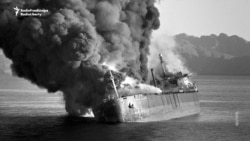
Veterans Of 1980s 'Tanker War' See Parallels In Current Hormuz Crisis
The US military said it would begin a blockade of ships traveling to and from Iranian ports following the failure of US-Iranian peace talks on the weekend. Former sailors who navigated tankers through the Strait of Hormuz during the Iran-Iraq War of the 1980s told RFE/RL that today’s crisis echoes that conflict four decades ago. (Video by RFE/RL, Amos Chapple, Margot Buff, and Will Tizard)
What To Know About The US Naval Blockade Of Iran
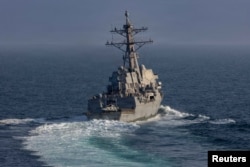
A US naval blockade on ships entering Iranian ports and coastal areas has come into effect, following failed peace talks between US and Iranian negotiators over the weekend.
And it already poses a dilemma: risk attack from Iranian assets near the Strait of Hormuz, or hold back and hope to catch vessels breaking out into the open seas.
The move is the latest attempt by US President Donald Trump to force Iran into making concessions, including a commitment not to seek a nuclear weapon or the means to build one.
It follows more than a month of air strikes and long-standing economic sanctions.
Read more here.