




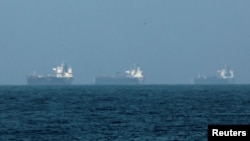
WASHINGTON -- With tanker traffic through the Strait of Hormuz down sharply since the start of the US-Israeli war with Iran and oil prices up amid fears of Iranian attacks on Gulf energy infrastructure, analysts increasingly warn that global energy flows themselves are becoming part of the strategic battlefield.
Iran produces only a small share of global oil supply but sits beside one of the world’s most important maritime energy choke points. That has raised questions about whether Tehran is attempting to exploit global dependence on Gulf oil to raise economic costs for its adversaries.
In an interview with RFE/RL, Ariel Cohen -- senior fellow at the Atlantic Council, managing director of energy, growth, and security at the International Tax and Investment Center, and founder of the advisory firm International Market Analysis -- discussed Iran’s long history in oil geopolitics, the limits of its ability to disrupt global markets, and why he believes the structural advantages remain on the side of the US and its partners.

Is Iran Weaponizing Energy Vulnerability?
RFE/RL: With tanker traffic through the Strait of Hormuz declining and oil prices rising, do you see Iran deliberately exploiting global dependence on Gulf oil as a strategic tool?
Ariel Cohen: Iran is a founding member of the Organization of the Petroleum Exporting Countries and always was a hawk. It often took the most radical positions in OPEC and pushed for higher oil prices, together with Venezuela, another founding member. Saudi Arabia, for example, traditionally preferred capturing a broader market share and did not necessarily want prices to become too hot.
So Iran has multigenerational expertise in oil markets. The Iranian people -- the Persian people -- have played geopolitics since the start of the Persian Empire some 2,600 years ago. The traditions of both oil politics and geopolitics run deep.
There is also the cliche that people in Iran invented chess, so they know how to play different figures on the chessboard.
Having said that, I think this regime has uniquely demonstrated how brutal it is and how often it misreads the global map. The regime has spent almost 50 years chanting “Death to America” and “Death to Israel,” and in the process it has managed to turn not only the United States and Israel but also many of its neighbors -- Arab states, Turkey, Azerbaijan, and others -- essentially into adversaries.
That approach is myopic and, in the long term, counterproductive to Iranian interests.
RFE/RL: How sustainable is Iran’s strategy of disrupting energy markets? Can Tehran maintain meaningful pressure over time, or do structural advantages still lie with the US and its partners?
Cohen: The military, kinetic advantages are clearly on the side of the United States and its partners. The Iranians are making a huge mistake because they appear to underestimate the scope of destruction the United States and Israel could bring upon Iran.
The Iranian people have a regime that has spent hundreds of billions of dollars supporting proxies across the Middle East that are now being wiped out, building a nuclear program that is being destroyed, and developing ballistic missile capabilities that are also being destroyed.
So, in terms of sheer economics, the regime has failed. Iran could have been a very rich country with the oil resources it has. Instead, it is a poor country. Many people who had the ability to leave -- doctors, engineers, scientists -- have emigrated.
This regime is not only destroying physical infrastructure but also destroying Iran’s human capital.
In terms of energy markets, oil prices today are around $87 a barrel. When we look at previous peaks -- in 2008, 2014, and 2022 -- prices were significantly higher. A price around $87 is not something that will destroy the American economy.
The situation in Asia and Europe is more difficult, but those countries are not the ones deciding the course of the conflict.
I believe this war may continue for weeks, not for months. And by the end of it, there is no way this regime will be better off than it was when the war started.
Whose Economic Resilience Matters More?
RFE/RL: If tanker traffic through the Strait of Hormuz were significantly reduced for weeks or months, what would the immediate impact be on oil prices and major economies, particularly in Europe and Asia?
Cohen: First of all, the United States has the naval and aerial capacity to prevent that from happening.
The United States would destroy the means Iran could use to mine the Strait of Hormuz -- whether those capabilities are on the ground or elsewhere in the Iranian system of command and leadership -- because such a development would be unsustainable.
RFE/RL: Iran has spent decades adapting to sanctions and economic isolation, while the United States and its allies are highly sensitive to oil price spikes that could drive inflation and political backlash. In such a conflict, whose economic resilience ultimately matters more?
Cohen: On the military side, it is not just about escorting tankers. It is about physically destroying Iranian capabilities that could block the strait -- naval systems, artillery, aerial assets, rockets, anything that could threaten the waterway.
On the economic side, the United States and other major economies have tools. Strategic petroleum reserves in the United States and the G7 countries -- and in other major economies, including China -- could be opened.
The United States could also adjust sanctions regimes, including those affecting Russian oil, to allow additional supplies to enter the market.
It is important to remember that Iran produces only about 2 percent of global oil supply. The United States produces far more. Saudi Arabia, Kuwait, and other Gulf producers also produce significantly more. African and Latin American countries can add supply as well, and Venezuela may bring additional production online.
So the loss of Iranian oil alone would not be decisive.
There has also been discussion that the United States might target Kharg Island, which is the main terminal for Iranian oil exports. If the United States were to occupy or destroy Kharg Island, the economic outlook for the Iranian regime would become far worse in terms of its future export capacity.

Exports from other Gulf countries, however, would continue. Protecting those exports would be a military priority for the United States.
RFE/RL: What is the strategic significance of Kharg Island?
Cohen: Kharg Island handles roughly 90 percent of Iranian oil exports.
If the United States were to control it, Washington could effectively dictate the future of Iranian export policy. If it were destroyed, it would deny Iran a major source of revenue.
RFE/RL: US President Donald Trump recently said oil companies should continue using the Strait of Hormuz despite the risks. What does that mean in practical terms?
Cohen: Businesses generally do not want to operate where bullets -- or missiles -- are flying.
The president of the United States cannot simply order private oil companies to send tankers into a war zone. However, the energy industry does have a relatively high tolerance for risk.
For example, Occidental Petroleum continued operating pipelines in Colombia even when they were attacked repeatedly by guerrillas.
But there is a difference between insurgent attacks on pipelines and the risk of a large tanker being hit and set on fire. There are also many actors involved -- shipping companies, insurers, and security providers.
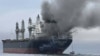
Ultimately, the goal is to eliminate Iran’s ability to target tankers in the Strait of Hormuz. The United States has the capability to do that, either by providing physical protection or by applying enough pressure on Iran that, through intermediaries or directly, an agreement is reached to stop attacks on tankers or attempts to mine the strait.

