




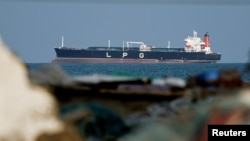
As the war with Iran continues, access to the Strait of Hormuz, a waterway that sees about one-fifth of the world's gas and oil transit through it, has become an urgent -- and uncertain -- objective.
US President Donald Trump called on NATO allies and major Asian partners, including China, to help secure the vital maritime corridor, but the response to his request was mixed.
Meanwhile, energy markets are reacting sharply: Brent crude surged past $115 per barrel last week before retreating slightly, and attacks on key infrastructure in Iran and Qatar have raised fears of a broader, longer-lasting supply shock.
Against this backdrop, Alex Raufoglu, RFE/RL's senior correspondent in Washington, D.C., spoke with Landon Derentz, former White House energy director during the first Trump administration and now vice president for energy and infrastructure at the Atlantic Council, about how markets are interpreting the crisis and what may come next.
RFE/RL: As markets respond to escalating tensions, with Brent crude now trading above $115 per barrel [at time of publication, the price was $106], are current price levels primarily reflecting a temporary geopolitical risk premium, or do they suggest investors are beginning to price in a more prolonged and structural supply shock?
Landon Derentz: I think they are looking at a premium right now. There is a distance between the physical market and the gap of losing 10 to 13 million barrels a day, and where the market is actually pricing the consequences of the current shutdown of the Strait of Hormuz.
So for me, there is still a bit of a transient nature to some of the price markers around the world, in particular Brent crude, because having a shortfall -- a market disruption of the scale we are seeing right now -- for any longer duration is going to lead to much higher prices over time.
RFE/RL: In that broader context, and given the recent attacks on Qatar's Ras Laffan Industrial City -- which accounts for roughly 20 percent of global LNG supply -- how should we understand the implications of this damage for the longer-term balance between oil and natural-gas markets?
Derentz: It is an interesting question, and it is a really important distinction. We talk significantly about the Strait of Hormuz in the context of shutting down oil, but it also has an impact on natural-gas markets.
Liquefied natural gas (LNG) is a major part of the global economy today. There are really three major exporters of liquefied natural gas: the US, Australia, and Qatar. Russia is also a significant exporter.
Ultimately, what has happened in the context of Ras Laffan is that natural gas is already shut in; the LNG cannot be exported because of constraints and shipping in the Strait of Hormuz, as Iran threatens global shipping and maritime navigation through the strait. So you cannot move LNG already, and about 20 percent of global liquefied natural gas comes through the Strait of Hormuz out of Qatar.
Now the Iranian regime has attacked the actual facilities, and that moves the natural-gas conversation from one that is transient, as we still see in the oil market, into one that is much more structural. QatarEnergy has announced that repairs could take between three to five years, and the amount of supply that is out is about 25 percent of its production.
We are looking at 20 million tons of liquefied natural gas on an annual basis that is not on the market, or about 5 percent of global supply. The consequences of what is going on right now in the Middle East will reverberate for some time, and not just during the conflict with Iran.
RFE/RL: Drawing on your experience in the first Trump administration, what is the current policy priority here: reopening the Strait of Hormuz or degrading Iran's asymmetric capabilities -- and how do these objectives interact?
Derentz: It is an interesting and nuanced question. The president made the decision to go into Iran because Iran was pursuing nuclear weapons. Throughout many administrations -- and even after the decision to strike Iranian nuclear facilities earlier in his administration -- the reality is that Iran was pursuing nuclear weapons at a relatively rapid rate. As we know, they have a missile and rocket capability that would make that even more damaging to global security and stability.
The president decided to take this action to address the nuclear weapons program, not so much regime change but that component of the discussion. The reason we are talking so much about the Strait of Hormuz is because it is a question of duration.
Historically, Iranian deterrence has been discussed in three categories. First is the global proxy network -- Hamas, Hezbollah, the Houthis -- as forward-deployed components to challenge adversaries outside of Iran and create chaos. The second is their missile and rocket program, including short-range and intercontinental ballistic missiles that challenge Israel, US installations, and partners in the Arab Gulf. The third is the nuclear program, where a nuclear-armed Iran would be far more difficult to address, similar to North Korea.
What we are seeing now with the Strait of Hormuz is effectively a fourth line of deterrence: asymmetric drone warfare and the geopolitical threat of holding the global economy hostage by disrupting trade flows and a significant share of global oil and gas through the strait. So the rationale for entering Iran is about the nuclear program. The importance of the Strait of Hormuz is that it provides the timeline and bandwidth to address the broader problem that triggered this confrontation.
RFE/RL: Given the administration's public appeals for allied support and the relatively cautious response from European and Asian partners so far, how does limited coalition participation affect both the speed and the overall feasibility of reopening the Strait of Hormuz?
Derentz: Every nation has limits in how it can extend its footprint in a given theater of conflict. If European partners, as well as those from East Asia and elsewhere, were to help secure and provide assets to protect critical energy infrastructure in the Gulf alongside our Gulf Arab allies, it would allow the United States to project its military power more forward over Iran.

Every incremental contribution from partners allows resources to be reallocated in ways that make it more difficult for Iran to succeed. From an ally's perspective, the key question is how existential this challenge is.
In my view, an Iran that emerges from this situation with a nuclear weapons program and the regime intact would be more dangerous over the long term. So the question becomes whether it is better to address this now or face a more difficult situation later as Iran continues to hold the global economy at risk.
RFE/RL: Staying with market dynamics and investor expectations, to what extent do you think markets are relying on the president to identify and implement an off-ramp to de-escalate the conflict, and, in your view, is that confidence potentially misplaced?
Derentz: This is a subject of a lot of debate. The reality is that markets still anticipate that the president will find an earlier off-ramp than may be realistic. That is partly because it does not depend only on President Trump's willingness to de-escalate. The Iranian regime sees this as an existential crisis for its survival and leadership, and it may not share the same interest.
It is reasonable to expect that Iran may continue to apply pressure on the global economy so that the consequences of a conflict with Iran are remembered. The key takeaway is that this conflict may extend far beyond a short-term action.
Even if the president decides to pivot to a cease-fire, that does not mean the Iranian regime will do the same. We should be prepared for a longer-duration conflict.
RFE/RL: At this stage, given that energy demand remains highly inelastic in the short term, what policy tools or market mechanisms -- if any -- could realistically contribute to bringing prices down in a sustained way?
Derentz: There are not many market mechanisms available to solve this problem. We are already drawing on global reserves, including barrels of oil already on the market. The president has even eased sanctions on Russian and Iranian cargo so that fuel continues to flow if it is already in transit.
The International Energy Agency and the United States have also used strategic petroleum reserves to provide a supply-side buffer. But these are temporary measures. Over time, as reserves are drawn down, there is no mechanism to offset a sustained shortfall of more than 10 million barrels per day.
The result is demand destruction, with significant consequences, particularly for emerging markets that cannot afford energy at elevated prices given the inelasticity of demand.
RFE/RL: In addition to supply disruptions, there is also the issue of damage to critical energy infrastructure. Even if the strait were to reopen in the near term, can markets truly stabilize while such damage may take years to repair?
Derentz: There is still an ongoing assessment of how much damage has been done. Iran has attacked some downstream refining capacity in Gulf Arab states, but, for the most part, oil markets appear intact. The major export infrastructure remains operational and capable of meeting global supply.
The question becomes how long it takes to ramp production back up and bring shut-in capacity online. Countries like Iraq and Kuwait have reduced production because storage is full. So it is largely a matter of timing and how quickly the system can return to full capacity if a cease-fire is reached.
RFE/RL: Expanding the lens beyond Western allies, how significant is China's position -- particularly given its dependence on energy flows through the Strait of Hormuz -- in shaping both market expectations and broader US strategic calculations in this crisis?
Derentz: China is one of the major pressure points for the Iranian regime. Over the past several years, China has built a very large strategic petroleum reserve, likely in the billions of barrels. That provides a buffer against short-term volatility, but China is still a major importer of crude oil, at around 10 to 12 million barrels per day. That is similar to where the United States was at its peak import dependence in the early 2000s.
While China has taken steps to enhance its supply security, that buffer will eventually decline. Over time, that could increase pressure on Iran.
At the same time, this is not only about supply. China depends on a stable global economy for growth. A prolonged period of high energy prices and economic slowdown could incentivize Beijing to push Iran toward de-escalation despite its existing buffer.
RFE/RL: Finally, when you look at this crisis, how is it different from the oil shocks of the 1970s, especially in terms of infrastructure targeting and broader vulnerabilities? What do you think the administration is getting right or wrong in trying to avoid a similar outcome?
Derentz: The crises of the 1970s were driven by producers choosing to constrain supply to exert geopolitical pressure. In this case, you have an adversary constraining global commerce at a scale that is largely unprecedented. There has not been a disruption of this magnitude since World War II in global energy markets.
This is not about suppliers withholding products: It is about a single actor using drones and missiles to disrupt global commerce and target partners in the region that had not inflicted damage on it.
What we are seeing is an Iranian regime acting out of desperation, with limited options and a willingness to escalate. That is a key distinction, and it underscores the scale of what is now the largest disruption to oil markets since World War II.

