

Trump Says US May Launch New Strikes On Iran In Coming Days
- By RFE/RL
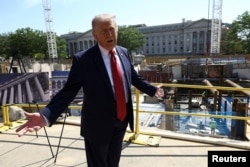
US President Donald Trump has said he may launch new military strikes on Iran in the coming days if diplomatic efforts fail to result in an agreement with Tehran.
Speaking at the construction site for the new White House ballroom on May 19, Trump also said he had previously been just an hour away from authorizing a strike on Iran before deciding to postpone the attack.
On May 18, Trump said in a Truth Social post that the leaders of Qatar, Saudi Arabia, and the United Arab Emirates had urged him to hold off on the attack because "a deal will be made."
Asked how much more time he would give Iran to agree to a deal, Trump said "two or three days."
"Maybe Friday, Saturday, Sunday, maybe early next week," he said, adding that the timeline was limited because "we can't let them [Iran] have nuclear weapons."
Trump announced a temporary cease-fire on April 8. He said this was extended indefinitely on May 22, following what Trump said was a request from Pakistan, which is mediating in the conflict.
Trump Says US May Launch New Strikes On Iran In Coming Days
- By RFE/RL
US President Donald Trump has said he may launch new military strikes on Iran in the coming days if diplomatic efforts fail to result in an agreement with Tehran.
Speaking at the construction site for the new White House ballroom on May 19, Trump also said he had previously been just an hour away from authorizing a strike on Iran before deciding to postpone the attack.
On May 18, Trump said in a Truth Social post that the leaders of Qatar, Saudi Arabia, and the United Arab Emirates had urged him to hold off on the attack because "a deal will be made."
Asked how much more time he would give Iran to agree to a deal, Trump said "two or three days."
"Maybe Friday, Saturday, Sunday, maybe early next week," he said, adding that the timeline was limited because "we can't let them [Iran] have nuclear weapons."
Trump announced a temporary cease-fire on April 8. He said this was extended indefinitely on May 22, following what Trump said was a request from Pakistan, which is mediating in the conflict.
G7 Finance Ministers Call For Reopening Of Strait Of Hormuz
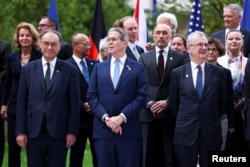
After two days of talks in Paris, the finance ministers of the Group of Seven (G7) -- the world's seven industrialized countries -- called for a "rapid return to free and safe passage" of ships through the Strait of Hormuz, citing the numerous challenges facing the world economy.
US Treasury Secretary Scott Bessent also wrote on X that he had "constructive discussions" about Iran, critical minerals, cybersecurity, and global imbalances at the meeting.
After issuing a final statement, the French finance minister acknowledged that two days of talks between G7 ministers had been "sometimes difficult," although the group ultimately agreed on a statement pledging multilateral cooperation to confront growing economic risks.
The final statement of the G7 ministers reaffirmed "our commitment to multilateral cooperation to address the risks facing the global economy."
Against the backdrop of the US-Israeli war with Iran, the statement said that "there are multiple and complex global challenges that require coordinated responses."
"Economic uncertainty, amid continued conflict in the Middle East, has increased risks to economic growth and inflation," the statement said.
The statement specifically referred to "the strain on energy, food and fertilizer supply chains, particularly affecting more vulnerable countries."
The Paris meeting took place while France holds the rotating presidency of the G7, paving the way for the group's summit in June in the city of Evian, which is scheduled to be chaired by French President Emmanuel Macron and is expected to be attended by US President Donald Trump.
Pakistani Shi'a In The UAE Caught In The Crosshairs Of Iran War
In early April, Hamid Ali Shah was ordered by his employer, Etihad Rail, the operator of the United Arab Emirates' national railway network, to report to the police. The civil engineer was questioned for several hours, held in detention for several days, and then deported to his homeland, Pakistan.
"I was on duty when I got the call," Shah told RFE/RL. "After two hours of questioning, I was bundled into a van along with 13 others and taken to an immigration detention center. On April 6, I was put on a flight and deported from the UAE."
Shah is among the thousands of Pakistanis who have been deported by the UAE since the United States and Israel launched a bombing campaign of Iran on February 28, according to a Pakistani lawmaker and media reports in the South Asian country.
Many of them are Shi'ite Muslims, a religious minority in Sunni-majority Pakistan, where they number around 35 million people. The community has ties with Iran, the world's largest Shi'ite-majority country.
To read the full report, click here.
Sanctions Expert Michael Parker On Russia, Iran, And Whether Waivers Work
WASHINGTON -- Washington remains deeply divided over the latest US sanctions waiver for Russian oil, which allows at-risk nations to buy Russian shipments already loaded at sea, as disruptions tied to the US-Israeli confrontation with Iran roil global energy markets.
Treasury Secretary Scott Bessent has argued the measure is needed to stabilize energy markets and limit China’s leverage over discounted Russian crude, while Democratic critics, including key Senators Jeanne Shaheen and Elizabeth Warren, say repeated exemptions risk weakening pressure on Moscow.
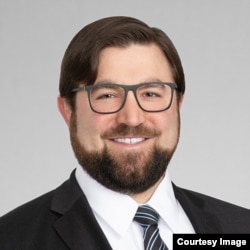
In an interview with RFE/RL's Alex Raufoglu, Michael Parker, a former investigator and section chief in the US Treasury’s Office of Foreign Assets Control (OFAC), explains why sanctions relief remains one of Washington’s most important diplomatic bargaining tools.
RFE/RL: What does the Treasury Department’s decision to extend the Russian oil waiver for another 30 days signal about the administration’s priorities? Is energy stability beginning to outweigh sanctions pressure on Moscow?
Michael Parker: I think what's important to start with, kind of at a threshold level, is understanding
what the general license issued by the Treasury Department actually covers. What it authorizes is oil that is already at sea and has been since April 17. Of course, this oil was already the subject of a prior waiver, or general license, to US sanctions up until approximately yesterday or the day before.
What this extended general license does is not add any additional oil that has since been loaded onto ships and put onto the high seas. It still covers the same stranded oil, so to speak, from April 17. I would view this as a very narrow and limited waiver for the purpose of selling oil that had already been covered by that prior general license. There’s no real expansion beyond that except for the time period in which it can be sold.
Read more here
Qatar Says US-Iran Negotiations Need More Time After Trump Delays Strike
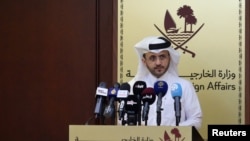
Qatar has indicated that US-Iran negotiations mediated by Pakistan need more time to produce a deal, a day after Donald Trump said he had postponed planned military strikes to allow diplomacy to continue.
Qatari Foreign Ministry spokesman Majed al-Ansari said on May 19 that Doha supported Pakistan’s mediation efforts and wanted to avoid further escalation in the region.
“We are supportive of the diplomatic effort by Pakistan,” he said, adding that Qatar believed negotiations “need more time.”
Trump said on May 18 that he had suspended attack on Iran planned for the following day after leaders of Qatar, Saudi Arabia, and the United Arab Emirates urged him to give talks a chance.
"We want to protect the people of the region," Ansari said in the hope of protecting them from becoming “the main losers of any escalation.”
With reporting by AFP
Iran Says Uranium Enrichment, End To Regional Fighting Among Proposals To US

Iran’s deputy foreign minister for legal and international affairs says Tehran’s proposals to the United States have included recognition of Iran’s “right to uranium enrichment,” “an end to the war on all fronts, including Lebanon,” and the release of Iranian assets.
Kazem Gharibabadi made the remarks on May 19 during a meeting with members of the Iranian parliament’s national security and foreign policy committee.
According to the state-run IRNA news agency, he presented a report on the course of negotiations, Iran’s proposal to the United States, and what he described as the negotiating team’s insistence on “principles.”
According to the report, Iran’s latest proposal to Washington includes demands such as recognition of its right to uranium enrichment and peaceful nuclear activities, an end to fighting across all fronts including Lebanon, the lifting of the US naval blockade, the release of frozen Iranian assets, compensation from the United States for war damage and reconstruction, an end to unilateral sanctions and UN Security Council resolutions, and the withdrawal of US forces from areas surrounding Iran.
Iran and the United States have engaged in direct talks and indirect exchanges through Pakistan since a fragile cease-fire between the two countries took effect on April 8 in an effort to reach an agreement ending the conflict.
Gharibabadi's remarks come as US President Donald Trump has repeatedly rejected Iran’s peace proposals, at one point calling them a “piece of garbage.”
He has repeatedly warned Tehran that time is running out and that failure to reach a deal acceptable to Washington could result in devastating military strikes.
With reporting by RFE/RL's Radio Farda
Europol Targets Thousands Of Social Media Posts Linked To Iran's Revolutionary Guards In Online Crackdown

Europol, the EU's law enforcement agency, says authorities from 19 countries have targeted more than 14,200 online posts and links tied to Iran’s Islamic Revolutionary Guards Corps (IRGC) following the group’s designation by the European Union earlier this year as a terrorist organization.
The coordinated operation, led by Europol’s EU Internet Referral Unit, ran between February 13 and April 28 and focused on disrupting IRGC-linked propaganda, recruitment, and fundraising activity across social media platforms, streaming services, blogs, and websites.
Europol said on May 18 that investigators identified material in several languages, including English, Persian, Arabic, French, and Spanish.
The content included speeches combining religious martyrdom narratives with political messaging, AI-generated videos glorifying the IRGC, and calls to avenge Iranian Supreme Leader Ayatollah Ali Khamenei, who was killed on February 28 in an air strike at the start of the US-Israeli conflict with Iran.
Authorities from countries, including France, Germany, Italy, the United States, and Ukraine participated in the operation. Europol said the IRGC’s main X account, which had more than 150,000 followers, had been blocked from view within the European Union following the action.
Investigators also identified cryptocurrency use and hosting providers in multiple jurisdictions as part of what Europol described as the group’s evolving online infrastructure.
Iran Releases US Resident Shahab Dalili After Years in Detention, Says NGO
Shahab Dalili, an Iranian with US residency who has been held in Iran since 2016, has returned home to his family following his release from detention, according to Hostage Aid Worldwide, a Washington-based nonprofit that advocates for hostages and wrongful detainees.
"After a long journey from Evin to Yerevan to DC, we joyfully announce that Shahab Dalili is finally home safe with his family after a decade+ of wrongful detention in Iran," Hostage Aid Worldwide said in a post on X on May 19.
In 2023, the United States and Iran agreed to a prisoner swap involving five detained Americans, but Shahab Dalili was excluded because the State Department had not officially classified him as "wrongfully or unjustly detained in Iran."
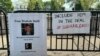
Dalili was arrested in 2016 when he returned to Tehran to attend his father's funeral.
He was detained by security forces while en route to the airport in the capital to return back to the US.
Dalili's family has said he was sentenced to 10 years in prison on charges of "collaborating with a hostile government."
More Than 100 Couples Married In Tehran With Military Vehicles And Machine Guns
A mass wedding ceremony for 110 couples was held on May 18 at Imam Hossein Square in central Tehran.
Images published from the event show military vehicles and machine guns present at the celebration venue.
A government-backed “Janfada” campaign -- meaning "devotion" or "self-sacrifice" -- was launched with the aim of demonstrating public preparedness in the face of a possible ground attack.
At the same time, weapons training courses in public spaces have also begun in recent days.
The ceremony took place while a fragile cease-fire remains in effect between Iran, the United States, and Israel.
With reporting by RFE/RL's Radio Farda
Any Agreement With Iran Must Be Approved By Congress, Says Graham
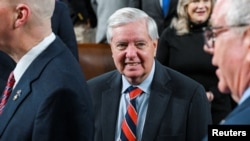
Republican Senator Lindsey Graham, a close ally of US President Donald Trump, has again said that any agreement between the United States and Iran must be approved by the US Congress.
His renewed emphasis on the issue came after Trump announced that, at the request of Arab Gulf leaders, he had postponed a planned May 19 attack on Iran.
Responding on X, Graham wrote that any agreement between Tehran and Washington "must come before Congress for approval, as was the case for the JCPOA under President Obama," referring to the 2015 Iran nuclear deal that Trump withdrew from in 2018.
While expressing skepticism about the prospects for reaching a deal with the Islamic republic, Graham nevertheless added that if the conflict could be ended "through diplomatic means that achieve our national security objectives, that would be a major accomplishment.”
Graham said Trump wanted Iran to halt uranium enrichment, surrender control of its stockpile of highly enriched uranium to the United States, stop interfering in shipping through the Strait of Hormuz, abandon its long-range ballistic missile and nuclear weapons programs, and end support for armed proxy groups across the region.
The US senator, however, also said he was deeply skeptical Iran would agree to terms that would make any new accord substantially different from the 2015 nuclear deal, adding that “time will tell.”