




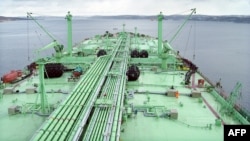
WASHINGTON -- Washington remains deeply divided over the latest US sanctions waiver for Russian oil, which allows at-risk nations to buy Russian shipments already loaded at sea, as disruptions tied to the US-Israeli confrontation with Iran roil global energy markets.
Treasury Secretary Scott Bessent has argued the measure is needed to stabilize energy markets and limit China’s leverage over discounted Russian crude, while Democratic critics, including key Senators Jeanne Shaheen and Elizabeth Warren, say repeated exemptions risk weakening pressure on Moscow.
In an interview with RFE/RL, Michael Parker, a former investigator and section chief in the US Treasury’s Office of Foreign Assets Control (OFAC), explains why sanctions relief remains one of Washington’s most important diplomatic bargaining tools.
RFE/RL: What does the Treasury Department’s decision to extend the Russian oil waiver for another 30 days signal about the administration’s priorities? Is energy stability beginning to outweigh sanctions pressure on Moscow?
Michael Parker: I think what's important to start with, kind of at a threshold level, is understanding what the general license issued by the Treasury Department actually covers. What it authorizes is oil that is already at sea and has been since April 17. Of course, this oil was already the subject of a prior waiver, or general license, to US sanctions up until approximately yesterday or the day before.
What this extended general license does is not add any additional oil that has since been loaded onto ships and put onto the high seas. It still covers the same stranded oil, so to speak, from April 17. I would view this as a very narrow and limited waiver for the purpose of selling oil that had already been covered by that prior general license. There’s no real expansion beyond that except for the time period in which it can be sold.

RFE/RL: Critics argue that once exemptions become predictable, governments and markets start planning around them. Do you think Moscow may now assume the West will continue easing pressure whenever energy prices rise sharply?
Parker: That is certainly something to keep in mind long term, but two variables are really important here. First is the time period involved -- in this case, we’re talking about several weeks as opposed to a major change in US policy.
Second is what exactly the easing pressure relates to. Again, this is such a narrowly tailored general license that only applies to oil already at sea since April 17. I don’t believe institutional actors, let alone governments, would take this as a broad change in US policy or in how the US approaches Russia-related sanctions.
By way of example, there haven’t been any major delisting actions. No major companies have been removed from the US sanctions list surrounding the issuance of this general license. There haven’t been broader waivers to Russian oil generally. It really only applies in this very narrow context to oil already at sea.
'Sanctions Relief Is The Proverbial Carrot'
RFE/RL: Oil prices remain above $110 a barrel despite these measures. If the waivers are not significantly calming markets, are they achieving their intended purpose?
Parker: It’s always important with US economic sanctions -- because they are tools of US foreign policy and national security -- to look at the overall purpose behind why they’ve been implemented or eased in certain instances.
Because this general license extension was so narrowly tailored, it may have served a more limited purpose: providing relief to certain countries. There really isn’t enough stranded oil out there, in my assessment, for this to make a meaningful difference in the global price of oil.

So the purpose may not have been to reduce the global price of oil. It may instead have been to provide specific relief to certain allies or certain parties.
RFE/RL: India appears to be one of the largest beneficiaries, continuing to import significant volumes of Russian crude. Does Washington risk friction with European allies and Ukraine by effectively tolerating those purchases?
Parker: US sanctions policy has been largely sensitive to the energy needs of the European Union. At the beginning of the sanctions regime after 2022, energy was largely carved out from US sanctions imposition and enforcement.
This cuts both ways in the sense that easing sanctions to help specific allies -- depending on foreign policy goals and the geopolitical climate -- is something the European Union would certainly understand. The US does not want to harm allies through sanctions as part of an overall sanctions policy or sanctions regime.
RFE/RL: At the same time, Treasury is pushing for tougher enforcement on Iran. How do allies and adversaries interpret the contrast between easing restrictions on Russian oil while demanding stricter compliance on Tehran?
Parker: Iran presents a different case. The United States, with the notable exception of the 2015 Joint Comprehensive Plan of Action, or JCPOA, has maintained a very consistent strengthening and intensification of sanctions.
Russia, before 2022, was much more integrated into the global economic and financial system. So I don’t necessarily see the actions taken today as creating friction or saying two different things.
Iran policy has been fairly consistent, and Russian sanctions policy has also been fairly consistent in providing carve-outs, waivers, and general license authorizations as necessary to adapt to changing geopolitics. I don’t necessarily see the two approaches as contradictory.
RFE/RL: Iranian media have portrayed the temporary waiver as part of broader negotiations. In your experience, how much leverage do sanctions waivers actually create in diplomacy?
Parker: In the context of the JCPOA, sanctions relief was really the proverbial carrot that accompanied the overall nuclear deal.
It’s going to depend on the broader policy priority and what you’re attempting to achieve by either implementing sanctions or easing them. But I think the word you used -- leverage -- is really the key point. Sanctions create leverage that can either be ratcheted up or scaled down depending on the tone and tenor of negotiations.

After all, US sanctions are meant to change behavior. On every major sanctions action targeting individuals or companies, OFAC states in its press releases that the purpose of sanctions is behavioral change. They are not meant to be static; they are meant to be dynamic.
When sanctions are tightened or eased, the question is: for what purpose? I view this as the appropriate use of sanctions -- creating leverage and creating a position where, depending on what Iran sees as its needs, sanctions relief could become a meaningful bargaining chip.
'Sanctions Are Not Meant To Be Static'
RFE/RL: Could offering sanctions relief during negotiations unintentionally signal weakness, particularly to countries like Iran and Russia that are highly experienced at operating under sanctions pressure?
Parker: That’s always front of mind for diplomats and policymakers. How do we make the carrot enticing without signaling weakness? How do we make it meaningful in the context of countries that have operated under sanctions for years and are sophisticated actors when it comes to sanctions pressure and sanctions evasion?
In this instance, my strongest sense is that the ability to reduce the intensity of sanctions does not imply weakness. If used effectively, it can further US policy goals.
That really is the intention behind sanctions when they are used correctly. They are not a form of punishment. They are designed so that, in negotiations like these, sanctions relief can be offered in exchange for a broader deal.
RFE/RL: Some analysts argue that once the US justified these waivers on humanitarian or stability grounds, it effectively established a precedent for future extensions. Is Washington now locked into a cycle that may become difficult to reverse?
Parker: That certainly is a consideration, but I do not necessarily see this as locking the US government into such a precedent.
The fact that the extension only runs until mid-June and applies solely to oil already at sea points in the direction of this truly being a temporary policy solution rather than locking Washington into a cycle it cannot reverse.
The way to reverse it is simply to allow the general license to expire. OFAC has allowed many general license authorizations over the years to expire for policy reasons and for a variety of other reasons.
I don’t necessarily see this extension as locking decision-makers in Washington into some permanent precedent.
RFE/RL: Stepping back from the immediate crisis, what do these developments tell us about the future of sanctions as a geopolitical tool? Are we entering an era in which energy security concerns fundamentally limit how aggressively the US can apply economic pressure?
Parker: I think they already have. In the Russian context, the energy sector was broadly exempt from many of the early sanctions designations, and I’m sure that had everything to do with European allies relying on Russian energy and with concerns about disrupting global markets.
To the extent that energy security is now a permanent feature of economic sanctions policy, I think that reality was already reflected in the US government’s original response to Russia.

