




Iran Restoring Internet, With Limits, After 88-Day Blackout
- By RFE/RL
NetBlocks, the global Internet monitoring organization, says live network data shows partial Internet access has been restored in Iran after 88 days of near-total blackout.
NetBlocks wrote on X that the outage, at more than 2,093 hours, is "the longest nationwide Internet outage in modern history."
The organization also said it remains unclear whether the restoration will hold.
Earlier in the day, officials from Masud Pezeshkian's government announced the start of a process toward full Internet reconnection within the next 24 hours. But the Administrative Court of Justice announced hours later that it had issued a suspension order against the government committee that had issued the decree to restore internet access.
Shortly after the NetBlocks post, Iranian First Vice President Mohammad Reza Aref wrote on X, "Following the directive of the President and in line with the government's promise, the first step toward free and regulated access to cyberspace has been taken."
Iranian media has reported that users are once again able to access the "international Internet" on their mobile phones, including services such as ChatGPT.
Iran maintains a two-tier Internet system: a domestic network limited to government-approved websites and services, and the international (global) Internet, which is frequently heavily filtered or completely shut down.
NetBlocks also reported that Internet access has now reached 86 percent, when compared to ordinary traffic volumes. “Filternet remains in place but can be worked around. WhatsApp now restricted, requiring circumvention. Some users still offline,” NetBlocks wrote on X.
Iran's state-run news agency ISNA reported that users of fixed broadband services are now connected to the global Internet without restrictions and "have been provided with the opportunity to fully use international websites and services."
Deputy Communications Minister Ehsan Chitsaz, however, announced that citizens' phones are at risk of hacking due to "attackers' misuse of un-updated devices" and urged Iranians to install the latest version of banking applications and security tools before going online.
Iranian TV Reports Draft Framework Deal With US
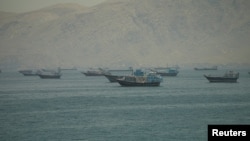
Iranian state television has reported that a draft framework agreement with the United States includes commitments to lift the US naval blockade on Iran, restore commercial traffic through the Strait of Hormuz, and reduce the American military presence in the Persian Gulf region.
According to the report on May 27, which cited a draft memorandum of understanding that was “still not finalized,” Washington had allegedly committed to lifting the naval blockade of Iran and to “cease harassing ships passing to or from the Islamic republic of Iran.”
In return, Iran would allow the resumption of commercial shipping through the Strait of Hormuz within one month, while continuing to manage shipping lanes, inspect vessels, and impose service fees introduced during the war that erupted on February 28.
The draft also said Washington had given “a commitment to the Islamic republic of Iran” regarding the withdrawal of US troops from the region, although it remained unclear whether this applied only to forces deployed during the conflict or also to longstanding US bases in the Persian Gulf.
The report said the two sides would enter a 60-day negotiation period after agreeing on the framework.
There has not yet been any comment from US authorities.
With reporting by AFP
Iran's IRGC Says Vessels From 'Hostile Countries' Still Cannot Pass Through Hormuz
The navy of Iran's Islamic Revolutionary Guards Corps says the vessels from "hostile countries" are still blocked from passing through the Strait of Hormuz.
The IRGC said in a statement released on May 27 by state television that 23 vessels have been allowed to pass through the strait "so far," with the passage of other vessels seen continuing "in the coming hours."
It gave no details on any vessels moving through the key waterway but added that "cooperation will be provided with countries that respect 'Iranian order.'"
Tasnim: Iran Demands Immediate Access To $12 Billion In Frozen Assets
Tasnim news agency, an outlet affiliated with Iran’s Islamic Revolutionary Guards Corps, reported that a proposed 14-article memorandum of understanding between Iran and the United States would include the release of approximately $24 billion in frozen Iranian assets.
According to the Tasnim report, which cited "an informed source close to the negotiating team," Iran insists that half of this $24 billion amount must be made available at the start of negotiations and the rest transferred within 60 days.
The report also claims that the recent trip to Qatar of Foreign Minister Abbas Araqchi and parliament speaker Mohammad Baqer Qalibaf was to reach an understanding about implementing this demand -- and how exactly to access the first $12 billion.
A few days earlier, Ahmad Bakhshish Ardestani, a member of the the Iranian parliament’s National Security and Foreign Policy Commission, claimed that Iran had planned to import $12 billion of its frozen assets through Russia, but the United States blocked the transfer.
Explosion On Tanker Off Oman Coast, British Maritime Monitor Says
A tanker captain has reported an explosion on his ship in waters of the coast of Oman, according to United Kingdom Maritime Trade Operations (UKMTO).
The report cited an “external explosion” that was “close to the waterline.” It said the crew and vessel were safe though some “bunker fuel has discharged into the sea.”
The cause of the blast was under investigation.
The incident occurred amid a shaky cease-fire in the region, a day after the US military command said it had carried out strikes on Iranian missile sites and boats.
A statement by US CENTCOM on May 25 said the action was taken in “self-defense” while Iran’s Foreign Ministry said on May 26 that Washington was guilty of a “flagrant violation” of the cease-fire.
Shipping in the region, particularly through the Strait of Hormuz, has largely ground to a halt since the US and Israeli strikes on Iran on February 28.
Iranian forces have attacked civilian vessels and laid mines in the sea, while the US Navy is maintaining a blockade of Iranian ports.
Iran Accuses US Of 'Flagrant Violation' Of Cease-Fire
Iran's Foreign Ministry has accused the United States of a "flagrant violation" of the April 8 cease-fire over the past 48 hours.
The ministry referred to “aggressive actions” in Hormozgan Province, though it made no explicit reference to US strikes in southern Iran.
It also cited what it described as "illegal actions" since the cease-fire was announced, including "maritime piracy against Iranian commercial vessels."
It "strongly condemned" US conduct, accused Washington of "ill-will and bad faith," and said the United States bore responsibility for "all consequences" of its actions.
Iran's Islamic Revolutionary Guards Corps (IRGC) separately warned that it would "respond decisively to any violation of the cease-fire."
US Central Command earlier said it carried out strikes in southern Iran on May 25 against "missile launch sites and Iranian boats attempting to emplace mines," describing the action as "self-defense" and saying the cease-fire remained in effect.
With reporting by RFE/RL's Radio Farda
Iran's Internet Reopening Push Hit By Court Order
Iran’s Administrative Justice Court has suspended implementation of a decree establishing a new state body intended to oversee cyberspace policy, complicating government plans to restore full Internet access after months of nationwide restrictions.
The court announced on May 26 that, following legal complaints, it had ordered a halt to the creation of the “Special Headquarters for the Organization and Management of the Country’s Cyberspace.”
It said that “until the final review of the complaints,” the body’s decisions and resolutions “shall not be enforceable.”
The ruling came shortly after officials in President Masud Pezeshkian’s government said reconnection to the global Internet would begin within hours and that full public access could be restored within 24 hours.
Government spokeswoman Fatemeh Mohajerani said the new cyberspace headquarters had concluded that “the reopening of the Internet should take place.”

Iran has experienced a near-total internet blackout since February 28, when authorities shut down access following the outbreak of the US-Israeli war against Iran.
Some officials have criticized the restrictions, citing their severe economic and social impact.
With reporting by RFE/RL's Radio Farda
Judiciary Announces Execution Of Another Man Accused Of Spying For Israel
Iran’s judiciary has announced that another citizen has been executed on charges of spying for Israel.
The judiciary’s news agency identified the executed individual as Gholamreza Khani Shekarab and claimed he had been “the head of an Israeli espionage network.”
The judiciary report on May 26 did not mention the date of the defendant’s arrest or trial.
At the same time, it described him as “a thug and hooligan from one of the country’s provinces with a history of violence and criminal activity,” and alleged that he had been “seeking to recruit individuals and use them inside the country to carry out anti-security operations.”
No details have been published regarding the legal proceedings in the case, and the report did not provide evidence or documentation supporting the accusations.
In recent months, Iran’s judiciary has carried out executions on an almost daily basis against protesters or individuals accused of cooperating with the United States and Israel.
Human rights organizations say the Islamic republic uses executions to create an atmosphere of fear and as a tool of repression.
With reporting by RFE/RL's Radio Farda
Drinking Water Shortages Possible In Several Iranian Provinces, Authorities Warn
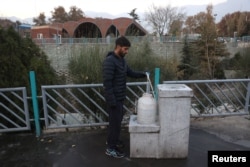
An official from Iran’s Meteorological Organization says water stress in some areas has become so severe that problems could arise in supplying drinking water unless water conservation measures are observed.
Ahad Vazifeh, head of the National Center for Climate and Crisis Management at the Meteorological Organization, pointed to prolonged water stress in major cities such as Tehran, Karaj, Mashhad, and Isfahan, emphasizing the need to reduce water consumption in those areas.
He said residents of Mashhad, Tehran, Saveh, Arak, and Karaj must exercise maximum water conservation, “otherwise it is predicted that these cities will face shortages of drinking water.”
The warning comes even though Vazifeh said rainfall during March and April this year was relatively high, with precipitation during the two-month period “about four percent above normal.”
However, Vazifeh said drought conditions continue in several provinces.
He said Tehran, Qom, Qazvin, Semnan, Markazi, and Gilan provinces are facing significant rainfall deficits, adding that conditions in Tehran are particularly severe.
Although Tehran has received 155 millimeters of rainfall during the current water year, precipitation remains 38 percent below normal, he said.
Tehran also ended the previous water year with nearly 50 percent below-normal rainfall and remains the country’s driest province this year.
Vazifeh added that, despite good rainfall during the first two months of the current year, precipitation levels remain below normal in many provinces.
With reporting by RFE/RL's Radio Farda
Iran Claims It Downed A US Drone
Iran’s Islamic Revolutionary Guards Corps (IRGC) says it has “shot down” a US drone and “opened fire” on several other American drones that had entered Iranian airspace.
In a statement published on May 26, the IRGC said that after US military aircraft "entered Iranian airspace in the Persian Gulf region," its air defense units “identified and shot down an MQ-9 drone.”
The IRGC added that its forces “also fired upon an RQ-4 drone and an intruding F-35 fighter jet.”
The statement did not specify when the incidents took place.
The Iranian claim came after US Central Command announced that the American military had carried out "self-defense" strikes in southern Iran on May 25 against targets that included "missile launch sites and Iranian boats attempting to emplace mines."
Iranian media reported early on May 26 that “American fighter jets targeted several Iranian vessels south of Larak Island,” adding that at least three people were killed in the attack.