



We are now closing the live blog for the day. We'll be back at 7:30 a.m. Central European time to cover the latest events across the Middle East.
The Iran Deal Couldn’t Restore Old Maritime Order, Analyst Raydan Says
WASHINGTON -- As Washington and Tehran trade accusations over the collapse of their latest cease-fire, the real battle may be unfolding far from the headlines -- in the shipping lanes of the Strait of Hormuz.
For Noam Raydan, the William Sudhaus Senior Fellow at The Washington Institute for Near East Policy, the unraveling of the 60-day memorandum of understanding (MoU) was always likely to expose unresolved disputes over who controls one of the world's most strategic waterways.
Speaking to RFE/RL, Raydan explains why Iran's campaign at sea goes far beyond isolated ship attacks, what recent tanker strikes reveal about Tehran's strategy, and why the coming days of ship-tracking data could determine whether a new maritime order is taking hold.
RFE/RL: Looking back, was the MoU fatally flawed from the beginning, or did the speed of its unraveling surprise you?
Noam Raydan: There were several paragraphs in it that made it clear, at least to me, that they were going to cause some problems, specifically on the maritime scene in the Strait of Hormuz.
With respect to the future management of the Strait of Hormuz, the memorandum of understanding was very unclear. This has been one of the points Iran has been insisting on: Tehran wants to play a central role in drafting the future management of the Strait of Hormuz.
At the same time, there has been pushback against Iran. Regional countries have their own reservations, as does the international shipping community, because we've seen Iran, from time to time, talk about transit fees or even maritime service fees.
So, going back to the memorandum of understanding, for me, as a person who focuses on energy and shipping, the paragraph dealing with the future maritime management of the Strait of Hormuz was not clear. I believe we will continue facing uncertainty with respect to how the Strait of Hormuz will be managed.
As I've been saying since March, there is a new navigational order in the region. There is no easy way to go back to the old maritime order. We should expect Iran to put up a lot of barriers to ensure there are no alternative systems in the Strait of Hormuz.
By that I mean Iran wants ships to use the Iran-controlled lanes instead of the alternative system -- the routes guided by US forces in the region.
To read the full interview, click here.
Trump Warns Tehran 'It Will Get Worse' If Iran Launches Further Strikes In Gulf Region
US President Donald Trump has warned Iran that it will face further strikes if it launches any further attacks on vessels in the Strait of Hormuz.
"This is in retribution for yesterday’s bombing of ships by Iran. If it happens again, it will get much worse!" Trump said in a social media post as the US military said it was striking targets around southern Iran.
It is the second night in a row that the United States has launched military strikes against Iran and comes a day after it revoked a key sanctions waiver covering Iranian oil sales after accusing Tehran of attacking commercial shipping in the Strait of Hormuz.
The moves mark the most serious crisis since the United States and Iran signed a 60-day memorandum of understanding (MOU) last month aimed at ending hostilities and reopening one of the world's most important maritime chokepoints.
US Strikes Targets In Iran Hours After Trump Vows To Hit 'Hard'
The US military said it had launched new strikes on targets in Iran just hours after President Donald Trump said a cease-fire accord with Tehran was "over" and threatened to "hit them [Iran] hard tonight."
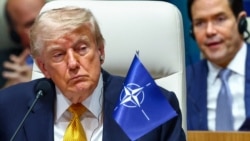
Speaking at the NATO summit in Ankara, Turkey, on July 8, he also said that the Iranian leadership were “scum,” “liars,” and “loco” after sirens wailed in Bahrain and Kuwait, where authorities said they were dealing with hostile strikes.
"At the direction of the Commander in Chief, U.S. Central Command forces have started conducting additional strikes against Iran to further degrade their ability to threaten freedom of navigation in the Strait of Hormuz," the US military said in a social media post.
"The United States is holding Iran accountable for recent unjustified aggression against commercial shipping and civilian crews freely navigating a vital international waterway."
To read the full story, click here.
Trump Says US Might Take Kharg Island
The US president said the US military attacked Kharg Island on July 7 and could take over the key oil hub.
Kharg Island is the main loading and export point for Iranian oil, and its military facilities were targeted by the US in March.
"We attacked Kharg Island last night.... I said don't touch the oil," Trump said, a reference to the energy infrastructure on the island.
"We might take over Kharg Island. There's not a thing they can do about it," Trump added.
On July 7, the US military attacked targets in the south of the country in response to attacks attributed to Iran on shipping in the Strait of Hormuz.
Khamenei Website Shows Ruins Where Supreme Leader Died In Air Strike
The official website of Ali Khamenei has published images of the compound where the former supreme leader was killed in a US-Israeli strike on February 28.
These images show the ruins of the Imam Khomeini Husseiniyeh, a major official and religious venue in Tehran, where Khamenei, family members, and a number of senior military commanders were killed in the attack.
The Imam Khomeini Husseiniyeh was built in 1989 and is part of the Office Of The Supreme Leader (The Beyt). It serves as a key official venue for the Iranian leadership, hosting government ceremonies and meetings with the supreme leader.
Satellite photos have also shown the extent of the damage.
European Aviation Agency Advises Airlines To Avoid Iranian Airspace
The European Union Aviation Safety Agency (EASA) said on July 8 that airlines should avoid the airspaces of Iran, Iraq, and Lebanon until August 31 amid ongoing tensions in the Middle East and the potential for more military action.
The move came after the United States launched a new round of military strikes against Iran after accusing Tehran of attacking commercial shipping in the Strait of Hormuz, one of the world’s most important maritime chokepoints.
Tehran retaliated by hitting Kuwait and Bahrain, US allies in the region and home to American military bases.
In response, US President Donald Trump said the framework deal with Iran that includes a 60-day cease-fire was “over,” although he added that he was leaving it up to US negotiators as to whether to continue peace talks.
EASA said its advisory decision was based on "ongoing high level of tensions and the potential for further military action."
The agency added that should the current cease-fire break down, Iranian airspace was likely to be exposed to “imminent threats.”
6,000 Seafarers ‘Remain Stranded’ In Persian Gulf
Nearly 6,000 seafarers “remain stranded” in the Persian Gulf, the head of the International Maritime Organization said on July 8.
“I condemn the attacks over the past two days against several ships transiting the Strait of Hormuz,” IMO chief Arsenio Dominguez said in a statement as he called for "maximum restraint and de-escalation.”
"These reckless attacks have again placed innocent seafarers in grave danger," Dominguez added.
His statement came after US President Donald Trump said the interim deal with Iran was “over,” although he added that he was leaving it up to US negotiators as to whether to continue peace talks.
The United States launched a new round of military strikes against Iran and revoked a key sanctions waiver covering Iranian oil sales after accusing Tehran of attacking commercial shipping in the Strait of Hormuz, one of the world’s most important maritime chokepoints.
Oil Prices Rise 5 Percent After Trump Says Deal 'Is Over'
Moments after US President Donald Trump said the deal with Iran had ended, oil prices on global markets rose by more than 5 percent.
Brent Crude rose 5.3 percent to $78 a barrel, while West Texas Intermediate crude rose 5.4 percent to more than $74 a barrel.
The United States struck more than 80 targets in Iran after Tehran targeted shipping in the Strait of Hormuz on July 5 and July 6.
Khamenei's Dayslong Funeral Ceremonies Move Through Holy City Of Qom
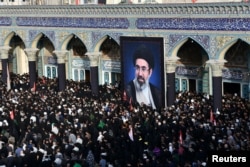
Thousands of mourners gathered in the Iranian holy city of Qom on July 7 as funeral ceremonies for the late Supreme Leader Ayatollah Ali Khamenei entered a fourth day.
Khamenei's remains are being carried through a series of funeral ceremonies and processions at Shi'ite holy sites ahead of his burial in his hometown of Mashhad on July 9.
State television broadcast aerial footage showing large crowds in Qom, where a prayer service was led by 93-year-old cleric Abdollah Javadi-Amoli while mourners chanted "death to America," a slogan frequently heard at official events in Iran.
Authorities have sought to portray the ceremonies as a demonstration of national unity and resilience following the US-Israeli war and months after anti-government protests, which posed one of the most serious challenges to the Islamic republic in years before being brutally suppressed.

So far, there has been no sign of Mojtaba Khamenei, who succeeded his father as supreme leader in March but has not appeared publicly since reportedly being wounded in the same air strike that killed his father at the start of the war in late February. It remains unclear whether he will attend the funeral ceremonies.
A further funeral procession is planned in Iraq before the ceremonies conclude with Khamenei's burial on July 9.