




White House Says US Delegation Will Head To Pakistan For Iran Peace Talks
WASHINGTON -- White House Press Secretary Karoline Leavitt said the United States would send a delegation to Pakistan this weekend, as Iranian Foreign Minister Abbas Araqchi is also expected to arrive in Islamabad.
Leavitt told journalists that President Donald Trump's special envoy Steve Witkoff and son-in-law Jared Kushner would be traveling for a fresh round of negotiations with Tehran on April 25, saying Washington had seen "some progress" from the Iranian side in recent days.
Araqchi was expected to arrive in Islamabad on April 24 for talks that would reports said would include consultations on proposals for reviving peace negotiations with the United States.
US and Iranian teams held peace talks in the Pakistani capital on April 11-12, but they ended without an agreement and a second round that had been expected earlier this week did not materialize.
US Vice President JD Vance, who led the US team on April 11-12, would not lead the US delegation this time around, Leavitt said. She added Vance would stay on "standby" in the United States and "will be willing to dispatch to Pakistan if we feel it's a necessary use of his time."
"The president, the vice president, the secretary of state, will be waiting here in the United States for updates."
According to an earlier report by CNN, which cited unnamed US officials, Vance would be ready to travel to Islamabad if negotiations produce progress.
In a post on X, Araqchi said he would visit Pakistan, Oman, and Russia to coordinate with regional partners on bilateral issues and to discuss recent developments. He added that relations with neighboring countries remain a priority for Tehran.
The US-Israeli war with Iran began on February 28. A cease-fire has been in place since April 8, and Trump announced an extension shortly before it was due to expire on April 22.
Iran Rights Group Says 3 Teenage Protesters Could Face Execution
The Committee to Follow Up on the Status of Detainees, an advocacy group that monitors arrests in Iran, says the Supreme Court has upheld the death sentences of three young protesters: Ehsan Hosseinipour Hesarloo, Matin Mohammadi, and Erfan Amiri. According to the group, the sentences have been confirmed, raising fears they could face imminent execution.
The three were reportedly 17 and 18 years old at the time of their arrests during the nationwide protests in January. They were arrested in connection with a fire at the Seyyed al-Shohada Mosque in Pakdasht, southeast of Tehran.
According to reports, prosecutors accused them of acting against national security, gathering and colluding against national security, participating in the killing of two people, intentionally setting fire to the mosque, and destroying public property.
Iran's judiciary-affiliated Mizan News Agency previously said the three were the "main instigators" of the attack on the mosque on January 8, and alleged that two people died after becoming trapped inside the building.
The detainee-monitoring committee said Hesarloo was arrested on January 8 and later told them he had been subjected to severe pressure and torture in detention.
The group also cited informed sources claiming that confessions used in the case were obtained under threats and coercion, and that the defendants were denied a meaningful chance to defend themselves.
These allegations have not been independently verified.
Merz: EU Could Ease Sanctions Against Iran If Agreement Reached With US
German Chancellor Friedrich Merz said that the European Union is willing to gradually ease sanctions on Iran if a comprehensive agreement is reached.
"Reducing sanctions could be part of a process," Merz said after the EU summit in Nicosia.
"And no one has objected to this," he added.
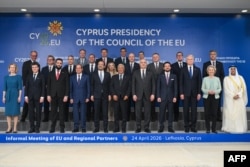
Merz described this as "part of the assistance" that Europe could provide to advance the process and hopefully help secure a lasting ceasefire.
This position was met with caution from other European Union leaders.
Antonio Costa, president of the European Council, said at a joint press conference after the meeting that it was still too early to discuss lifting any sanctions on Iran.
Ursula von der Leyen, president of the European Commission, made similar remarks.
Merz made the comments as the European Union is reportedly developing contingency plans to deal with an imminent jet fuel shortage and to maximize refinery production because of rising energy prices linked to the Iran war.
Europe is more dependent on jet fuel imports than any other transport fuel, with around 75 percent coming from the Middle East.
Jet fuel prices have risen sharply since the closure of the Strait of Hormuz, which followed the US-Israeli war with Iran that started on February 28. European airlines have warned that if the conflict continues, ticket prices could rise, flights may be canceled, and aircraft could be grounded.
Beijing Rejects Claim Seized Ship Contained 'Gift From China'
China has refuted a claim by US President Donald Trump that the Iranian ship seized by the United States in the Strait of Hormuz on April 19 was carrying a "gift from China."
Chinese Foreign Ministry spokesman Guo Jiakun said Beijing refutes "any accusations and implications that lack a factual basis."
"Normal international trade between countries should not be disrupted or undermined,” he added, speaking at a press conference on April 24.
Beijing denies any direct military involvement in the war in Iran.
Trump had made the comment during an interview with American new channel CNBC on April 21 as he hinted that Beijing had attempted to supply Tehran with lethal aid.
The Touska, the Iranian ship that had been travelling through the Strait of Hormuz from China, was seized by the US Navy on April 19. The US Central Command claimed the ship was seized after it refused to follow orders to abort its passage through the strait.
Maritime security sources told Reuters on April 21 that the Iranian-flagged container ship was likely carrying items that the US would consider "dual-use," meaning the items onboard have civilian and possible military applications.
The statement from the Foreign Ministry comes as Beijing placed seven EU-based companies on an export control list on April 24. The new restrictions prohibit operators from exporting dual-use items to these entities from China on "national security" grounds.
Kuwait Says Drones From Iraq Hit Northern Border Posts
Kuwait’s military said on April 24 that two explosive-laden drones arriving from the direction of Iraq struck two northern border posts, causing "material damage" but no casualties.
In a statement on X, the military described the incident as a “criminal act of aggression” and said the drones were guided by fiber-optic cables.
Since the US-Israeli war with Iran began on February 28, pro-Iranian armed groups have claimed repeated attacks on "enemy" targets in Iraq and elsewhere, though they later said operations were suspended after a cease-fire.
Persian Gulf states have nevertheless protested continued cross-border attacks.
With reporting by AFP
Mojtaba Khamenei Awaiting Prosthetic Leg And Plastic Surgery, Says NYT Report
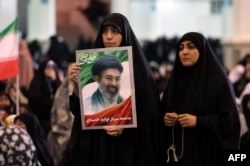
Iranian Supreme Leader Mojtaba Khamenei is facing serious medical complications after surviving an attack, leaving him awaiting a prosthetic leg and plastic surgery on his face, The New York Times reported on April 23.
Citing four officials familiar with the matter, the newspaper said he remains mentally able to make decisions but has undergone hand surgery and suffered severe facial burns.
The report said Khamenei has had limited contact with Iranian generals during negotiations to end the war, reinforcing earlier US comments that he was “wounded” and likely “disfigured.”
Analysts told the Times that Khamenei -- who succeeded his father, Ali Khamenei, after the ayatollah died in the same air strike that injured his son on February 28 -- is formally leader but not yet fully in control.
“Mojtaba is not yet in full command or control,” said Sanam Vakil, the director of the Middle East and North Africa program at Chatham House.
The Times report said day-to-day authority has shifted toward senior officials and the Revolutionary Guards while Khamenei avoids public appearances.
Is The US Naval Blockade On Iran Working? Yes And No.
- By Frud Bezhan
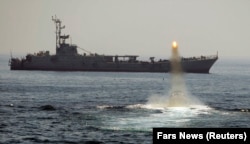
To pressure Iran into a peace deal, the United States has imposed a naval blockade on the Middle Eastern country’s ports and vessels since April 13.
While it has intensified pressure on Iran’s already battered economy, the US blockade has yet to force Tehran into making concessions to end the nearly two-month-long war, experts say.
Iran has refused to come to the negotiating table unless the United States lifts the barricade, which targets Tehran’s lucrative oil revenue. Washington has insisted that the blockade will only end when a peace deal is signed.
The US embargo came in response to Iran’s effective closure of the Strait of Hormuz, a key artery for global energy supplies, to international shipping since the war began on February 28. The move has rattled international markets, upended the global economy, and handed Tehran new leverage in the war.
“If the primary goal of the blockade is to stop vessel traffic to and from Iran, and most importantly the flow of Iranian crude exports, then the blockade has been a success,” said Nader Itayim, a Middle East energy expert.
“But if Washington expects the blockade to swiftly put Iran in a position where it will have no choice but to deal, then it might be disappointed,” added Itayim, who works at the UK-based Argus Media, which provides market intelligence to global energy and commodity markets.
Read more here
Report: US Eyes Strait Of Hormuz Targets If Iran Cease-Fire Fails
US military officials are developing new contingency plans to target Iran’s capabilities around the Strait of Hormuz if the current cease-fire collapses, sources familiar with the matter have told CNN.
Options include strikes focused on the “dynamic targeting” of small fast attack boats, minelaying vessels, and other asymmetric assets that have helped Tehran disrupt shipping through the strait, the southern Gulf, and Gulf of Oman, CNN reported on April 23.
Sources said any renewed campaign could also hit missiles, launchers and production facilities that survived earlier US-Israeli strikes, as well as dual-use infrastructure or senior Iranian figures accused of obstructing talks.
A US Defense Department official said the military continues to provide President Donald Trump with options and that “all options remain on the table.”
Trump has pressed for the reopening of the strait while signaling a preference for diplomacy.
Kallas Says Iran Nuclear Talks Without Experts Risk Weaker Deal
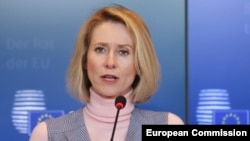
EU foreign policy chief Kaja Kallas said talks with Iran should include nuclear experts, warning that otherwise they would “end up with an agreement that is weaker than the JCPOA was,” referring to the 2015 nuclear pact that the United States left in 2018 during Donald Trump’s first term as president.
Speaking ahead of an informal EU leaders’ summit in Cyprus on April 24, she said negotiations should also address Iran’s missile program, regional activities, and cyber and hybrid operations in Europe, or risk producing “a more dangerous Iran.”
Kallas's remarks came after an inconclusive first round of US.-Iran talks in Islamabad on April 11-12. At mediator Pakistan’s request, Donald Trump later extended a two-week cease-fire between the warring parties that was due to expire on April 22, but the US naval blockade of Iran and Tehran’s closure of the Strait of Hormuz remain major obstacles to a second round of talks, whose timing is still uncertain.
With reporting by Reuters
US Offers $10 Million Reward For Leader Of Iran-Backed Iraqi Group
The US State Department has offered up to $10 million for information leading to Hashim Finyan Rahim al-Saraji, leader of the Tehran-backed Iraqi armed group Kataeb Sayyid al-Shuhada, which Washington designates as a terrorist organization.
US officials have accused the group of killing Iraqi civilians and attacking American diplomatic facilities, bases, and personnel in Iraq and Syria.
Al-Saraji also holds a seat in Iraq’s ruling Shi'ite Coordination Framework alliance.
Earlier this month, Washington announced a similar reward for the head of Kataeb Hezbollah, accused of kidnapping US journalist Shelly Kittleson for a week last month.