




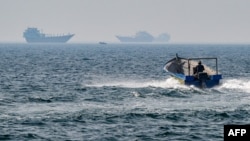
Iran said it has opened the Strait of Hormuz to commercial shipping traffic for the remainder of a 10-day cease-fire between Israel and Lebanon, and US President Donald Trump again said Washington and Tehran could reach a deal to end the war with Iran in the near future.
"We're very close. Looks like it's going to be very good for everybody. And we're very close to having a deal," Trump told the news agency AFP by telephone on April 17. The media outlet Axios quoted Trump as saying, "I think we'll get a deal in the next day or two."
The Strait of Hormuz, which leads to the Persian Gulf and was the conduit for 20 percent of global oil and liquefied natural gas shipments before the war began on February 28, will be "completely open" for the duration of the Israel-Lebanon truce, Iranian Foreign Minister Abbas Araqchi said in a social media post.
The strait had been effectively closed to traffic amid Tehran's strikes at targets around the Middle East, sending oil prices skyrocketing and shaking the global economy. Oil prices dropped sharply and stock prices rose on world markets following the announcement.
The US-brokered 10-day cease-fire Israel-Lebanon took effect on April 16 and can be extended by mutual agreement. Iran has repeatedly said that an end to Israeli attacks on Lebanon, where Israel has been targeting Iran-backed Hezbollah sites since March 2, was a requirement for its own peace negotiations with the United States.

A militant group and political party that controls much of southern Lebanon, Hezbollah is considered a terrorist organization by the United States, while the European Union has blacklisted its only armed wing. A two-week cease-fire agreed by Iran and the United States on April 7 does not include Lebanon.
Shortly after Araqchi's post about the strait, Trump posted a message of gratitude on his Truth Social platform.
"IRAN HAS JUST ANNOUNCED THAT THE STRAIT OF IRAN IS FULLY OPEN AND READY FOR FULL PASSAGE," he wrote in a reference to Hormuz. "THANK YOU!"
"Iran has agreed to never close the Strait of Hormuz again. It will no longer be used as a weapon against the World!" Trump wrote in a subsequent post.
In yet another Truth Social message, Trump said a US blockade on Iranian ports would "remain in full force...until such time as our transaction with Iran is 100% complete." The United States imposed the blockade, aimed at preventing ships from entering or leaving Iranian ports, on April 13.
Iran, however, didn't sound happy about that. Foreign Ministry spokesman Esmail Baqaei said Tehran would take "necessary reciprocal measures" if the blockade continued.
Trump said he expects a resolution of the conflict with Iran will come "very quickly," asserting that "most of the points are already negotiated."
It was part of a string of upbeat comments from Trump on the prospects for a deal to end the war, which is halted by the cease-fire that expires on April 22.
"I think the deal will go very quickly. We're getting along very well with Iran," the Reuters news agency quoted Trump as saying in a phone interview on April 17. He said more talks will be needed to reach a deal and that these would take place "probably over the weekend."
"The Iranians want to meet. They want to make a deal. I think a meeting will probably take place over the weekend. I think we will get a deal in the next day or two," Axios quoted Trump as saying by phone.
In a post on X, the Axios reporter who spoke to Trump cited unnamed senior US officials and "sources knowledgeable on the matter" as saying the United States and Iran have made progress in negotiations on a three-page memorandum of understanding to end the war.
In the brief call with AFP, Trump asserted there were "no sticking points at all" left with Tehran.
Speaking on condition of anonymity, however, a senior Iranian official told Reuters that serious negotiations were required to overcome differences.
Iran hopes a preliminary agreement can be reached in the coming days with Pakistan continuing to mediate and with the possibility of extending the cease-fire to "create space for more talks on lifting sanctions on Iran and securing compensation for war damages," Reuters quoted the official as saying.
A day earlier, Trump said he believed the United States was "very close to making a deal with Iran."
Trump has given few details about a prospective deal with Iran, and Tehran has said even less, but on April 17 the US president repeated his suggestion that Tehran has agreed to give up its stocks of enriched uranium -- which, enriched to a certain level, can be used in nuclear weapons.

"The U.S.A. will get all Nuclear 'Dust'.... No money will exchange hands in any way, shape, or form," Trump said in another post. US news outlet Axios has reported that Washington was considering a $20 billion cash-for-uranium deal.
Reuters cited Trump as saying Washington would work with Iran to recover the enriched uranium and would then bring it to the United States. "We're going to get it together. We're going to go in with Iran, at a nice leisurely pace, and go down and start excavating with big machinery.... We'll bring it back to the United States," he said.
He referred to "nuclear dust" and said it would be retrieved "very soon," Reuters reported, adding: "Trump's mention of 'nuclear dust' is a reference to what he believes remains after the United States and Israel bombed Iran's nuclear installations" in June 2025.
But the news agency quoted the senior Iranian official as saying that "no agreement has been reached on the details of the nuclear issues."
Separately, Trump took an unusually tough tone with Israel, saying that the longtime US ally "will not be bombing Lebanon any longer. They are PROHIBITED from doing so by the U.S.A. Enough is enough!!!"
In a message issued after Iran's announcement that the Strait of Hormuz was open but before Trump's post, Israeli Prime Minister Benjamin Netanyahu said he had agreed to the "temporary cease-fire in Lebanon" at Trump's request but that Israeli forces remained stationed in southern Lebanon to defend against "the near threat."
"There are things we plan to do regarding the remaining rocket threat and the drone threat, which I will not detail here," Netanyahu said. He said Israel still aims to dismantle Hezbollah and that this "requires sustained effort, patience, and endurance, and it requires wise navigation of the diplomatic field."

