




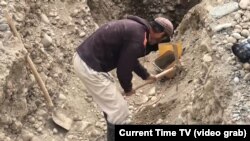
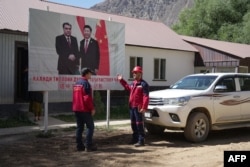
After years of deepening engagement through mining operations, road construction, and industrial projects, Chinese companies operating in Tajikistan now face challenges from the communities that host their investments.
One of the latest such developments took place in November at the Zarafshon gold mine, a major gold operation run by a joint venture between China's Zijin Mining and the Tajik state, near the northwestern city of Panjakent, one of the country's largest Chinese-run mining ventures.
Frustrated by stagnant wages and an alleged salary disparity with their Chinese peers, a group of Tajik workers petitioned the Chinese management for a pay raise, saying "the current salary of employees does not correspond" to rising consumer prices. For miners laboring in one of the country's most demanding sectors, the letter was a rare act of collective protest.
Two workers at the company told RFE/RL on condition of anonymity to avoid reprisals from management that the miners' monthly salaries ranged from 2,000 sominis to 4,000 somonis -- around $215 to $430. Their demands to increase wages and bridge any pay gap between local Tajik and Chinese employees were rejected by the Zarafshon mining company.
"The work is physically demanding and risky," one miner said. "We expect salaries to reflect that."
The dispute underscores deepening disagreements at Zarafshon, a joint venture that has become symbolic of both opportunity and alleged inequality brought by the flagship Chinese investment that started operating in 2007.
The Zarafshon gold mining complex, which accounts for 70 percent of the gold mined in Tajikistan, is particularly important for the Tajik government and was praised by Tajik President Emomali Rahmon when he visited in July 2023.
Other Tajik employees who spoke to RFE/RL complain about the lack of transparency in management practices and claim there are wide pay disparities between Tajik and Chinese employees.
In a written reply sent in response to the workers' petition that was reviewed by RFE/RL, the company's director said they declined to raise the base pay for workers but announced a modest bonus system that is set to start in 2026.
That structure would give workers an extra 200 somoni ($21) for birthdays, 300 ($32) for the New Year holiday, and 500 ($53) for Norouz, the Persian New Year observed on the spring equinox and celebrated across Central Asia.
Workers who spoke to RFE/RL say the offer will do little satisfy their frustrations and that tensions are rising at the mining venture between local Tajik staff and Chinese employees.
"Bonuses are nice," one miner said, "but they are not enough to change our lives month-to-month."
Tajikistan's Ministry of Labor, Migration, and Employment told RFE/RL in a letter that it imposed fines in 2024 following a visit of Zarafshon's operation "on the head of the HR department and the deputy head of labor protection and safety," but said that their review did not find any "wage differences between local and foreign workers."
In a statement provided to RFE/RL by Zarafshon after publication, the mining venture said it "operates in full compliance with Tajikistan's labor legislation" and that it "remains committed to responsible employment practices, compliance with applicable laws, and the long-term social and economic development of the communities in which it operates."
The firm says that it employs 3,000 people in the country, 97 percent of whom are Tajik citizens, and that the majority of management positions are held by locally-hired staff.
The statement added that the company pays a competitive salary at 3.2 times the national average wage and that according to its aggregated payroll data, the wages of Tajik employees have risen 16 percent year-on-year between 2024 to 2025, reaching approximately 7,927 somoni ($850) per month on average across the company.
Frustration Inside a Flagship Chinese Project
China is Tajikistan's largest foreign investor, with more than $5.1 billion in capital invested since 2007 and over 700 Chinese-backed enterprises operating across the country. In 2024, Tajik lawmakers ratified a bilateral investment protection agreement with China that offered stronger legal guarantees and protections for Chinese investors.
But Chinese-supported projects have faced challenges.
A 2024 investigation by RFE/RL revealed environmental damage in several Chinese-run mining and agricultural zones, including Zarafshon, where residents have cited health problems ranging from premature births to respiratory illness, accusations that were immediately denied by Tajik officials.

The controversies exposed growing mistrust between local communities and the institutions responsible for overseeing foreign projects amid evidence that Chinese firms are harvesting the Central Asian country's mineral wealth while receiving impunity and preferential treatment from the Tajik government.
At the Zarafshon mine, tensions are rising between Tajik workers and the Chinese nationals who occupy mostly technical and administrative posts and whose wages are undisclosed.
A Tajik worker at the Zarafshon mining company told RFE/RL on condition of anonymity that after complaints challenging alleged low wages and the disparity between Tajik and Chinese salaries, the company split the accounting department into two, one taking care of Chinese workers and another one involved in calculating the salaries of Tajik workers.
He says a former employees in the company's financial department informed him about a substantial wage disparity between Tajik and Chinese employees.
"For example, if a Tajik engineer earns 5,000 to 7,000 somonis, a Chinese engineer earns up to 30,000–40,000 somonis," he said. "Chinese staff work eight hours each day, while some Tajik workers have to labor up to 11 hours a day in order to earn more, even though an eight-hour workday is the standard."
RFE/RL has not been able to independently verify the alleged wage disparity, and the Zarafshon mining company did not reply to requests for comment.
The accusations and lack of transparency add to a widespread public perception in Tajikistan that Chinese workers receive preferential treatment -- tensions that have boiled up at times requiring Tajik authorities to respond.
In 2025, under pressure from the Panjakent city prosecutor's office, Zarafshon converted more than 1,000 Tajik contract workers to permanent status.
On January 13, Panjakent's prosecutor, in an official response to RFE/RL, acknowledged "various labor rights violations" at the gold mining site, but provided no specifics.
Violence And Investment Uncertainty In Tajikistan
Labor unrest has also coincided with rising security concerns surrounding Chinese projects nationwide.
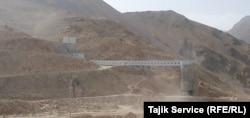
Since December 1, work on a major section of the Dushanbe–China highway has been suspended following two deadly attacks near the Afghan border.

On November 30, gunmen killed two Chinese workers and wounded two others at a construction site in the Darvoz district, prompting Beijing to urge Dushanbe to strengthen protection for its citizens.
Tajik officials blamed an "armed terrorist group" for the incident but offered no further identification. Days earlier, three Chinese nationals were killed in another attack on a gold-washing site in the Shamsiddin Shohin district. Tajik officials said both attacks came from the Afghan side.
The assaults have sent a chill among Chinese contractors along the strategic Dushanbe–Kulma route, a 109-kilometer highway that goes through remote terrain toward China's Xinjiang region. Rahmon celebrated the route's partial opening in mid-2025, but construction delays and new security precautions now cast doubt on its completion this year.

The wave of instability could jeopardize relations with Beijing and make Chinese firms less willing to operate and invest, which could also have an impact on Tajikistan's economy.
Chinese firms now dominate Tajikistan's gold sector, accounting for 84 percent of national output, according to official data.
Beyond Zarafshon, other major ventures include the Pokrud gold deposit located south of Dushanbe and the $136 million TALCO Gold mine in the northern district of Aini developed with China's Tibet Huayu Mining. The sector's expansion has helped one of the poorest countries in the Central Asian region to boost exports but also deepened its dependence on Chinese investments.
For workers at Zarafshon, meanwhile, rising costs and stagnant wages remain a big problem.
"We do the hardest work. But the rewards go elsewhere," a Tajik worker at the gold mine told RFE/RL.



