



Washington’s objectives in the war with Iran are both military and political, including neutralizing the threat Tehran poses to the United States and its allies and creating conditions for political change inside the country, according to Nathan Sales, a former U.S. ambassador-at-large and coordinator for counterterrorism who is now a distinguished fellow with the Atlantic Council’s Middle East Programs.
Sales said a key short-term measure of success would be how quickly Iran’s attacks begin to decline. In his view, a drop in missile and drone strikes would show that the US campaign is weakening Iran’s ability to continue attacking.
“I think operations to target the security services are also important because those are the elements of the regime that would try to put down any uprising, any future uprising by the Iranian people to restore democracy and freedom to their country”.
Sales also warned that the war could create security threats beyond the Middle East.
RFE/RL: How would you describe the U.S. objective at this stage of the war with Iran?
Nathan Sales: There are two objectives, one related to security and one related to the future of Iran.
On security, I think Washington's goal is to neutralize the threat that the Islamic republic poses to the United States and to our allies and partners in the region. So that's why you're seeing a focus on ballistic missiles. It's why you're seeing a focus on the Iranian regime's support for terror proxies and why you're seeing a focus on the Iranian regime's nuclear weapons program.
The immediate goals are military in nature -- ballistic missiles and terrorism and nuclear weapons...”
I think the president’s (Donald Trump) goal is to degrade and destroy those capabilities so that Americans in the region and our partners in the region are no longer threatened by violence by the Iranian regime.
I think there's also a political objective and the president has talked about the moment of liberation being at hand for the long suffering Iranian people. For 47 years they have been victims of the Islamic republic. They are the world's first victims and longest victims of the mullahs in Tehran.
I think the military activity has a goal of weakening the foundations of the Islamic republic and creating openings, creating opportunities for the people of Iran to take back their government and establish one that is democratic and that will respond to and respect their human rights.
RFE/RL: Have these objectives changed since the start of the war on February 28?
Sales: I don't think so. It's only been four days or so since combat operations began. So I think the messaging coming out of the White House has been consistent over those days. The immediate goals are military in nature -- ballistic missiles and terrorism and nuclear weapons -- whereas there are longer term goals as well, and that is to enable the Iranian people to take back their government and establish freedom and democracy.
RFE/RL: If Iran can still strike US facilities, Gulf partners, key energy infrastructure, how would the United States measure success?
Sales: Well, I think success over the short run would be measured by the pace at which the Iranian armed forces can continue to terrorize their neighbors, including US facilities and US forces in the region.
You know, we've seen a really appalling use of military force against civilian infrastructure in Bahrain, in Qatar, in the United Arab Emirates, Oman, Jordan, Israel. The list goes on.
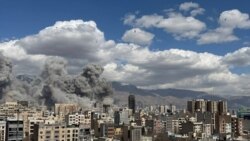

What we will want to see is the volume of those attacks beginning to taper off. That would be evidence that the air war is successful at identifying ballistic missile launchers and ballistic missile stockpiles as well as drone related facilities that can be used to launch drones.
That I think is a key short term measure of success -- how rapidly can those Iranian capabilities be degraded.
RFE/RL: If Iran's military position is weakening, what, in your view, should be next phase of the US policy?
Sales: Well, I think the initial stage of the operation was designed to eliminate the civilian and military leadership of the regime, along with the suppression of the regime's air defenses.
Once the United States and our partners achieve air superiority, and I think they're very close to doing so, once air superiority is achieved, I think you'll see a focus on eliminating ballistic missiles, drones, and other weapons that Iran is using to attack US facilities as well as civilian infrastructure in the region.
Our most important ally in this effort is the Iranian people themselves."
We're also starting to see some reports that the United States and Israel have begun to target the security services that were responsible for massacring thousands and thousands of peaceful protesters in January of this year. And that's important for a number of reasons. The president enforcing his red line, he warned the regime, do not slaughter your own people. They ignored him and went ahead and did it anyway. And so this is a measure of accountability and enforcement of that red line.
But I think operations to target the security services are also important because those are the elements of the regime that would try to put down any uprising, any future uprising by the Iranian people to restore democracy and freedom to their country. To the extent that the United States -- over the short to medium term -- is able to weaken those elements of repression, that will help the Iranian people as they take their country back and try to restore a responsive government.
RFE/RL: What is, in your view, the main risk if this war continues for longer?
Sales: Any war has risks. And it's also the case that not taking action also carries risks. I think there are a couple of risks that are immediate, and that is the risk of casualties to US forces and to partner forces. We've already seen reports that six American service members lost their lives in Kuwait. And this is tragic. And the American people honor their sacrifice and mourn their loss. Unfortunately, in combat like this, casualties happen. And I think we have to be realistic that we are likely to incur future tragedies like this and future losses like this as the war continues.
I think another risk that Washington will want to keep an eye out for is the risk that security services in Iran will cling to power and refuse to read the writing on the wall and hand over power to civilians or some kind of transitional authority.

The way you manage that risk, I think, is twofold. As I mentioned, applying military pressure to the instruments of repression is one part of this.
There's also a need to try and identify and exploit and take advantage of divisions and fissures within the security services. Try to identify. Maybe there are pragmatists or maybe there are people who are not as ideological, who are in positions of authority, who are open to working with the United States and open to working with the Iranian people to facilitate a transition to a future democratic state. That's hard work. It's very difficult to identify people who are reliable and who have authority and are credible within the Iranian system and simultaneously are willing to work with the Iranian people towards democracy.
But that is one way to manage the risk of regime holdovers clinging to power and taking the people down with them as the regime collapses.
RFE/RL: How much does allied support matter in this conflict if it becomes longer and more difficult to contain?
Sales: I think allied support is incredibly important. And I think I would start by saying our most important ally in this effort is the Iranian people themselves.
The Iranian people are the boots on the ground who will be responsible for overthrowing the Islamic republic dictatorship that has governed them for 47 years and replacing that dictatorship with a democracy that respects freedom and human rights. That's the most important ally that anyone could hope for.

Short of that, the United States, I think, would also benefit from contributions from European allies who face a threat of a nuclear Iran or an Iran that backs terrorism, or an Iran that has ballistic missiles that can reach into Europe.
And also the United States will look to our Gulf partners and allies who are, as we speak, under attack by the Iranian regime. I think it would be valuable for those countries to step up and contribute militarily to this effort, not as a favor to the United States, but simply as a matter of national self interest.
If you're under attack by your neighbor, you can't let your neighbor get away with that. You have to take action to prevent that, to protect your people.
RFE/RL: What kind of allied support matters most in practice?
Sales: It's hard for me to answer that question from the seat I'm in on the sidelines watching the game being played. I know that the Qataris reportedly shot down a couple of Iranian bombers that threatened Qatari airspace. So I think that kind of air superiority mission would be valuable. Attacks on Iranian infrastructure that is being used to target our Gulf partners, homelands, whether that's air bases or drone facilities or ballistic missile facilities or something else, intelligence services that could also be a valuable contribution to the war effort.
But I think the most important point that I can emphasize here is such assistance would not be a favor to the United States. It would be an investment by our Gulf Arab allies in their own security and in protecting their own people.
RFE/RL: Ambassador, could this conflict create security threats outside the Middle East, including in Europe or the United States?
Sales: That's a very real concern and it stems from the fact that Iran has long been the world's worst state sponsor of terrorism. Iran has funded and trained and provided weapons to a host of terrorist groups, not just in the Middle East, but really around the world. Groups like Hezbollah have carried out terrorist attacks in Europe, in South America, here in the United States as well. You know, since the late 1990s, it's estimated that as many as 130 or so Hezbollah operatives have been arrested here in the United States. We don't know how many are here on the ground today as the war in Iran is underway.
But we have to assume that some are here and we have to take action to detect and prevent any threats that they might pose. So the global risk of Iran-backed terrorism is very much a concern and should really be a focus of policymakers around the world.
RFE/RL: But what kind of threats would you be watching for most closely?
Sales: Well, there's two different kinds of threats that we should worry about. One is threats from terrorists who are somehow formally affiliated with the Islamic republic. Maybe they're working for the IRGC (Islamic Revolutionary Guards Corps) or maybe they're working for the Ministry of Intelligence and Security.
The other bucket of threats that we have to worry about are people who are independent. They don't have a formal affiliation with Hezbollah or another Iran-backed group, but they're sympathetic and they want to take matters into their own hands and commit a terrorist attack on their own. And, you know, we may have seen an example of that in Austin, Texas, several days ago with a gunman shooting a number of people on the streets of Austin, Texas.
He appears to have been wearing an Iran flag T-shirt and may well have been inspired by sympathy for the Iranian regime to commit this act of terrorism. So we have to worry about both types of threats.