



Accessibility links

Breaking News

News

Netherlands Proposes New EU Human Rights Sanctions Regime

Dutch Foreign Minister Stef Blok (file photo)

BRUSSELS -- The Netherlands is proposing a new EU sanctions regime that would target individuals accused of human rights abuses worldwide.

Government officials from all 28 EU member states will meet in The Hague on November 20 to discuss the Dutch proposal outlined in a position paper called Towards An EU Global Human Rights Sanctions Regime.

The document, seen by RFE/RL on November 19, says the proposed sanctions regime "differs significantly from the existing EU geographically limited sanctions regimes," which it says aim to "change state behavior and are therefore political in nature."

The proposed regime "could target individual human rights violators globally, unrelated to the political context and intergovernmental developments. It could also be used against individuals belonging to non-State actors (i.e. rebel groups)," the paper says.

The document says asset freezes and visa bans should be placed on individuals who "commit serious human rights violations and abuses" such as extrajudicial, arbitrary or summary executions, enforced disappearances, and torture.

"We have seen in a number of human rights violations over the last couple of years where individual countries have introduced the possibility of implementing sanctions on individuals involved," Dutch Foreign Minister Stef Blok told RFE/RL on the sidelines of an EU Foreign Affairs Council meeting in Brussels.

"But currently there is not an EU-wide sanction instrument and of course sanctions are most effective if they would be EU-wide," Blok added.
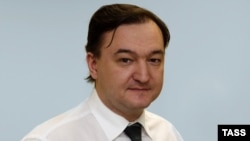
Sergei Magnitsky (1972-2009)

On November 19, Russian authorities leveled new accusations at British-based financier Bill Browder, saying the vocal Kremlin critic is now suspected of involvement in the death of his associate Sergei Magnitsky in a Moscow jail in 2009.

In a tweet, Browder dismissed the new accusations as "Kafkaesque," saying they come one day before "the Dutch government will be inviting all EU member states to The Hague to propose an EU wide Magnitsky Act."

Magnitsky was arrested after exposing a scheme in which officials allegedly defrauded the Russian state of $230 million. Since his death, Browder has campaigned for laws in nations worldwide that are designed to punish those responsible for human rights abuses -- including the 2012 U.S. Magnitsky Act.

Blok said there was no EU consensus yet on the Dutch proposal but said he was "optimistic about it."

The minister added that EU foreign ministers could discuss the proposal at their next meeting in Brussels on December 10.

More News

Russian Court OKs Early Release For Notorious Criminal Kingpin

Zakhary Kalashov*
Zakhary Kalashov*

A Russian court on March 13 approved early release for notorious criminal kingpin Zakhary Kalashov, who is widely known by the nickname Shakro Molodoi. The 70-year-old Georgian-born ethnic Yazidi Kurd was arrested in Moscow in 2016 on extortion charges following a shoot-out in which two people died. He was convicted two years later and sentenced to nearly 10 years in jail. Russian officials have called him "the boss of all bosses" among the leaders of criminal groups in the country and he once held the highest position in the criminal hierarchy in the former Soviet Union: thief-in-law. To read the original story by RFE/RL's Russian Service, click here.

CORRECTION: A previous version of this article contained a photo that was wrongly identified as Zakhary Kalashov.

'Prudence Is Not Weakness': Scholz Reiterates Refusal To Send Taurus Missiles To Ukraine

A long-range Taurus cruise missile

German Chancellor Olaf Scholz has again voiced his opposition to delivering long-range Taurus cruise missiles to Ukraine. Scholz reiterated his stance on March 13 during a debate in the Bundestag, citing his fears that providing the advanced weapons might draw Germany more directly into the conflict with Russia. "Prudence is not something that can be classified as weakness, as some do, but instead prudence is what the citizens of this country are entitled to," Scholz said. Scholz has faced sharp criticism from the conservative opposition and others for his refusal to give Ukraine the missiles, despite repeated pleas from Kyiv.

Jailed Kyrgyz Border-Deal Protesters Criticize Judge For Trial Delays

Protesters rally against the deal in Bishkek in March 2023

Eleven jailed Kyrgyz activists who are on trial along with 16 others who are under house arrest for their 2022 protest against a Kyrgyz-Uzbek border delimitation deal accused Judge Marat Sydykov on March 13 of violating their rights by repeatedly postponing hearings. The Birinchi Mai district court in Bishkek said illness among three of the defendants' lawyers was to blame for the delays. Earlier this week, hundreds rallied in Kyrgyzstan's three regions demanding the defendants' release. The activists were arrested in October 2022 after they protested the deal, which saw Kyrgyzstan hand over the territory of the Kempir-Abad water reservoir to Uzbekistan. To read the original story by RFE/RL's Kyrgyz Service, click here.

Finnish Leader Says Russia Is Preparing For 'Long Conflict With The West'

Finnish Prime Minister Petteri Orpo

Finnish Prime Minister Petteri Orpo said Russia was preparing for a "long conflict with the West" and he asked for more spending and coordination on European defense. Russian President Vladimir Putin said in remarks published on March 13 that Finland and Sweden's entry into NATO was "a meaningless step" and that Russia will deploy troops and "systems of destruction" to the Finnish border. Orpo told the European Parliament on March 13: "Russia...represents a permanent and essential military threat to Europe," he said. "If we, as a united Europe, fail to respond sufficiently to this challenge, the coming years will be filled with danger and the looming threat of attack."

Crimean Tatar Activist Detained After Home Searched

Edem Dudakov (file photo)

Police in Ukraine's Russian-occupied Crimea region detained Crimean Tatar activist Edem Dudakov on unspecified charges after searching his house on March 13, the Crimean Solidarity human rights groups said. Dudakov's relatives say he has diabetes and needs medication. Last week, 10 Crimean Tatar activists were detained on terrorism charges after police searched their homes. Since illegally annexing Crimea in 2014, Russia has imposed pressure on Crimean Tatars, the peninsula's indigenous ethnic group, many of whom openly protested the occupation. To read the original story by RFE/RL's Crimea.Realities, click here.

Jailed Ukrainian Rights Defender Loses Appeal At Russia's Supreme Court

Maksym Butkevych (file photo)

Russia's Supreme Court on March 13 rejected an appeal filed by well-known Ukrainian human rights defender Maksym Butkevych against a 13-year prison term he was handed by a Russian-installed court in Ukraine's eastern Luhansk region after making a confession he says was preceded by torture.

Butkevych was sentenced for allegedly attempting two murders, along with premeditated damage of others' property, cruelty against civilians, and using banned methods in an armed conflict.

The 46-year-old, who participated in the hearing via video link from a detention center in Russian-occupied Luhansk, said he initially agreed to confess to the charges after being tortured and promised that an admission of guilt would allow for him to be exchanged for Russian soldiers captured by Ukraine.

That didn't happen and during the trial he pleaded not guilty and continues to maintain his innocence.

In addition to his human rights activities, Butkevych is known for his journalistic activities and is a well-known public figure in Ukraine as a co-founder of Hromadske radio, which has broadcast a series of special programs for residents of the Donetsk and Luhansk regions.

Just days after Russia launched its ongoing full-scale invasion of Ukraine in late February 2022, Butkevych enlisted in Ukraine's armed forces.

In July 2022, his mother recognized him in a video showing Ukrainian soldiers captured by Russian forces near the towns of Zolote and Hirne in the Luhansk region.

She says she has had no contact with her son since his capture. She has been trying to free him from Russian captivity in prisoner swaps that have taken place sporadically since Russia invaded Ukraine.

Butkevych was known for raising awareness of the problems faced by refugees even before the Russian invasion.

He came to prominence for his calls to amend Ukraine's migration regulations for Belarusian nationals who fled en masse to Ukraine following a crackdown on dissent that started after a disputed presidential election in August 2020 that handed authoritarian ruler Alyaksandr Lukashenka a sixth consecutive term.

With reporting by Mediazona

Russia Reportedly Investigating Self-Exiled Journalist Zygar

Mikhail Zygar now lives in the United States. (file photo)

Russian state news agency RIA Novosti cited sources on March 13 as saying a probe was launched against the self-exiled writer and former chief editor of Dozhd television, Mikhail Zygar, for spreading false information about Russia's military. Dozhd's current editor in chief, Tikhon Dzyadko, and the Shot Telegram channel also confirmed the probe, which has not officially been confirmed. Zygar, who currently lives in the United States, has condemned Russia's invasion of Ukraine in his video blogs. Zygar's books -- All The Kremlin's Men and The Empire Must Die -- became bestsellers in Russia and were translated into English. To read original story by RFE/RL's Russian Service, click here.

EU Removes Yandex Co-Founder Volozh From Sanctions List

Arkady Volozh openly condemned Russia's "barbaric" aggression against Ukraine, stressing that he had been living in Israel since 2014.

The European Union on March 12 lifted sanctions imposed in 2022 against the co-founder of Russian Internet giant Yandex, Arkady Volozh, over Russia's invasion of Ukraine. In August 2023, in an apparent effort to distance himself from Kremlin, Volozh openly condemned Russia's "barbaric" aggression against Ukraine, stressing that he had been living in Israel since 2014. Volozh also described himself as a "Kazakhstan-born, Israeli tech entrepreneur" on a personal website. The 60-year-old Volozh stepped down as CEO after the EU included him on its sanctions list in June 2022. To read the original story by RFE/RL's Russian Service, click here.

Russia Ready With Nuclear Response If Sovereignty Threatened, Putin Warns

Russian President Vladimir Putin gives an interview to state media at the Kremlin in Moscow on March 12.

President Vladimir Putin, speaking two days before the start of an election he is expected to easily win, has issued his latest of many warnings that Russia is ready to use nuclear weapons if its sovereignty is threatened, saying he hopes Washington will not do anything to trigger such a conflict.

In an interview broadcast on Russian state television on March 13, Putin, who faces no real challengers in his bid to win another six-year term in office, said he doesn't think the world is headed toward a nuclear conflict, but that his country is in full readiness and "from the military-technical viewpoint, we're prepared."

Since launching the full-scale invasion of Ukraine just over two years ago, Putin has often warned of a nuclear option in the war, including during his state-of-the-nation address last month.

Live Briefing: Russia's Invasion Of Ukraine

RFE/RL's Live Briefing gives you all of the latest developments on Russia's full-scale invasion, Kyiv's counteroffensive, Western military aid, global reaction, and the plight of civilians. For all of RFE/RL's coverage of the war in Ukraine, click here.

"Weapons exist in order to use them. We have our own principles," Putin said in the interview, adding that he is ready to use nuclear weapons if there is a threat to "the existence of the Russian state, our sovereignty and independence."

Putin added that there was no need at present to use nuclear weapons in the war against Ukraine, though in a thinly veiled reference to NATO and its allies, he said, "the nations that say they have no red lines regarding Russia should realize that Russia won't have any red lines regarding them either."

With his tight grip on politics, media, law enforcement, and other levers, the 71-year-old Russian leader, who has ruled Russia as president or prime minister since 1999, is certain to win the March 15-17 election barring a very big, unexpected development.

Russian elections are tightly controlled by the Kremlin and are neither free nor fair but are viewed by the government as necessary to convey a sense of legitimacy.

During the election campaign Putin has repeatedly argued that the war in Ukraine, which the Kremlin mandates be called a "special military operation," was necessary to prevent Kyiv from posing a major security threat to Moscow by joining NATO.

With the war still grinding along almost 25 months later -- costing both sides tens of thousands of lives -- Putin said Russia would be willing to negotiate on Ukraine, but only if it is done on the basis of "reality."

Ukraine recovered much of the territory Russia initially seized in 2022. However, Kyiv's much-anticipated 2023 counteroffensive failed to make much progress, raising concerns the war had reached a stalemate.

Experts say that a negotiated settlement now would only benefit Russia, cementing its gains to date in Ukraine and allowing it to reconstitute its forces for a future attack. Such experts say Putin has not given up hope of conquering all of Ukraine.

"Are we ready for negotiations? Yes, we are ready, but only ready for negotiations, not based on some desires after the use of psychotropic drugs, but based on the realities that have developed, as they say in such cases, on the ground," Putin said.

Head Of Would-Be Russian Presidential Candidate's Team In Vladivostok Jailed

Boris Nadezhdin's attempt to register as a candidate for Russia's upcoming presidential vote was rejected by election officials.

Igor Krasnov, the head of the team of would-be anti-war presidential candidate Boris Nadezhdin in the Russian Far East city of Vladivostok, said on March 13 he was sentenced to six days in jail for "propagating extremist LGBT." Krasnov's associate told RFE/RL that a member of Nadezhdin's team in Vladivostok, Daniil Laptev, was also detained. Nadezhdin is the only politician who openly criticized Russia's ongoing invasion of Ukraine as he attempted to register his candidacy for March 15-17. His application was rejected by election officials over "violations of the signature collection procedure." Nadezhdin's appeal to the Supreme Court was rejected. To read the original story by RFE/RL's Siberia.Realities, click here.

Russian Women Fined For Kissing In Video

In November, Russia's Supreme Court labeled the "international public movement of LGBT people" an "extremist organization." (illustrative photo)

A court in the Russian city of Krasnodar fined two women aged 19 and 24 after a video in which the two were kissing in a cafe was posted on the Internet. The court said in a message posted on Telegram on March 12 that the two girls were fined 50,000 rubles ($547) each for an administrative-level violation of the ban on the "propaganda of nontraditional sexual relations." The girls, who did not appear in court and were not named, were detained by the police and forced to apologize on camera. In November, Russia's Supreme Court labeled the "international public movement of LGBT people" an "extremist organization." To read the original story by Current Time, click here.

Updated

Ukraine's SBU Said Behind Massive Attacks On Russian Oil Refineries

Smoke rises over the Ryazan oil refinery after what Russian officials said was a Ukrainian drone strike on March 13.

Ukraine's Security Service (SBU) was behind a sweeping wave of drone attacks on several Russian regions on March 13 that reportedly set a Rosneft refinery on fire and targeted other economic and military objectives, a Ukrainian intelligence source told RFE/RL.

Russia's Defense Ministry earlier said its air defenses shot down 65 Ukrainian drones over six regions -- 35 in Voronezh, 25 in Belgorod, eight in Bryansk and Kursk each, one in Leningrad, and one on Ryazan region.

Regional officials reported that the Rosneft oil refinery in Ryazan was struck, a day after another drone attack seriously damaged a LUKoil refinery.

Live Briefing: Russia's Invasion Of Ukraine

RFE/RL's Live Briefing gives you all of the latest developments on Russia's full-scale invasion, Kyiv's counteroffensive, Western military aid, global reaction, and the plight of civilians. For all of RFE/RL's coverage of the war in Ukraine, click here.

Pavel Malkov, the governor of Ryazan, some 180 kilometers southeast of Moscow, said the local Rosneft oil refinery, Russia's seventh-largest, was on fire as a result of a drone attack.

There were also casualties, according to preliminary information, Malkov wrote on Telegram, without providing further details.

The Shot Telegram channel reported that the attack on the Rosneft subsidiary Ryazannefteprodukt also injured two people.

Russian news agency RIA Novosti later quoted emergency services as saying that four drones had hit the refinery. The fire, which affected two tanks used in the processing of oil products on an area of some 175 square meters, was later extinguished, it said.

The source, who is in security enforcement and spoke on condition of anonymity to RFE/RL, said that three Russian oil refineries -- one in Ryazan, one in Kstovo in the Nizhny Novgorod region, and one in Kirishi in the Leningrad region -- were targeted by Ukrainian drones as Kyiv seeks to inflict as much damage as possible to Russia's economy

"We have been systematically implementing a detailed strategy to diminish the economic potential of the Russian Federation. Our task is to deprive the enemy of resources and reduce the flow of oil money and fuel, which the Russia directs toward the war and the murdering of our citizens," the source said

Ukrainian drones also targeted a Russian air base in Buturlinovka and a military airfield in Voronezh region, the source said.

Separately, an SBU source who wished to remain anonymous confirmed to Ukrayinska Pravda that the strikes had been orchestrated by the agency.

"We are at war with everything that finances the Russian military and the war. And Russia is at war with civilians and high-rise buildings," Andriy Yermak, the head of Ukraine’s presidential office, wrote on Telegram, without directly confirming the attacks.

In Belgorod, regional Governor Vyacheslav Gladkov said an apartment building was struck but there were no injuries, while according to TASS, the facade of the regional headquarters of the Federal Security Service (FSB) was damaged and windows were broken.

The March 13 attacks came a day after another sweeping wave of strikes on multiple targets in Russia that reportedly started fires at two major oil facilities.

The attacks damaged LUKoil's NORSI refinery, Russia's fourth-largest, in the Nizhny Novgorod region about 775 kilometers from the Ukrainian border and hit an oil depot in Oryol, 116 kilometers from Ukraine.

Also on March 12, the Freedom of Russia Legion, the Russian Volunteer Corps, and the Siberian Battalion, which consist of Russian citizens who have been fighting alongside Ukrainian forces in the war, claimed to have launched cross-border attacks into Russia territory.

The Kremlin said Russian forces repelled the incursions and inflicted heavy losses on the armed groups. Neither claim could be independently verified.

Meanwhile, Russian air strikes killed at least two people and wounded several others on March 13 in Ukraine's Donetsk and Sumy regions, officials said.

Two civilians were killed and 11 wounded in the eastern Donetsk region in the bombardment of a high-rise residential building in the city of Myrnohrad, regional Governor Vadym Filashkin said on Telegram.

In the northeastern region of Sumy, a Russian drone attack on a five-story apartment building destroyed 30 apartments and caused a number of casualties, the region's military administration said on Telegram.

Ten people were rescued from the rubble, eight of whom sustained injuries, it said.

Updated

Lithuania Says Hammer Attack On Navalny Aide 'Likely' Organized By Russia

Lithuanian Police Hunt Suspect After Hammer Attack On Navalny Aide
please wait

No media source currently available

0:00 0:02:10 0:00

Lithuania said an attack in Vilnius on Leonid Volkov, a former close aide to late Russian opposition leader Aleksei Navalny, "likely" organized by Moscow as part of a series of provocations in the Baltic country aimed at intimidating President Vladimir Putin's opponents abroad.

Volkov was attacked late on March 12 with a meat hammer by an unidentified assailant in the Lithuanian capital, leaving him bloodied, with a broken arm and other injuries.

Lithuania's intelligence services said on March 13 that the assault was "likely" an operation "organized and implemented by Russia, the purpose of which was to stop the implementation of Russian opposition projects."

President Gitanas Nauseda took that assessment a step further, saying the attack was clearly preplanned and appeared to be related to other provocations against Lithuania, where Volkov, Navalny's ex-chief of staff and a former chairman of the Kremlin critic's Anti-Corruption Foundation, has lived since going into exile in 2019 as he feared for his security in Russia.

"I can only say one thing to Putin: Nobody is afraid of you here," Nauseda said in commenting on the attack.

Russian dissidents who have fled their homeland amid a brutal crackdown on dissent by Putin have often warned they are being targeted with threats and attacks.

The death of Navalny -- Putin's most vocal critic -- last month while being held in an Arctic prison on convictions widely seen as politically motivated has only served to heighten those fears.


Volkov told the independent Meduza media outlet just hours before the attack that he felt a growing sense of unease over his safety since Navalny's death under suspicious circumstances was announced on February 16.

"The main risk now is that we will all be killed," he told Meduza.

Still, Volkov vowed to continue his fight against Putin despite the attack.

"I will keep working and I won't give up," Volkov said in a video released on his Telegram channel after being discharged from a Vilnius hospital.

"They wanted to turn me into a steak. Naturally, with a meat hammer. A man attacked me right in the front yard of my house," Volkov said.

"He hit my leg 15 times, but somehow, my leg remained intact. It hurts to walk, but they say that there is no fracture. However, he broke my arm," Volkov said, adding that this was a "characteristic gangster greeting from Putin."


Meduza quoted journalist Sergei Parkhomenko as saying Volkov lived in a small community on the outskirts of Vilnius. Police had cordoned off the road where the attack occurred and continued their investigation as of midday on March 13.

Lithuanian police commissioner Renatas Pozela said on March 13 that law enforcement officers were devoting "massive resources" to investigate the attack, which sent shock waves across the tiny Baltic state, which is flanked by Russian ally Belarus to the east, and the Russian exclave of Kalliningrad to the west.

"News about Leonid's assault are shocking. Relevant authorities are at work. Perpetrators will have to answer for their crime," Lithuanian Foreign Minister Gabrielius Landsbergis wrote on X, formerly Twitter.

The chairman of the Lithuanian parliamentary Foreign Affairs Committee, Zygimantas Pavilionis, told the Delfi news agency that the attack on Volkov showed Lithuania must provide Russian and Belarusian opposition politicians and activists living in the country with protection and safety.

Lawmaker and former cabinet minister Giedrius Surplys said Putin "just reminded us that his arms are long, and even Lithuania, which has turned into an asylum for Russian and Belarusian opposition, is not safe."

"I would say [the attack] is linked to the upcoming presidential election in Russia, where Putin is doing his best to demonstrate his power by murdering Navalny [in prison last month] and now demonstrating it abroad," Surplys said.

The attack was first reported by Kyra Yarmysh, Navalny's former spokeswoman and the secretary of his Anti-Corruption Foundation (FBK), who said on X that an unidentified man broke the window of Volkov’s car and sprayed tear gas in his eyes before proceeding to hit him with a meat hammer.

Photos of the injured Volkov and his damaged car were also posted on Navalny's team on Telegram.

FBK director Ivan Zhdanov later published a photo of the politician being carried into an ambulance on a stretcher.

With reporting by Meduza, Delfi, and AFP

Russia Strikes Apartment Buildings In Kryviy Rih, Kupyansk, Killing 3

A Russian missile slammed into two apartment buildings in Kryviy Rih in central Ukraine on March 12, killing three people and injuring at least 38.

Russian forces on March 12 struck apartment buildings in the Ukrainian cities of Kupyansk and Kryviy Rih, killing at least three people.

Early in the day, a Russian strike hit an apartment building in Kupyansk, in the eastern region of Kharkiv, Ukraine's State Emergency Service said.

Live Briefing: Russia's Invasion Of Ukraine

RFE/RL's Live Briefing gives you all of the latest developments on Russia's full-scale invasion, Kyiv's counteroffensive, Western military aid, global reaction, and the plight of civilians. For all of RFE/RL's coverage of the war in Ukraine, click here.

The strike caused extensive damage and triggered several fires, but there were no immediate reports of casualties, the service said in a message on Telegram.

Then, late in the evening, a Russian missile slammed into two apartment buildings in Kryviy Rih in central Ukraine, killing three people and injuring at least 38. Ten children were among the injured.

Rescue teams were sifting through rubble in a nighttime search for survivors.

Kryviy Rih, President Volodymyr Zelenskiy's hometown, has regularly been targeted by Russia's armed forces.

The Ukrainian military said earlier in the day that its air defenses shot down 17 of 22 drones launched by Russia.

Russia has stepped up air and ground attacks on Ukraine this year as the country runs low on air defense and ammunition.

Ukraine has asked the United States and other NATO members for more air defense.

A $60 billion U.S. aid package that would open the door to shipments of military aid to Ukraine has been held up for five months by Republicans in the House of Representatives.

The United States on March 12 announced a new $300 million military aid package to Ukraine, the first in months, after it found additional funding from the Pentagon.

That aid package will consist of munitions and rockets, the Biden administration said.

U.S. To Send $300 Million In Military Aid To Ukraine, First New Package In Months

U.S. national-security adviser Jake Sullivan told reporters on March 12 that the funding would come from the Pentagon, which had saved money on contracts.

The Biden administration said it will send $300 million in military aid to Ukraine, the first new package in months, as its massive aid bill for the embattled country remains stuck in Congress.

The White House has been scrambling to find ways to send more military assistance to Ukraine after Congressionally approved funding dried up in December.

Live Briefing: Russia's Invasion Of Ukraine

RFE/RL's Live Briefing gives you all of the latest developments on Russia's full-scale invasion, Kyiv's counteroffensive, Western military aid, global reaction, and the plight of civilians. For all of RFE/RL's coverage of the war in Ukraine, click here.

U.S. national-security adviser Jake Sullivan told reporters on March 12 that the funding would come from the Pentagon, which had saved money on contracts. The $300 million represents a rounding error in the Pentagon's roughly $840 billion budget.

Sullivan said the funding would be used to send artillery rounds and munitions for High Mobility Artillery Rocket Systems (HIMARS) to Ukraine. He said the aid would suffice for only a few weeks.

Russia has stepped up its attacks along the front this year as Ukraine's armed forces suffer from a lack of munitions and rockets.

Prior to today, the United States -- Ukraine’s biggest source of military aid over the past two years -- had been unable to approve new weapon shipments to the country amid Congressional gridlock.

Republicans in the House of Representatives have been holding up a spending bill that would allocate $60 billion in aid to Ukraine, the majority of which consists of military support.

U.S. intelligence officials told Congress yesterday that if the United States does not send aid soon to Ukraine, its forces will struggle to stop Russia's advances.

Romanian President Says He Will Run For NATO's Top Job

Romanian President Klaus Iohannis says NATO needs change and an Eastern European perspective.

Romanian President Klaus Iohannis said he will run for NATO's top job as the influence of the alliance's Eastern European member states grows stronger.

Iohannis, a former physics teacher who has been serving as the president of Romania since 2014, announced his candidacy on March 12, saying the alliance needs change and an Eastern European perspective.

"NATO needs a renewal, with a strong, influential representation from this region, which meets the needs of the member states," he said.

If elected, Iohannis would be the first Eastern European to head NATO. Eastern European countries began joining the alliance exactly 25 years ago following the collapse of communism and the Warsaw Pact in the late 1980s.

In a Politico article published the same day outlining his vision for the alliance, Iohannis said European members must boost defense spending to at least 2 percent of gross domestic product (GDP) and rebuild the military-industrial complex on the continent in light of Russia's invasion of Ukraine.

"While we have been lagging on defense financing, benefiting from what we thought to be an everlasting peace dividend for many years, this is no longer possible," Iohannis said, referring to the war in Ukraine.

Europe has struggled to supply Ukraine with ammunition and heavy equipment following decades of underinvestment in arms production.

Iohannis said NATO must help Ukraine in its existential struggle with Russia "for as long as it takes." A Russian victory in Ukraine would greatly increase security risks for Romania, which borders Ukraine along the Black Sea.

Iohannis said the alliance had "a moral, political, and strategic obligation" to make sure Ukraine makes progress on its path toward NATO membership and EU accession.

The alliance, which will mark its founding 75 years ago this June, quickly came together to support Ukraine in the first year of the war. However, support has weakened in some member states in recent months, most notably the United States, which has been unable to agree on a new Ukraine aid package since October.

Furthermore, there is a growing isolationist voice within the U.S. Republican Party. Some experts fear that should Donald Trump win the U.S. presidency in November, he might try to withdraw the United States from NATO.

Trump has repeatedly complained about the failure of some European member states to reach the minimum defense-spending level of 2 percent of GDP.

Iohannis's call for European countries to boost spending could potentially assuage Trump's concerns.

Iran Official Says Health System Faces 'Disaster' Over Nurse Exodus

A nurse at a hospital in Hamedan, Iran, pauses for a moment while caring for patients with the coronavirus in April 2021.

A member of the leadership of Iran's Medical Council (IRIMC) says the issue of nurses migrating to other countries has become a full-blown crisis, leaving Iran's hospitals far below international standards for treating patients.

Abolghasem Talebi, a member of the Supreme Council of IRIMC, told state-run radio on March 11 that the stark disparity between Iran and the global standard for nurse-to-bed ratios highlights the critical state of the country's health-care system.

He said nearly 3,000 nurses leave Iran each year, a figure that starkly contrasts with the 10,000 individuals trained annually at the country's educational institutions. This mass exodus, Talebi said, creates a "disaster" for the nation's health-care system.

"While the international norm stands at three nurses per bed, Iran's ratio is alarmingly less than a third of this benchmark," he said.

Talebi said Iran's health-care system currently employs around 240,000 nurses and that even with recruitment efforts trying to match the current total number of active nurses the system remains well below accepted international standards.

The Iranian Nursing System Organization has acknowledged the alarming rate of nurse migration and its effects on patient care, noting that retirement levels -- around 6,000 nurses annually -- is making it even harder to staff nursing stations, "compromising the quality of care and potentially leading to increased patient mortality."

Thousands of Iranian health professionals have left their homeland in recent years, mainly due to the country’s deepening economic crisis, difficult working conditions, and the lack of social and political freedoms.

Iranian media outlets estimate some 16,000 doctors, including specialists, have left the Islamic republic since 2020, leading to warnings of a public health-care crisis.

Tehran's harsh response to unrest across the country -- both by struggling industrial workers and farmers suffering severe water shortages in recent years, as well as supporters of the country's Women, Life, Freedom movement who have voiced their anger at the clerical establishment -- appears to have pushed many Iranians to consider leaving as well.

Written by Ardeshir Tayebi based on an original story in Persian by RFE/RL's Radio Farda

Armenian Leader Again Threatens To Leave Russian-Led Defense Bloc

The leaders of Russia, Armenia, and other CSTO member states pose for a picture during a summit in Yerevan on November 23, 2022.

YEREVAN -- Armenia will leave the Collective Security Treaty Organization (CSTO) if its lingering security concerns are not addressed by the Russian-led military alliance, Prime Minister Nikol Pashinian warned again on March 12.

Pashinian, who has led the South Caucasian country since 2018, said the CSTO must first and foremost clarify its "zone of responsibility" in Armenia and pledge to defend it against foreign aggression.

"If the CSTO answers these questions and its answers correspond to our expectations, it will mean that the problems between Armenia and the CSTO have been solved," he told a news conference. "If not, Armenia will leave the CSTO. When? I can't tell."

Yerevan has boycotted high-level meetings, military exercises, and other activities of the CSTO over the past year in what Pashinian described last month as an effective suspension of Armenia's membership in the alliance of six ex-Soviet states. On February 28, the Armenian premier also threatened to pull his country out of the CSTO, saying it is becoming a security threat to his country.

In an interview with the Russian TASS news agency published earlier on March 12, CSTO Secretary-General Imangali Tasmagambetov said Armenia has not yet notified the organization about the suspension of its membership and therefore "remains our ally." At the same time, he expressed concern at "certain events and sentiments among a part of the Armenian elite."

"But we hope for the political sobriety of the political leadership of Armenia and a balanced assessment of prospects for the implementation of various scenarios in relation to the organization," added Tasmagambetov.

The Armenian government had asked Russia and other CSTO allies for military support after Azerbaijan launched an attack along the Armenian-Azerbaijani border in September 2022.

Article 4 of the 2002 Collective Security Treaty states that any aggression against one signatory would be perceived as aggression against all. Aside from Russia and Armenia, the other signatories of the treaty are Belarus, Kazakhstan, Tajikistan, and Kyrgyzstan.

Armenia accused Russia and the CSTO of ignoring its request for military support. Russian Foreign Minister Sergei Lavrov said the CSTO had agreed in November 2022 to send a "peacekeeping mission of observers" to the border but Pashinian rejected it. Yerevan also declined CSTO offers to provide it with "military-technical assistance," Lavrov claimed.

Leading Armenian opposition groups contend that an exit from the CSTO and a breakup of Armenia’s broader military alliance with Russia would create a dangerous security vacuum that cannot be filled by Western powers and would only encourage Azerbaijan to launch new attacks. Azerbaijan has more than three times the population of Armenia and a defense budget that is larger than Armenia’s entire budget.

During the March 12 press conference, Pashinian said Armenia has "informed" Moscow that the service of Russian border guards at Yerevan's Zvartnots international airport will end by August 1. Armenian border guards will replace them.

Kremlin spokesman Dmitry Peskov later confirmed that Moscow had received Armenia's notification. Russian media quoted Peskov as saying that there were ongoing "contacts" between relevant departments of Russia and Armenia at the moment.

8 Of 11 Kyrgyz Journalists Sent To Pretrial Detention, Others Transferred To House Arrest

Another Two Months: A Kyrgyz Court's Decision For 11 Journalists
please wait

No media source currently available

0:00 0:01:41 0:00

A Bishkek court on March 12 ordered eight of 11 reporters from the Temirov Live investigative group to pretrial detention until at least May 13 for allegedly calling for mass riots, a charge the journalists reject. Three journalists were transferred to house arrest. The reporters were detained on January 16. Temirov Live's founder, prominent investigative journalist Bolot Temirov, was deported to Moscow in November 2022 after a court ruled that he illegally obtained Kyrgyz citizenship, which he denies. Rights groups have condemned the detentions, calling them an attack on the free media. To read the original story by RFE/RL's Kyrgyz Service, click here.

Tajik Prosecutors Seek Life Sentence For Alleged Murderers Of Wealthy Banker

Senior police officer Dilshod Saidmurodov (left) is one of four accused of masterminding and organizing the abduction of Shohrat Ismatulloev, who was then murdered.

Prosecutors in the case of the abduction and murder of Tajikistan's top banker Shohrat Ismatulloev have asked the Supreme Court of the Central Asian nation to convict and sentence four of 14 defendants to life in prison.

Sources close to the court and law enforcement structures told RFE/RL on March 12 that the four defendants include a former senior police officer, Dilshod Saidmurodov, who is accused of masterminding and organizing the abduction.

The prosecutors also identified one defendant possibly facing the death penalty as Qamarruzamon Azizov, while the others remain unknown.

According to the sources, the prosecutors asked the court to sentence the other 10 defendants to prison terms of between three and 14 years.

An employee of the Supreme Court told RFE/RL on condition of anonymity that the closing arguments have been made and the verdicts and sentences for the defendants will be handed down in the coming days.

No further details of the trial, which started in January, are available as it is being held behind closed doors inside a detention center in Dushanbe.

Last month, Tajik Prosecutor-General Yusuf Rahmon said two others suspected of involvement in Ismatulloev's abduction and murder are still at large and two more suspects were dead. Rustam Ashurov fled to Moldova in June last year where he was fatally wounded after he resisted Moldovan police at the Chisinau airport, and Parviz Mustafokulov died in pretrial detention.

Moldovan authorities said at the time that Ashurov worked at the Tajik Interior Ministry for seven years but was fired for unspecified criminal activities.

Shohrat Ismatulloev, the deputy chairman of Orienbank, one of Tajikistan’s leading banks, was abducted in June last year. His body was found later in August.

Investigators say the abductors wanted to extort cash from the banker. According to the investigators, the abductors severely tortured Ismatulloev before killing him.

Orienbank is the largest private financial institution in the authoritarian Central Asian country and has been linked to the family of President Emomali Rahmon, several sources told RFE/RL.

Moldova Has Fulfilled Nearly All Remaining Conditions For Starting EU Admission Talks

Moldova's parliament building lit up in the European Union colors on December 12, 2023.

The European Commission, the EU's executive arm, has found that candidate Moldova has fulfilled two out of three conditions necessary for opening accession talks. The commission last year determined that Chisinau had fulfilled six out of nine conditions set by the bloc. An assessment by the commission seen by RFE/RL on March 12 says Moldova has ticked off two of the remaining three requirements: taking further measures toward deoligarchization and providing adequate resources to its anticorruption authority. The third condition -- the vetting of judges and appointing a new prosecutor-general -- is already in an advanced phase, it said. To read the original story by RFE/RL's Moldovan service, click here.

Russia Bans 347 Citizens Of Estonia, Latvia, Lithuania From Entering Country

A car enters a border-crossing point with Russia in Narva, Estonia. (file photo)

Russia's Foreign Ministry said on March 12 it has banned 347 citizens of Estonia, Latvia, and Lithuania, including ministers, lawmakers, public figures, and journalists, from entering Russia over the three Baltic nations' "hostile policies toward Russia." According to the ministry, the Baltic states have supported sanctions against Russia, supplied weapons to Ukraine, and "re-written history," among other things. After Russia launched its full-scale invasion of Ukraine in February 2022, Estonia, Latvia, and Lithuania have supported Ukraine and its efforts to repel Russian invading forces.

Russia Refuses To Reverse Decision To Open Polling Stations In Moldova's Separatist Transdniester

Russian Ambassador Oleg Vasnetsov on March 12 was summoned to Moldova's Foreign Ministry, where he was told that the opening of polling stations without Chisinau's approval was a defiance of international norms and undermines Moldova's sovereignty.

Russia's ambassador to Chisinau says Moscow will not reverse its move to open six polling stations in separatist Transdniester for presidential elections in Russia this week despite an official protest over the move by Moldova.

Russia is scheduled to hold presidential elections on March 15-17 that are widely expected to give President Vladimir Putin another term in office in the absence of any credible competition and amid the increasingly harsh repression of dissent in the country just over two years into its invasion of Ukraine.

Moldova's pro-Western government has approved the opening of only one polling station at the Russian Embassy in Chisinau, and Moldovan Foreign Minister Mihai Popsoi has said it is "unacceptable" that other polling stations are planned for Transdniester.

Ambassador Oleg Vasnetsov on March 12 was summoned to Moldova's Foreign Ministry, where he was told that the opening of polling stations without Chisinau's approval was a defiance of international norms and undermines Moldova's sovereignty.

After the meeting, Vasnetsov told the media that the decision made jointly by Russia's Central Electoral Commission, the Russian Foreign Ministry, and Transdniester's de facto authorities, will not be rescinded.

"Several polling stations will be opened. Of course, not as many as in previous years. But I am urging all Russian citizens to go and vote on March 17," he said.

Moscow-backed Transdniester broke away from Moldova in 1990 and the two sides fought a war that left more than 1,000 dead in 1992 before Russian troops intervened on the separatists' side. Although it has not recognized Transdniester's independence officially, Moscow has been economically and militarily backing the separatists, many of whom hold Russian passports.

Under U.S.-educated President Maia Sandu, who came to power in late 2020 after defeating the Moscow-backed incumbent, Moldova has sought to distance itself from decades of Russian influence.

In 2022, Moldova secured EU candidate status and Brussels said in December that it would open accession negotiations for Moldova to the 27-nation bloc once the country is prepared.

Moldova joined EU sanctions against Russia in November.

During the 2018 presidential election in Russia, there were 24 polling stations opened for the Russian passport holders in the region. According to official results, Putin won in Transdniester with 96 percent of the vote.

Transdniester authorities claim that more than 220,000 Russian citizens live in the separatist region, although there is no official confirmation of the number.

Updated

More Homes Of Russian Artists Searched Amid Probe Into Treason Case

Artist Katrin Nenasheva

Russian police have searched more homes of artists and performance artists as part of an investigation of Pyotr Verzilov, a member of the Pussy Riot protest group and the former publisher of the Mediazona website.

Moscow police on March 13 searched the home of artist Anatoly Osmolovsky. In the city of Perm, police searched the homes of Nailya Allakhverdiyeva, director of a local arts museum, and an unidentified performance artist.

Verzilov has been accused of high treason. In October 2023, he said he had joined the Ukrainian armed forces.

On March 12, police in the country's second-largest city, St. Petersburg, searched the home of artists Katrin Nenasheva and Natasha Chetverio. Nenasheva was taken away in a car that had no license plates.

In Moscow, an acquaintance of artist Filipp Kozlov, aka Philippenzo, was taken from her apartment while police also searched the homes of members of the Yav art group, artist Sasha Blot, and a member of the Party of the Dead art group, Kristina Bubentsova.

The Moscow homes of Pussy Riot protest group members Rita Flores, Olga Kurachyova, and Olga Pakhtusova were searched as well.

The mass searches came a day after the Moscow City Court overturned the verdict and sentence of Verzilov, citing procedural violations in a case of spreading "false information" about the Russian military.

Moscow police also searched the home of Verzilov's mother. The Setevyye Svobody Telegram channel reported that many of the searches were sanctioned by Moscow’s Lefortovo district court as part of an investigation into a high treason case.

There were no official reports or statements given during the searches about any high treason charges filed against Verzilov.

The searches weren't restricted to the country's two main cities.

In the Urals city of Yekaterinburg, police detained artist Ilya Mozgi for questioning, while the homes of artists Artyom Filatov and Andrei Olenev in Nizhny Novgorod and Yegor Kholtov in Ulyanovsk were also searched. Those artists were detained for questioning as well.

Police in the Volga city of Samara searched the home of artist Denis Mustafin. It was not clear whether he was detained afterward.

A lower court in Moscow sentenced Verzilov in absentia to 8 1/2 years in prison in November on a charge of distributing via the Internet fake news about Russia's armed forces involved in the invasion of Ukraine.

The Moscow City Court ruling on March 11 sent the case back for retrial.

In October last year, Verzilov, who holds Russian and Canadian citizenships, announced that he had joined the Ukrainian armed forces. He also said he has left Mediazona.

Russian Supreme Court Rejects Appeal Filed Over Imprisonment For Anti-War Posts

Nikita Tushkanov
Nikita Tushkanov

Russia's Supreme Court on March 12 rejected an appeal filed by history teacher Nikita Tushkanov from the country's Komi Republic against his imprisonment over online posts criticizing Moscow's war in Ukraine. Tushkanov reiterated at the hearing that he committed no crime and only expressed his opinion, which is his right guaranteed by the constitution. Tushkanov was sentenced to 5 1/2 years in May 2023 on a charge of "repeatedly discrediting Russia's armed forces and justifying terrorism." The sentence was later cut by six months. To read the original story by RFE/RL's North.Realities, click here.

Load more

RFE/RL has been declared an "undesirable organization" by the Russian government.

If you are in Russia or the Russia-controlled parts of Ukraine and hold a Russian passport or are a stateless person residing permanently in Russia or the Russia-controlled parts of Ukraine, please note that you could face fines or imprisonment for sharing, liking, commenting on, or saving our content, or for contacting us.

To find out more, click here.

XS
SM
MD
LG