



Accessibility links

Breaking News

Afghanistan

Updated

Bomb Kills At Least 11 In Western Afghanistan

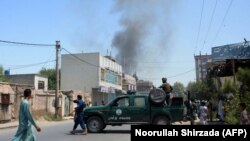
Afghan security personnel secure a road as smoke billows from the site of a suicide attack in Jalalabad on July 31.

Afghan officials say at least 11 civilians have been killed by a roadside bomb in the western province of Farah, while another six died when unidentified gunmen stormed a government building in the eastern city of Jalalabad.

Farah provincial governor spokesman Naser Mehdi told RFE/RL that about 40 people were also wounded when the explosion hit a bus that was traveling through Bala Baluk district on the morning of July 31.

The bus was on its way from western Herat Province toward the capital, Kabul.

No group immediately claimed responsibility for the bombing, but provincial police spokesman Muhibullah Muhib put the blame on the Taliban, which has a strong presence in Farah Province.

"It was a bomb planted by the Taliban to hit security forces, but unfortunately it got a passenger bus," Muhib said.

Women and children were among those killed and wounded in the blast, officials said.

The death toll was expected to rise as some of the passengers of the bus were in critical condition.

Civilians have borne the brunt of the 17-year conflict in Afghanistan and improvised explosive devices are one of the main causes of casualties.

A total of 10,453 civilian casualties -- 3,438 people killed and 7,015 injured -- were recorded by the UN Assistance Mission in Afghanistan last year.

In Jalalabad, a suicide bomber blew himself up in front of the entrance of the compound of the refugees and repatriations department, clearing the way for gunmen to storm the building, provincial council member Zabit Mir Ahmad said.

Attaullah Khogyani, spokesman for Nangarhar Province's governor, said at least six people died in the attack and at least 14 more were wounded.

There was no immediate claim of responsibility for that attack. The Taliban denied involvement in a WhatsApp message sent to journalists.

The assault comes three days after militants raided a midwife training center in Jalalabad, killing at least three people and wounding several others. The Islamic State (IS) extremist group claimed responsibility.

Jalalabad has been the scene of multiple attacks in recent months that have killed dozens, as the Western-backed government in Kabul continued to struggle to fend off the Taliban and other militant groups since the withdrawal of most NATO troops from Afghanistan in 2014.

With reporting by AFP and Reuters

More News

The Azadi Briefing: Concerns Over Rising Terrorism Threat From Taliban-Ruled Afghanistan

Taliban fighters in Wardak Province, Afghanistan (file photo)

Welcome to The Azadi Briefing, an RFE/RL newsletter that unpacks the key issues in Afghanistan. To subscribe, click here.

I'm Abubakar Siddique, senior correspondent at RFE/RL's Radio Azadi. Here's what I've been tracking and what I'm keeping an eye on in the days ahead.

The Key Issue

A new report by the United Nations says Afghanistan under Taliban rule is turning into a hub for extremist groups.

“Terrorism emanating from Afghanistan will be a driver of insecurity in the region and further afield,” said the report by the UN Security Council committee that monitors the Islamic State (IS) extremist group and the Al-Qaeda terrorist network.

Issued on July 22, the report details how extremist groups with thousands of fighters endanger the security of Afghanistan’s neighbors and pose a growing threat globally.

The report identified Islamic State-Khorasan (IS-K), the Afghanistan branch of IS, as the “most serious threat” in the Central and South Asia region and said the group was “projecting terror beyond Afghanistan.”

The report said Al-Qaeda was adopting “strategic patience” in Afghanistan. Building ties with the Tehrik-e Taliban Pakistan (TTP) extremist group that is waging an insurgency against Islamabad, Al-Qaeda could transform the Pakistani militants into a regional threat, the report warned.

“With Taliban acquiescence, and at times support, TTP has intensified attacks inside Pakistan,” the report said, noting that the Pakistani group is estimated to have around 6,500 fighters.

Why It's Important: Nearly three years after the Taliban’s return to power, there are increasing fears that Afghanistan is once again turning into the headquarters of global terrorism.

The Taliban has battled against IS-K and claims to have severely curtailed its operations in Afghanistan. But the Taliban’s alliances and relations with other extremist groups, including the TTP, have allowed militancy to flourish in the region.

For now, fewer Afghans are dying in terrorist attacks than in recent years, according to a new report by the Institute of Economics and Peace, an Australian think tank. But attacks by Afghanistan-based militant groups abroad are increasing.

External attacks by extremist groups based in Afghanistan could provoke retaliation against the Taliban. Islamabad has already carried out air strikes inside Afghanistan in response to TTP attacks.

The United States says it is working to prevent the reemergence of external terrorism threats from Afghanistan. Vedant Patel, a deputy spokesperson for the U.S. State Department, said on August 1 that Washington is employing international cooperation to ensure that Afghanistan does not become a launching pad for terrorist attacks.

What's Next: The Taliban is expected to keep fighting IS-K because of ideological differences.

But it is unlikely to stop harboring or clamp down on other extremist groups on Afghan soil. That will continue to make Afghanistan a threat to the region and beyond.

What To Keep An Eye On

The Taliban’s unrecognized government on July 30 announced that it was cutting ties with 14 Afghan diplomatic missions abroad and will cease to accept consular documents issued by those missions.

They include Afghan missions in Australia, Canada, Poland, Greece, London, Belgium, Berlin, Bonn, Switzerland, Austria, France, Italy, Sweden, and Norway.

But many of those missions have vowed to defy the Taliban and continue their consular and diplomatic services without any interruption.

“Until the Taliban take steps to gain domestic and international legitimacy, their announcements will have no bearing on our work,” Muhibullah Taib, an Afghan diplomat in Switzerland, told RFE/RL’s Radio Azadi.

The Taliban’s decision is likely to impact hundreds of thousands of Afghans based abroad.

“It will not allow Afghans to travel,” Hamza Khan, an Afghan living in France, told Radio Azadi. “We demand that the Taliban rescind this decision.”

Why It's Important: Since seizing power, the Taliban has tried to gain control of Afghan diplomatic missions abroad in a bid to boost its legitimacy.

So far, the Taliban has successfully assumed control of Afghan diplomatic missions in more than a dozen countries in the region.

But it now appears to be seeking to assert authority over missions in Western nations where Afghan diplomats appointed by the previous government have resisted working with the Taliban.

That's all from me for now.

Don't forget to send me any questions, comments, or tips that you have. You can always reach us at azadi.english@rferl.org

Until next time,

Abubakar Siddique

If you enjoyed this briefing and don't want to miss the next edition, subscribe here. It will be sent to your inbox every Friday.

Pakistan Bans Entry Of Afghan Truckers Without Visas, Documents Through Torkham

The Torkham border crossing between Afghanistan and Pakistan (file photo)

Pakistani authorities have banned the entry of Afghan drivers through the Torkham border crossing as of August 1 unless they have passports and visas. Torkham, a critical trade route between Pakistan and Taliban-ruled Afghanistan, had been reopened by Pakistan in January after a 10-day closure prompted by Islamabad's imposing passport and visa requirements on Afghan drivers. Pakistan initially set an April 1 deadline for compliance, but then extended it until August 1. lslamabad's move to require visas and passports -- documents many Afghans do not have -- came as Pakistan accused the Taliban of allowing militants to stage attacks across the border from Afghanistan's territory. To read the original story by RFE/RL's Radio Mashaal, click here.

How Will Rising Middle East Tensions Impact Afghanistan and Pakistan?

Hamas leader Ismail Haniyeh (center) attends the inauguration of the newly elected Iranian president in Tehran on July 30, the day before his death.

The killing of Ismail Haniyeh, the political leader of the EU- and U.S.-designated Palestinian terrorist group Hamas, has thrown the Middle East into crisis.

But his assassination in a suspected Israeli strike in Iran on July 31 and the heightened risk of a broader war also have implications in the wider region, including for Iran's eastern neighbors, Afghanistan and Pakistan.

Experts say Kabul and Islamabad will likely struggle with the security, economic, and political fallout from a major escalation in the Middle East.

But a potential regional war involving Iran is unlikely to directly drag in Taliban-ruled Afghanistan and Pakistan, both of which have cordial relations with Tehran, experts say.

"The attacks will not draw either country into direct participation in the conflicts such as by offering to send fighters," said Marvin Weinbaum, director of Afghanistan and Pakistan studies at the Middle East Institute think tank in Washington.

Pakistan and the Taliban both directly blamed Israel for Haniyeh's assassination, which Tehran has also blamed on its archenemy.

Islamabad denounced the killing as an act of "terrorism," and hundreds of supporters of a Pakistan Islamist party held a symbolic funeral for Haniyeh near Islamabad on July 31.

Amid tensions with Islamabad, Kabul depends on Iranian ports such as Chabahar for most of its imports and exports.

'Making Life Harder For Afghans'

Iran is on friendly terms with the Taliban. Tehran is also the biggest trading partner of the cash-strapped and internationally unrecognized Taliban-led government. Kabul is dependent on Iranian ports for most of its imports and exports amid tensions with neighboring Pakistan.

The Islamic republic is also home to around 4 million Afghan migrants and refugees. The remittances they send back home keep many impoverished families afloat in Afghanistan, which has grappled with an economic crisis since the Taliban takeover in 2021.

Graeme Smith, a senior Afghanistan analyst at the Brussels-based International Crisis Group, said rising tensions in the Middle East "could have destabilizing consequences for the fragile situation in Afghanistan."

Smith said the risk is that a conflict involving Iran will harden the country's borders with Afghanistan, "making life harder for Afghans."

He said Afghanistan's humanitarian crisis, the largest in the world, could worsen if its borders with Iran are closed.

"The exit route from that crisis depends on renewed trade across the region," he said. "[But it] requires borders opening to the flow of goods and labor."

A Pakistani man kisses the portrait of the late Iranian President Ebrahim Raisi, who died in a helicopter crash, during a condolence ceremony held at the Iranian Cultural Center in Peshawar on May 21.

Pakistan Not To Become 'Directly Involved'

Hundreds of thousands of Afghans and millions of Pakistanis work as laborers and traders in the oil-rich Arab Gulf countries.

A potential regional war could disrupt the flow of Afghan and Pakistani migrant workers heading to the Gulf. That would deal a major blow to Afghanistan and Pakistan, both of which are both heavily dependent on remittances sent from abroad.

In Pakistan, some political parties and the media have called for Islamabad to take a more hard-line approach to Israel, which is not formally recognized by the South Asian country.

But Weinbaum said the "general feeling among [Pakistani] policymakers is that the country has enough security concerns of its own not to become directly involved."

Faced with rising militant attacks in the northwestern province of Khyber Pakhtunkhwa and the southwestern province of Balochistan, which borders Iran and Afghanistan, Islamabad's choices are limited.

"There are also worries about an American reaction if Pakistan makes any military commitments [to Iran]," Weinbaum said.

Afghanistan and Pakistan are home to millions of Shi'ite Muslims. And Iran, a Shi'a-majority country, could look to Shi'ite communities living in its eastern neighbors for recruits in the event of a war.

During the Syrian civil war, Iran recruited, trained, and armed thousands of Shi'ite fighters from Afghanistan and Pakistan to fight. Many of those fighters who survived have returned home as the war has died down.

China In Eurasia Briefing: Is China Finally Ready To Cash In On Afghanistan's Resources?

Afghan and Chinese officials attend a ribbon-cutting ceremony to inaugurate the Mes Aynak copper-mining project on July 24.

Welcome back to the China In Eurasia briefing, an RFE/RL newsletter tracking China's resurgent influence from Eastern Europe to Central Asia. To subscribe, click here.

I'm RFE/RL correspondent Reid Standish and here's what I'm following right now.

Harvesting Afghanistan's Mineral Wealth

After 16 years of delays, Chinese engineers and the Taliban government officially started work at Mes Aynak, a massive project in Afghanistan to mine the world's second-largest deposit of copper, my colleagues at RFE/RL's Radio Azadi reported.

Finding Perspective: At the July 24 event, Taliban officials along with Chinese businessmen and diplomats carried out a ribbon-cutting ceremony as work began on the construction of a road to the mining site.

A $3 billion deal signed in 2008 with the previous Afghan government gave the Chinese state-owned China Metallurgical Group Corporation (MCC) a 30-year mining concession, but combat between NATO-led troops and Taliban insurgents at the time delayed the project from moving forward.

But with violence waning since the Taliban's 2021 takeover, the cash-strapped Taliban-installed government is eager to exploit the country's vast and lucrative mineral deposits.

Since it seized power, the Taliban has faced the task of undertaking the reconstruction and development of a country devastated by decades of war. At the same time, officials have also found their economy suffocated by Western sanctions and are dealing with international isolation that has cut them off from receiving financial support.

China has been an exception for the Taliban government, with Beijing vowing to pursue deeper cooperation shortly after the group took control of Kabul, and Chinese companies have had an eye on exploiting Afghanistan's extensive resource wealth, signing a series of deals to secure the rights to oil and gas fields and rare-earth metal deposits.

What Comes Next?: Taliban officials said it would likely be at least two years before the first copper was extracted by MCC.

According to a Brookings Institute report, Afghanistan sits on some 2.3 billion metric tons of iron ore and 1.4 million metric tons of rare-earth minerals, and the U.S. Geological Survey has calculated that the country is sitting on $1 trillion in untapped minerals, such as iron, gold, and lithium -- an essential but scarce component in rechargeable batteries and other technologies.

Mes Aynak is one of the most attractive offerings for Chinese firms. The deposit is estimated to contain 11.5 million tons of copper ore, which is vital for electronics components and is surging in value due to its use in growing markets related to electric vehicles, renewable energy, and data centers.

Why It Matters: The ground breaking is a sign that Chinese resource ventures are moving forward in the country after decades of delays, but security concerns are still paramount.

Further developing the mine and turning a profit from it will require a substantially larger footprint of Chinese workers inside Afghanistan, and there are lingering questions about whether the Taliban can offer protection, especially amid Islamic State-Khorasan’s expanding profile.

Chinese workers have increasingly become a target of attacks in the region by various militant groups.

In neighboring Pakistan, there have been growing attacks on Chinese citizens, including a suicide attack that killed five Chinese engineers in March and a 2021 bombing that killed 13 people, including nine Chinese workers, at a dam project.

In Afghanistan, at least five Chinese nationals were wounded when gunmen stormed a Kabul hotel popular with Beijing businessmen in 2022.

Three More Stories From Eurasia

1. Kuleba's China Trip

Ukrainian Foreign Minister Dmytro Kuleba wrapped up a three-day trip to China and Hong Kong, where he met with his Chinese counterpart, Wang Yi.

Here’s what happened:

The Details: While meeting with Wang in Guangzhou, Kuleba said that Ukraine remains ready to hold talks with Russia provided Moscow proves it's ready to negotiate in “good faith,” but that Kyiv has yet to see such inclination from the Kremlin.

He then met with Guangdong Governor Wang Weizhong and regional officials, where he encouraged them “to consider investment and business prospects and humanitarian needs.”

“There is great demand for construction, industrial recovery, renewable energy, and other areas. So now is a good time to deepen trade ties,” Kuleba said.

Ukraine’s top diplomat then went to Hong Kong and met with Chief Executive John Lee where he asked him “to take measures to prevent Russia from using Hong Kong to circumvent restrictive measures introduced for Russian aggression against Ukraine.”

The next day after Wang’s meeting with Kuleba, the Chinese official met with Russian Foreign Minister Sergei Lavrov on the sidelines of the Association of Southeast Asian Nations (ASEAN) talks in Laos where they praised their close ties and discussed implementing “a new security architecture” in Eurasia.

2. Hearts, Minds, And Dirty Air

The massive copper-mining complex in eastern Serbia run by China’s state-owned Zijin Mining Group is facing fresh pushback from nearby residents over pollution concerns, my colleague from RFE/RL’s Balkan Service, Branko Pesic, reports.

What You Need To Know: Zijin took over Bor’s massive copper-mining and smelting complex in 2018 and has grappled with concerns about its environmental impact and the health of nearby residents, including fines and a temporary work-stop order.

But the Chinese mining venture, which has poured billions into the project, has been praised by the Serbian government as a much-needed job creating investment.

Environmental groups have accused Serbian authorities of turning a blind eye to pollution and health concerns stemming from the copper mine, which is boosting its output and expanding operations rapidly as value for the metal rises amid increased demand for the role it plays in the global energy transition away from fossil fuels.

Branko spoke with locals and activists who say that pollution, especially from some carcinogenic heavy metals, is getting worse, despite Zijin’s claims. Read his full report here.

3. A China And Russia Flyby Of Alaska

The United States and Canada scrambled fighter jets on July 24 after two Russian and two Chinese military planes were tracked in international airspace close to Alaska.

What It Means: The North American Aerospace Defense Command (NORAD) said that it “detected, tracked, and intercepted two Russian Tu-95 and two PRC H-6 military aircraft operating in the Alaska Air Defense Identification Zone (ADIZ).”

The “identification zone” is a stretch of international airspace that acts as a buffer zone where U.S. and Canadian national airspace ends. All aircraft entering the ADIZ require identification for national security reasons.

The presence of the Russian and Chinese planes was not seen as a threat, and intercepts of Russian planes are relatively common in the area.

But China and Russia together represent a newer development. While the two countries have carried out several joint patrols in the past, this incident was the first one that brought together bombers from both countries in the north Pacific area.

Earlier in July, the Chinese and Russian navies conducted their fourth joint sea patrols in the western and northern Pacific.

Across The Supercontinent

Anaklia Ruling: In May, the Georgian government awarded a contract to a consortium of Chinese companies to build a new deep-sea port in Anaklia on the country’s Black Sea coast.

But a previous bid to build the strategic port that was canceled by the government after years of political jostling had spent years waiting for a ruling by an international arbitration court, which ruled on July 29 in Tbilisi’s favor. The move removes a legal obstacle to the project, RFE/RL’s Georgian Service reports.

Election Watch: The U.S. Director of National Intelligence said “foreign actors” are conducting and planning "influence operations" targeting the November elections in the United States using increasingly refined tactics “to better hide their hand.”

Il Ripristino: After pulling her country out of the Belt and Road Initiative (BRI), Italian Prime Minister Giorgia Meloni made her first trip to Beijing, where she met with Chinese leader Xi Jinping.

The trip is seen as part of a reset effort by Rome after criticizing the Chinese infrastructure project. During her visit, Meloni called China an "important interlocutor" in managing global tensions.

Harris’s Foreign Policy: My colleague Margot Buff and I made a short video looking at what U.S. foreign policy might look like under a Kamala Harris presidency, with a particular focus on Russia and China. Watch it here.

One Thing To Watch

The Summer Olympics in Paris kicked off on July 26, and a doping scandal involving Chinese swimmers and the World Anti-Doping Agency (WADA) is under way in the background.

Three different incidents have been reported over the last several months in which the Chinese have blamed food contamination for positive drug tests. WADA accepted the results of the Chinese investigations and an independent follow-up was carried out. The doping watchdog organization then kept the matter secret until reporting made the incidents public.

Now, a bipartisan group of U.S. lawmakers has introduced a bill that could cut future U.S. funding for the global sports anti-doping system unless sweeping reforms are made.

That’s all from me for now. Don’t forget to send me any questions, comments, or tips that you might have.

Until next time,

Reid Standish

If you enjoyed this briefing and don't want to miss the next edition, subscribe here. It will be sent to your inbox every Wednesday.

Taliban Cuts Ties With 14 Afghan Diplomatic Missions Abroad

The entrance to the Afghan Embassy in Rome

Afghanistan's Taliban rulers have announced that they are cutting ties with 14 Afghan diplomatic missions abroad and will cease to accept consular documents issued by those missions, in a move likely to cause further difficulties for Afghan citizens living abroad.

Following the Taliban's return to power in August 2021 in the wake of the withdrawal of U.S.-led forces from Afghanistan, some diplomatic missions abroad continued to pledge allegiance to the former government.

The move, which takes effect immediately, was announced by the Taliban Foreign Ministry in a message posted on X on July 30.

It refers to passports, visas, and other consular documents issued by Afghan missions in London, Belgium, Berlin, Bonn, Switzerland, Austria, France, Italy, Greece, Poland, Sweden, Norway, Canada, and Australia.

The Taliban "has repeatedly urged the Afghan political and consular in European countries to engage with Kabul to at least address consular service-related issues of Afghans and provide better services for Afghan citizens," the statement said.

"Unfortunately, the actions of most of the missions are carried out arbitrarily, without coordination, and in explicit violation of the existing accepted principles," it said.

Afghans in the countries affected by the move were urged in the statement to seek consular and embassy services in the diplomatic missions controlled by the Taliban.

Afghan embassies in Pakistan, China, and Russia are among those controlled by the Taliban government. In October, Afghan diplomatic missions in Spain and the Netherlands publicly accepted to offer their services to the Taliban authorities in Kabul.

Afghanistan's Taliban government has not been recognized by any country in the world, many of its leaders are under international sanctions, and the country's seat at the United Nations is still occupied by former Afghan President Ashraf Ghani's government.

However, countries such as China and Pakistan still have diplomatic missions in Kabul.

The UN has so far rejected the Taliban's bid for Afghanistan's seat in the organization three times.

Germany In Talks To Deport 'Criminal' Asylum Seekers, Interior Minister Says

German Interior Minister Nancy Faeser (file photo)

German Interior Minister Nancy Faeser says Berlin is in secret talks to deport “criminal” asylum seekers. In an interview with Bild am Sonntag, Faeser said, “We want to consistently deport Islamist violent criminals. We are negotiating confidentially with various states to make deportations to Afghanistan and Syria possible again.” The issue was raised following the stabbing death of a police officer in Mannheim in June. Investigators said an Afghan immigrant carried out the attack. Some 40,000 Syrians and 20,000 Afghans have applied for asylum this year, the newspaper reported. Foreign Minister Annalena Baerbock criticized the move, saying it was "not possible" to deport migrants to countries like Afghanistan. To read the original story by RFE/RL's Radio Farda, click here.

The Azadi Briefing: Afghans Complain Of Rising Abuse In Iran

Afghan refugees deported from Iran arrive in the western Afghan province of Herat. (file photo)

Welcome to The Azadi Briefing, an RFE/RL newsletter that unpacks the key issues in Afghanistan. To subscribe, click here.

I'm Abubakar Siddique, senior correspondent at RFE/RL's Radio Azadi. Here's what I've been tracking and what I'm keeping an eye on in the days ahead.

The Key Issue

Afghan refugees and migrants have complained of rising harassment and abuse in neighboring Iran.

This week, banners appeared to be hung in a neighborhood in Tehran, the Iranian capital, demanding that Afghans leave. It was unclear if locals or the authorities were behind the move.

It came after Iranian media reported on July 18 that a local man was allegedly stabbed to death by his Afghan neighbors.

Last week, the homes of several Afghan migrants in the southern city of Khur were reportedly set on fire in apparent retaliation for the killing of an Iranian man, allegedly by an Afghan.

Why It's Important: Anti-Afghan sentiment in Iran has been on the rise in recent years, especially after a mass influx of refugees and migrants following the Taliban's takeover of Afghanistan in 2021.

Tehran has long blamed Afghans for insecurity and unemployment in Iran, and expelled many members of the community.

An estimated 4.3 million Afghans currently live in Iran, according to the United Nations. More than 1 million have been deported in the past year.

Human rights groups have also documented a sharp rise in the number of Afghans executed in Iran so far this year.

What's Next: As anti-Afghan sentiment rises in Iran, members of the community are likely to be the targets of more discrimination and abuse.

It is unclear if the ill-treatment of Afghans in Iran will discourage others from moving to the Islamic republic.

Hundreds of Afghans are believed to be illegally entering Iran every week to escape Taliban rule and the devastating humanitarian and economic crises in Afghanistan.

What To Keep An Eye On

A growing number of Afghans affected by natural disasters are leaving for neighboring countries.

Afghanistan has been the scene of severe droughts, floods, and other extreme weather events in recent years.

"I was forced to move to Iran after the earthquakes," Hassanzada, a resident of the western Afghan city of Herat, told RFE/RL's Radio Azadi.

A series of tremors last year killed at least 1,000 people and affected more than 100,000 in and around Herat.

But survivors said the lack of aid and financial assistance forced them to leave the country.

Why It's Important: Afghanistan remains among the world's most vulnerable countries to the effects of global warming and climate change.

In the latest natural disaster to hit Afghanistan, flash floods in the eastern province of Nangarhar last week killed at least 71 people, according to the UN.

The Taliban's seizure of power led international donors to immediately cut international development funding. While some foreign aid organizations continue to operate in Afghanistan, many of them have been forced to curb their work as international funding diminishes.

That's all from me for now.

Don't forget to send me any questions, comments, or tips that you have. You can always reach us at azadi.english@rferl.org

Until next time,

Abubakar Siddique

If you enjoyed this briefing and don't want to miss the next edition, subscribe here. It will be sent to your inbox every Friday.

Afghan Sisters Escape The Taliban To Achieve Olympic Dreams

Afghan Sisters Escape The Taliban To Achieve Olympic Dreams
please wait

No media source currently available

0:00 0:02:39 0:00

Sisters Yulduz and Fariba Hashimi are set to become the first female cyclists from Afghanistan to compete in the Olympics. The siblings fled their country after the Taliban seized power in 2021 and cracked down on women's rights, including banning women from participating in sports.

New Extremist Groups -- At Least In Name -- Enter Pakistan's Militant Scene

Men watch as smoke rises following an explosion after militants attacked an army base in Pakistan's northwestern city of Bannu on July 15.

Suicide bombers and gunmen penetrated a military base in northwestern Pakistan last week, killing eight soldiers.

It was just the latest in a string of deadly attacks to hit the South Asian country, where militant violence has surged in recent years.

But what was significant about the July 15 attack in the city of Bannu was the group that claimed responsibility -- Jaish Fursan-e Muhammad (JFM) -- a previously unknown militant outfit.

JFM is among several new militant groups that have announced their arrival on the crowded militant scene in Pakistan in recent months.

But experts believe the new actors are in fact fronts for existing groups, including the Tehrik-e Taliban Pakistan (TTP), the most lethal militant organization waging war against Islamabad.

JFM is a believed to be a front for Hafiz Gul Bahadar (HGB), a separate extremist group. The group is named after its leader, a former TTP commander.

Tehrik-e Jihad Pakistan (TJP), another militant group that announced its emergence last year, is considered by experts to be a front for the TTP. It marked its arrival with a spectacular attack on a key air base in the eastern province of Punjab in November.

Experts say the fronts have allowed the TTP and HGB -- which are coming under military pressure from Islamabad -- to maintain a position of plausible deniability.

"All these groups are either part of the TTP or Hafiz Gul Bahadar," said Mansur Mehsud, director of the FATA Research Center, an Islamabad-based nonprofit organization. "This is part of the TTP and HGB's strategy to create confusion."

TTP fighters in Pakistan's northwestern district of South Waziristan, near the Afghan border, in 2012

'Using Different Names’

The TTP and HGB are both believed to be based in Afghanistan, where the Afghan Taliban seized power in 2021.

Experts say the Taliban takeover has emboldened and strengthened Pakistani militants. The withdrawal of foreign troops from Afghanistan has significantly reduced U.S. air strikes in the region, allowing militants to operate more freely.

TTP and HGB fighters have also obtained sophisticated weaponry, including U.S.-made firearms, left behind by international forces.

Pakistan has accused the Afghan Taliban of sheltering the TTP, with which it has close ideological and organizational ties.

Pakistan has used pressure tactics, observers say, to force the Afghan Taliban to sever ties with the TTP, including by expelling hundreds of thousands of Afghan refugees from Pakistan, shutting key border crossings, and blocking Afghan transit goods in recent years.

Islamabad has also conducted deadly cross-border attacks targeting alleged TTP hideouts in eastern Afghanistan.

The Afghan Taliban has tried to appease Pakistan by relocating TTP fighters away from the border with Pakistan to other areas of Afghanistan and brokering a year of peace talks between the Pakistani militants and Islamabad that broke down. But the Afghan militants have refused to expel the TTP from Afghanistan.

Each major TTP attack inside Pakistan has been followed by Islamabad issuing condemnations and summoning the Afghan Taliban's ambassador in protest.

"The [Pakistani] Taliban are strong, but also under pressure," said Muhammad Amir Rana, an Islamabad-based security and political analyst. "They are using different names as part of their strategy and also to avoid pressure."

Mehsud of the FATA Research Center said the "TTP sometimes deliberately avoids large-scale attacks just to avoid pressure" from the Afghan Taliban, which he said has tried to convince its Pakistani ally to rein in its attacks.

'Security Situation Is Very Bad'

The TTP and HGB as well as their affiliates have concentrated most of their attacks in Khyber Pakhtunkhwa, the northwestern province along the border with Afghanistan that has long been a hotbed of militancy.

Several other militant groups that have attracted less headlines have also recently emerged in the region. They include Lashkar-e Khorasan, a militant group believed to be a front for the TTP. The other is the Shaheen Group, which is considered a front for the HGB. Both groups have claimed attacks in Khyber Pakhtunkhwa in recent months.

Pakistan earlier this year said the military would launch a new offensive to root out militants in the northwest, without offering details.

The planned military operation has been fiercely opposed by locals in Khyber Pakhtunkhwa, the scene of numerous offensives that have killed thousands and uprooted millions of civilians in the past.

Thousands of people rallied in Bannu on July 19 to call for an end to military operations in the region. The demonstration turned violent and security forces fired on protesters, killing one person. Since then, thousands of people have been participating in a sit-in protest in Bannu.

Rana, the Islamabad-based analyst, says Pakistan faces no good choices in its battle to curb the soaring number of militant attacks in the country.

If it launches a deadly military assault, it will attract the wrath of the public. If it targets alleged TTP strongholds inside Afghanistan, it will further escalate tensions with the Afghan Taliban, he says.

"The security situation is very bad," Rana said. "This is the peak of it now."

China Breaks Ground On Massive Afghan Copper Mine After 16 Years Of Delays

Taliban security personnel surround an excavator at work during an inauguration ceremony of the Mes Aynak copper-mining project on July 24.

Chinese engineers and the Taliban government officially started work on a massive project in Afghanistan to mine the world's second-largest deposit of copper.

At the July 24 event at Mes Aynak, some 40 kilometers southeast of the capital, Kabul, Taliban officials along with Chinese businessmen and diplomats carried out a ribbon-cutting ceremony as work began on the construction of a road to the mining site.

A $3 billion deal signed in 2008 gave the Chinese state-owned China Metallurgical Group Corporation (MCC) a 30-year mining concession, but combat between NATO-led troops and Taliban insurgents at the time delayed the project from moving forward for 16 years.

With violence waning since the Taliban's 2021 takeover of power amid the withdrawal of foreign troops, the cash-strapped Taliban-installed government is eager to exploit the country's vast and lucrative mineral deposits.

"The time wasted in the implementation of the project should be recuperated with speedy work," Deputy Prime Minister for Economic Affairs Abdul Ghani Baradar said at the ribbon-cutting event.

Can China Learn To Live With The Taliban?
please wait

No media source currently available

0:00 0:33:49 0:00

Taliban officials said it would likely be at least two years before the first copper was extracted by MCC while Chinese diplomats praised the progress as a sign of warming ties between Beijing and Kabul.

"The economic and trade relations between the two countries are becoming increasingly close," said China's ambassador to Afghanistan, Zhao Xing.

Since it seized power, the Taliban has faced the task of undertaking the reconstruction and development of a country devastated by decades of war.

But officials have also found their economy suffocated by Western sanctions and dealing with international isolation that has cut them off from receiving financial support.

China has been an exception for the Taliban government, with Beijing vowing to pursue deeper cooperation shortly after the group took control of Kabul.

Beijing has been particularly focused on exploiting Afghanistan's extensive resource wealth, from oil and gas to rare-earth metals.

Mes Aynak remains one of the most attractive offerings for Chinese firms. The deposit is estimated to contain 11.5 million tons of copper ore, which is vital for electronics components and is surging in value due to its use in growing markets related to electric vehicles, renewable energy, and data centers.

According to a Brookings Institute report, Afghanistan sits on some 2.3 billion metric tons of iron ore and 1.4 million metric tons of rare-earth minerals, and the U.S. Geological Survey has calculated that the country is sitting on $1 trillion in untapped minerals, such as iron, gold, and lithium -- an essential but scarce component in rechargeable batteries and other technologies.

Amir Mohammad Musazai, a retired professor from the Department of Geology and Mines at Kabul Polytechnic University, told RFE/RL's Radio Azadi that mining Mes Aynak is likely to yield amounts of copper ore worth more than the $3 billion that was signed for the mining rights, given that nearby areas also hold large copper reserves that weren’t factored into the original plans.

While the groundbreaking event at Mes Aynak is a sign that Chinese resource ventures are moving forward in the country after decades of delays due to war, security concerns are still a major hurdle holding back more expansive projects, which often rely on Chinese engineers and other staff.

The July 24 ceremony was closely guarded by dozens of armed men and Taliban officials made assurances that they would protect staff at the mining project.

Chinese workers have increasingly become a target of attacks in the region, including a suicide attack that killed five Chinese enginners in Pakistan in March and a 2021 bombing that killed 13 people, including nine Chinese workers, at a dam project in the South Asian country.

In Afghanistan, at least five Chinese nationals were wounded when gunmen stormed a Kabul hotel popular with Beijing businessmen in 2022.

Pakistan Reopens Key Border Point With Afghanistan After Months Of Closure

Pakistan has reopened the key Chaman-Spin Boldak border crossing with Afghanistan after a nine-month closure that resulted in financial losses and rising anger on both sides.

Macron Praises Afghan Female Athletes Coming To Paris

Macron Praises Afghan Female Athletes Coming To Paris
please wait

No media source currently available

0:00 0:00:57 0:00

RFE/RL's Radio Azadi asked French President Emanuel Macron on July 22 about the significance for Afghan female teams competing in the upcoming Paris Olympics. He says these athletes carry the "hope of other women" and praises the resilience of Afghans.

Interview: Pakistani Islamist Leader Opposes Military Operation To Root Out Militants

In an interview with RFE/RL's Radio Mashaal on July 22, the controversial cleric Maulana Fazlur Rehman called for peace talks between Pakistan and Tehrik-e Taliban Pakistan. (file photo)

Maulana Fazlur Rehman, leader of the largest Islamist party in Pakistan, has voiced his opposition to a planned operation by the military to root out militants along the Afghan border.

In an interview with RFE/RL's Radio Mashaal on July 22, the controversial cleric called for peace talks between Pakistan and Tehrik-e Taliban Pakistan (TTP), the most lethal militant group waging war against Islamabad.

The comments from Rehman, the head of the Jamiat Ulema Islam-Fazl (JUI-F) party, came as militant violence has surged across the predominately Muslim nation of some 240 million people.

A high-profile bomb-and-gun attack on a military base in the northwestern city of Bannu on July 15 killed 10 government security personnel.

But residents of Khyber Pakhtunkhwa, the northwestern province that has been the scene of devastating military operations that uprooted millions of people and killed thousands of civilians in the past, have protested against any new military operations in the region.

"People are not ready to suffer yet again," Rehman, who hails from Khyber Pakhtunkhwa, told Radio Mashaal. "We have been through bitter times."

Thousands of people waving white flags and calling for peace rallied in Bannu on July 19 calling for an end to military operations in the region. The demonstration turned violent and security forces fired on protesters, killing one person.

Residents take part in a July 19 peace rally to protest after the recent suicide attack by militants on an army enclave in Bannu.

Since then, thousands of people have been participating in a sit-in protest in Bannu.


"The voices in Bannu are the voices of all the residents of Pakhtunkhwa," Rehman said.

Rehman
Rehman

Islamabad earlier this year said the military would launch a new offensive to combat militants along the Afghan border, without offering details.

Pakistani military spokesman Lieutenant General Ahmed Sharif on July 22 said the planned operation would be a "comprehensive counter-terrorism campaign" that would not displace locals.

But those comments have done little to quell the concerns of protesters and locals who fear for their lives and livelihoods in any new military offensive.

Since 2003, tens of thousands of civilians have been killed in major counterterrorism offensives in Khyber Pakhtunkhwa, where more than 6 million people have been displaced. The province was a former stronghold of the Afghan Taliban, the Haqqani network, and Al-Qaeda.

A soldier stands guard as a tractor carrying refugees fleeing the military offensive against militants in North Waziristan drives past a checkpoint in Bannu in 2014.

"People are ready to be buried in the ruins of their homes," Rehman said. "But they do not want to be humiliated again."

Peace Prospects

The TTP has intensified its deadly insurgency against Pakistan since the Afghan Taliban seized power in Kabul.

Islamabad has repeatedly accused the Afghan militants of sheltering the TTP, with which it has close ideological and organizational ties. Kabul has rejected the claim, and ties between Pakistan and the Taliban, which have been close allies for decades, have plummeted.

An injured man is shifted to a hospital to receive medical treatment following a blast that targeted a police vehicle near the Afghan border in the Bajaur district of Khyber Pakhtunkhwa on January 8.

In January, the 71-year-old Rehman visited Afghanistan to repair ties. During his stay in Kabul, he met with Taliban officials, including its reclusive chief, Mullah Haibatullah Akhundzada, and TTP leaders.

In his interview with Radio Mashaal, Rehman said he presented a plan to resolve the conflict between Islamabad and the TTP with the mediation of the Afghan Taliban.

"But our [security] establishment and rulers are so incompetent that they didn't accept that solution," said Rehman.

Members of the National Democratic Movement, the Pashtunkhwa National Awami Party, and the Awami Workers Party protest in Karachi on July 21 against the shooting at the peace rally in Bannu two days earlier.

Rehman said a peace deal was the only way to end the TTP’s 17-year insurgency against Islamabad.

In 2022, the Afghan Taliban brokered yearlong peace talks between the TTP and Islamabad. But the talks broke down and the TTP resumed its attacks.

Rehman has courted controversy for his support of the Afghan Taliban.

A JUI-F-led coalition governed Khyber Pakhtunkhwa between 2002-2007. Critics blame the party for sheltering the Afghan Taliban whose presence in the region led to the emergence of the TTP. Many Afghan Taliban leaders were educated in Islamic seminaries run by JUI-F leaders.

Written by Abubakar Siddique based on reporting by Tahir Khan of RFE/RL's Radio Mashaal

Taliban Intensifies Crackdown On Dissent In Afghanistan

Taliban fighters stand guard during a ceremony in Kabul. (file photo)

The Taliban has detained a former politician, a journalist, and a filmmaker in recent days across Afghanistan, according to their relatives.

The detentions mark a sharp escalation of the extremist group's crackdown on dissent, a violent campaign that has targeted reporters, activists, and political figures.

The latest target of the clampdown was Sayyed Rahim Saeedi, a television producer and filmmaker based in the capital, Kabul.

Relatives of Saeedi, who spoke on the condition of anonymity for fear of retribution, told RFE/RL's Radio Azadi that members of the General Directorate of Intelligence, the Taliban's notorious intelligence agency, detained him and his son on July 20.

His son was freed on July 21, the relatives said.

It was not clear why they were detained. The filmmaker's whereabouts remain unknown, and the Taliban has not commented on his detention.

Meanwhile, the Taliban detained Rohullah Rauf, the former head of the provincial council in the northeastern province of Takhar, a source close to him who spoke on condition of anonymity told Radio Azadi.

The source said Rauf was detained by the Taliban after returning home from Friday Prayers on July 19. It was unclear why he was detained, the source said.

Mowloda Tawana, an Afghan rights campaigner, said Rauf's detention showed that the Taliban was not committed to the amnesty that it announced shortly after seizing power in 2021.

The blanket amnesty included all Afghan officials, security forces, and individuals who cooperated with the departed U.S.-led military presence in Afghanistan.

But international rights watchdogs and the United Nations have documented widespread cases of retribution -- including extrajudicial killings and torture.

An Afghan man at a Kabul restaurant watches a live television broadcast of the Tolo News channel showing a religious scholar speaking.

Meanwhile, freelance journalist Mohammadyar Majrooh was detained by the Taliban in the southern city of Kandahar, according to his relatives.

Relatives of Majrooh said the reporter was detained on July 12. His whereabouts are unknown, they said.

Majrooh was previously detained in February 2023 while working on a report for the private Tolo News channel.

In a statement issued on July 17, the Afghanistan Journalists Center, a local media watchdog, demanded that Majrooh be released "without further delay and without conditions."

Hamid Obaidi, head of the Afghanistan Journalists Support Organization, another media watchdog, said the "illegal detentions and harassment of journalists violate the freedom of speech."

"We strongly condemn these detentions," Obaidi told Radio Azadi.

The Taliban's intelligence agency did not respond to Radio Azadi's requests for comment about the recent detentions.

Since its takeover in August 2021, the Taliban has detained and jailed scores of journalists, activists, and academics for publicly opposing its repressive policies.

Hundreds of Afghan journalists have fled their homeland because of intimidation or for fear of persecution. The Taliban has banned several international broadcasters and denied visas to foreign journalists.

As part of its assault on dissent, the militant group has also clamped down on political parties and local nongovernmental organizations. The Taliban banned all political groups and NGOs last year.

Written by Abubakar Siddique based on reporting by Firuza Azizi of RFE/RL's Radio Azadi

Pakistan Reopens Key Border Point With Afghanistan Following Complaints

Persons with disabilities protest in Chaman against the closure in December.

Pakistan on July 21 reopened a key border crossing point with Afghanistan after a nine-month closure following complaints by residents. Pakistan in October closed the Chaman-Spin Boldak border that runs through Pashtun communities, ending the century-old Easement Rights, which had allowed certain communities along the 19th-century Durand Line border to cross freely. Pakistan began requiring people show valid documents like passports and visas to cross into Spin Boldak, a district in Afghanistan's Kandahar Province, sparking anger. Pashtun communities on both sides of the border argued that it harmed their livelihoods and caused significant financial losses.

Homes Of Afghan Migrants Reportedly Attacked After Killing Of Iranian

Hundreds of Afghans are deported from Iran every day. (file photo)

The homes of several Afghan migrants in the southern Iranian city of Khur have reportedly been set on fire in apparent retaliation for the killing of an Iranian man allegedly by an Afghan national.

Hosna, an Afghan who lives in Khur, told RFE/RL’s Radio Azadi on July 19 that he moved his family from Khur to Shiraz in Fars Province out of fear for their safety.

"People in the region are very angry and set homes of several Afghans on fire," he claimed.

Hosna and others who spoke to Radio Azadi attributed the anger to the July 3 killing of a 62-year-old restaurant owner in the town of Khenj by his 17-year-old apprentice. Iranian media have not identified the nationality of the suspected killer, but Hosna said the suspect was an Afghan citizen.

"The people of the region have sworn not to sell 1 kilogram of meat, or even a piece of bread, to Afghan nationals," Hosna said. "So, many were forced to flee to Shiraz."

Anti-Afghan sentiment in Iran has been on the rise in recent years, especially after a mass influx of migrants following the Taliban's return to power in August 2021.

Occasionally, a hashtag that describes the expulsion of Afghan migrants as a "national demand" becomes a top trend on X, formerly Twitter, often boosted by anonymous accounts.

Last week, an unsubstantiated claim on social media blamed Afghan migrants for an alleged rise in leprosy cases in Iran.

The UN’s refugee agency says Iran hosts around 780,000 Afghan refugees, in addition to some 2.6 million undocumented Afghan migrants. But Iran claimed last year that the number of illegal Afghan immigrants was closer to 5 million.

The authorities have vowed to deport illegal refugees and hundreds of Afghan migrants are sent back to Afghanistan every day. They are also banned from living or working in half of Iran's 31 provinces.

Afghans living in Iran have complained to Radio Azadi about rising harassment, even during deportation.

Iranian Film Casts Real Refugees To Show Plight Of Displaced Afghans
please wait

No media source currently available

0:00 0:04:13 0:00

Tehran has for years maintained that it does not receive sufficient financial aid from international organizations to handle the number of refugees on its soil.

Pakistan Summons Diplomat Of Taliban-Led Government Over Bannu Attack 

Residents appear on a street partially blocked by barbed wire a day after a Pakistani Army garrison was attacked by a suicide bombing squad in Bannu.

Islamabad summoned a senior Afghan diplomat over a deadly militant attack on the Bannu garrison in northwest Pakistan, the Pakistani Foreign Ministry said on July 17.

Pakistani officials said the attack on July 15 led to the deaths of eight soldiers after a militant rammed an explosive-laden vehicle into the outer wall of the garrison.

The army said that its forces opened fire and killed all 10 suspected militants in the encounter.

The Foreign Ministry said in a statement that it summoned the deputy minister of the Taliban-led government's Afghan Embassy to the ministry and strongly protested.

The ministry blamed the Afghanistan-based Hafiz Gul Bahadur Group for the attack and said in its statement that it had asked Kabul to take “immediate, robust, and effective action against the perpetrators.”

The ministry also said the Hafiz Gul Bahadur Group and the Tehrik-e Taliban Pakistan, an ally of the Afghan Taliban, are responsible for killing “hundreds of civilians and multiple members of law enforcement agencies” throughout Pakistan.

On the day of the attack, a previously unknown group called Jaish-e Fursan-e Muhammad claimed responsibility in a WhatsApp message to media outlets. RFE/RL could not independently confirm the existence of any such armed group.

The Pakistani Foreign Ministry statement on July 17 said it asked Kabul to fully investigate the bombing and take immediate action against the perpetrators.

There was no immediate reaction from the Taliban-led Afghan government.

Pakistan has witnessed a surge in militant attacks in recent years, mainly in Khyber Pakhtunkhwa Province, where Bannu is located. Residents of the province have protested the lack of security provided by Islamabad against the actions of extremists.

Pakistani security forces have said that they have conducted targeted operations against militants in several parts of Khyber Pakhtunkhwa.

With reporting by AP

Health Fears Over Leprosy Fuel Anti-Afghan Sentiment In Iran

Iranian authorities said last year that 5 million Afghans lived in the country illegally and vowed to deport them. (file photo)

An unsubstantiated claim on social media linking an alleged rise in leprosy cases in Iran to the country’s Afghan community has resulted in renewed calls for the expulsion of Afghan migrants.

Iranian media have cited the Health Ministry as reporting nine new cases of leprosy over the past year. The reports said three of those afflicted were Afghans.

The same day, a freelance Iranian journalist who advocates for the expulsion of Afghan refugees alleged without evidence that “Afghan migrants” were responsible for spreading leprosy in Iran.

He incorrectly charged that “no cases of leprosy had been seen in Iran in years” -- a claim that is easily debunked by data available on the World Health Organization’s (WHO) website.

On July 9, another journalist who often writes in support of expelling Afghan migrants went as far as calling the alleged rise in leprosy cases “bioterrorism” and demanded that the incoming government of President-elect Masud Pezeshkian “start deporting Afghans.”

“Afghans are bringing and spreading the leprosy virus,” he wrote without offering evidence, falsely claiming that leprosy, which is caused by bacteria, is a viral disease.

Both posts on the social media platform X have received nearly half a million views, been shared more than 1,000 times, and liked by over 7,000 accounts.

What Does The Data Say?

Leprosy in Iran has never been eliminated, but it has declined sharply since 2005, dropping from 79 to six in 2022, according to WHO data. No certified health authority has ever declared leprosy an epidemic in Iran or Afghanistan.

Leprosy is a chronic bacterial infectious disease that mainly affects the skin and peripheral nerves. It is curable but leaving it untreated may cause permanent disabilities.

The disease spreads via droplets from the nose and mouth through close and frequent contact with untreated individuals.

Rising Anti-Afghan Sentiment

Afghans fleeing the Soviet invasion in the 1980s were welcomed in Iran, thanks in large part to the anti-Soviet views of the recently established Islamic republic. But animosity toward the growing Afghan community has only worsened since.

In recent years -- especially after an influx of migrants following the Taliban’s return to power in August 2021 -- there have been more frequent displays of anti-Afghan sentiment.

Over the past several months, a Persian hashtag that calls the “expulsion of Afghans” a “national demand” has been trending, often boosted by anonymous accounts.

The UNHCR, the United Nations’ refugee agency, says Iran hosts 780,000 Afghan refugees, in addition to 2.6 million undocumented Afghan nationals.

But the authorities in Tehran claimed last year that 5 million Afghans were living in Iran illegally, and vowed to deport them. Afghan migrants were later banned from living or working in half of the country’s 31 provinces.

In recent months, Afghan migrants in Iran have complained to RFE/RL's Radio Azadi about rising harassment, even during deportation.

Iran has long said that it does not receive enough financial assistance from international bodies to deal with the number of refugees on its soil.

Death Toll After Afghan Floods Rises To At Least 45

Afghan villagers shovel mud on July 15 following flash floods after heavy rainfall in the Dara district of Panjshir Province.

The death toll from heavy rains and storms in Afghanistan's eastern Nangarhar province has risen to 40, with 347 people injured, Sharafat Zaman, a spokesperson for the de facto Taliban government's Health Ministry said on July 16. Zaman said the storms have destroyed numerous houses, without providing specific numbers. Zaman said aid and health workers had arrived in the region and were coordinating relief efforts with international organizations. However, locals speaking to RFE/RL's Radio Azadi voiced frustration over the lack of official assistance. Panjshir and Kunar provinces were also hit by floods on July 15, with at least five dead in Kunar. To read the original story by RFE/RL's Radio Azadi, click here.

40 Dead, Hundreds Injured After Heavy Rain, Storms In Eastern Afghanistan

Heavy rains and storms have killed dozens in Nangarhar Province in eastern Afghanistan.

Thirty-five people have died and more than 230 others have been injured in heavy rains and storms in Nangarhar Province in eastern Afghanistan, the provincial administration of the Taliban-led government said on July 15 in a statement. Earlier on July 15, five people died in heavy rain and floods in the eastern province of Kunar. The statement on the situation in Nangarhar Province said that heavy rain and strong winds contributed to the deaths there and said the number of victims is expected to increase. Officials also said financial losses and telecommunication interruptions are expected. The Meteorological Department of Afghanistan's Taliban-led government predicted heavy rains and floods in 12 Afghan provinces. To read the full story by RFE/RL's Radio Azadi, click here.

Pakistani Court Ensures Dual Citizenship For Women Married To Afghans

An Afghan refugee (second from right) deported from Pakistan receives humanitarian aid at a UN camp on the outskirts of Kabul in 2023.

The Pakistani High Court in Peshawar has ruled in a case brought by 95 Afghan and Pakistani citizens that women married to Afghan nationals have the right to both Pakistani and Afghan citizenship, eliminating a problem for many women stemming from administrative obstacles arising from such dual registrations. Millions of Afghan nationals live in neighboring Pakistan, many of them for decades dating back to the Afghan-Soviet War of the 1980s. A number of Pakistani women recently protested in Peshawar after Pakistani authorities expelled their husbands. To read the original story by RFE/RL's Radio Mashaal, click here.

The Push To Recognize 'Gender Apartheid' As A Crime

Afghan women wait to receive food rations distributed by a humanitarian aid group in Kabul.

The world has long been aware of the scourge of apartheid -- the systemic segregation or discrimination of people based on their race. But what about the institutionalized practice of singling people out for ill-treatment due to their gender?

The push to recognize "gender apartheid" under international law is gaining steam, with oppression against women and girls in Afghanistan and Iran fueling calls for immediate action, but tremendous obstacles remain.

What Do They Want?

Advocates want to clearly define gender apartheid as a crime under international law. Currently, only "persecution" on the basis of gender is recognized as a crime against humanity. But rights groups and activists say the concept of persecution does not fully capture the scope of the abuses committed under a system of institutionalized gender apartheid.

The goal is for the United Nations to make up for this gap by legally shielding women and girls from systemic abuse and violence.

Afghan women's rights defenders are credited with being the first to articulate the concept of gender apartheid in the 1990s, during the Taliban's first regime.

Since the Taliban returned to power in 2021, the hard-line Islamist group has reimposed its oppressive policies against women and girls, including severe restrictions on their appearances, freedom of movement, and right to work and study.

Hoda Khamosh, an Afghan women's rights activist, says the recognition of gender apartheid would greatly benefit women's rights in the country.

"We would be able to hold accountable the authorities and perpetrators of gender-based violence and discrimination against women," Khamosh told RFE/RL's Radio Azadi.

Meanwhile, Iranian women’s rights activists have said the institutionalized discrimination against women in the Islamic republic amounts to gender apartheid.

UN experts have said the violent enforcement of the hijab law and punishments on women and girls who fail to wear the head scarf could be described as a form of gender apartheid.

Security forces in Iran warn women to wear their hijabs properly.

When Do They Want It?

Today. The United Nations has been considering the adoption of a major treaty that would unite signatories against crimes against humanity.

Dozens of rights groups and hundreds of individuals signed a statement in March calling for gender apartheid to be included on the draft list of such crimes.

The hope is that the UN General Assembly will adopt procedures to begin negotiations on the treaty when it next meets in September.

Tough Going

While the concept of gender apartheid has increasingly been used by the United Nations and international organizations, particularly in connection with abuses against women and girls in Afghanistan and Iran, there have also been missed opportunities.

During UN-hosted talks in Doha with the Taliban in early July, for example, women did not have a seat at the table.

Where Are The Women? All-Male UN Talks With Taliban Spark Controversy
please wait

No media source currently available

0:00 0:02:46 0:00

Rights activists calling for the recognition of gender apartheid and for sanctions to be imposed on those responsible accused the UN of giving legitimacy to the Taliban's rule and of betraying its commitment to women's rights.

"The international community has a moral obligation to ensure the protection of Afghan women’s rights and uphold the principles of justice and equality in any engagement with the Taliban," Sima Samar, former chairperson of the Afghan Independent Human Rights Commission (AIHRC), told CIVICUS, a global alliance of civil society organizations.

Imprisonment And Death In Iran

Like the Taliban in Afghanistan, Iran's clerical regime has been labeled a "gender apartheid regime" by rights watchdogs.

Nobel Peace Prize laureate Shirin Ebadi, an Iranian human rights activist who lives in exile, is among the key signatories of a global effort to End Gender Apartheid Today.

The movement, highlighting the international community's successful effort to end apartheid in South Africa decades ago, noted that women in Iran are banned from many fields of study, sporting events, and from obtaining a passport or traveling outside the country without their husband's consent.

The Iranian authorities' goal is to maintain women's subjugation to men and the state through a system of laws, the movement said. Violations can lead to "violence, imprisonment, and death."

"The situations in the Islamic Republic of Iran and under the Taliban in Afghanistan are not simply cases of gender discrimination," the movement concluded in its call for support.

"Rather, these systems are perpetuating a more extreme, systematic, and structural war against women designed to dehumanize and repress them for purposes of entrenching power.”


Written by Michael Scollon with reporting by RFE/RL's Radio Azadi

44,000 Afghans In Pakistan Still Awaiting U.S., Foreign Resettlement

Afghan refugees arrive from Pakistan at the Afghanistan-Pakistan border in December 2023.

At least 44,000 Afghans approved for relocation to Western countries following the Taliban's return to power are still waiting in limbo in Pakistan, Islamabad said on July 11. In the days after the NATO-backed government collapsed in August 2021, more than 120,000 people, mostly Afghans, were airlifted from Kabul in a chaotic evacuation. Hundreds of thousands more Afghans have fled Taliban rule since then, with many promised new lives in the nations involved in their country's 20-year occupation. Pakistan’s Foreign Office said that 25,000 Afghans approved for relocation to the United States are still living in Pakistan.

Iranian Film Casts Real Refugees To Show Plight Of Displaced Afghans

Iranian Film Casts Real Refugees To Show Plight Of Displaced Afghans
please wait

No media source currently available

0:00 0:04:13 0:00

An Iranian writing-directing duo has filmed the story of millions of Afghans living for decades in Iran without fundamental rights. Alireza Ghasemi and Raha Amirfazli cast real Afghan refugees as their characters, secretly shooting in locations where their cast cannot legally go. In the Land Of Brothers screened at the Karlovy Vary International Film Festival in July, shedding light on a population of permanent refugees that began streaming into Iran in the 1980s during the Soviet invasion of Afghanistan. Many are still eking out a living, taking on unofficial manual labor jobs while facing constant discrimination.

UN Refugee Chief Welcomes Pakistan Suspending Expulsions Of Undocumented Afghans

Pakistan Prime Minister Shahbaz Sharif (right) meets UN refugee chief Filippo Grandi on July 9 in Islamabad.

The UN's high commissioner for refugees, Filippo Grandi, has commended Pakistan for suspending its forced deportation of undocumented Afghan migrants and called for increased efforts toward long-term solutions for Afghan refugees in Pakistan, the UN Refugee Agency (UNHCR) said.

Grandi expressed appreciation that the Illegal Foreigners Repatriation Plan had been suspended and sought assurances that it would "remain on hold," the UNHCR said in a statement on July 9.

Islamabad suspended the deportation of Afghan refugees following talks between Grandi and top Pakistani officials during the former's three-day visit to Pakistan.

Grandi met with Prime Minister Shehbaz Sharif, Foreign Minister Mohammad Ishaq Dar, and Minister for States and Frontier Regions Amir Muqam, along with senior officials from the ministries of the interior and foreign affairs.

The commissioner called for a permanent solution to the problem of Afghan refugees in Pakistan, the statement said, adding that he also called for "the timely extension of the Proof of Registration (PoR) cards."

PoR cards are a crucial identity document for the more than 1.3 million legal Afghan refugees in Pakistan.

The number of undocumented Afghans who sought refuge in neighboring Pakistan rose steeply following the Taliban's return to power in Afghanistan in August 2022 following the departure of the U.S.-led international forces.

There is no accurate figure for the total number of Afghans in Pakistan, but UN estimates put the number in October last year at nearly 3.7 million. Pakistani authorities, however, put the number at 4.4 million.

Last year, Pakistan's interim government decided to deport 1.7 million undocumented Afghan refugees from the country and send them back to Afghanistan.

Since the decision in November last year, an estimated 500,000 Afghan refugees have been returned to Afghanistan.

“We need to seize this opportunity to accelerate solutions and have a bigger, broader vision for the Afghan people in Pakistan,” Grandi was quoted as saying in the statement.

Load more

RFE/RL has been declared an "undesirable organization" by the Russian government.

If you are in Russia or the Russia-controlled parts of Ukraine and hold a Russian passport or are a stateless person residing permanently in Russia or the Russia-controlled parts of Ukraine, please note that you could face fines or imprisonment for sharing, liking, commenting on, or saving our content, or for contacting us.

To find out more, click here.

XS
SM
MD
LG