



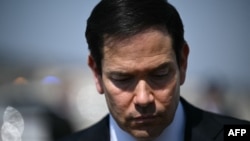
PARIS -- US Secretary of State Marco Rubio arrived in France early on March 27, joining G7 foreign ministers and allied representatives who have already gathered for the second day of a high-stakes meeting overshadowed by tensions over Iran, Ukraine, and global security.
Rubio is set to attend formal sessions of the G7 Foreign Affairs Ministerial in Cernay-la-Ville, near Paris. This will be his first face-to-face engagement with key allies since President Donald Trump intensified Washington's messaging on Iran.
The gathering, hosted nearby in the Vaux-de-Cernay Abbey under France's rotating G7 presidency, brings together top diplomats from Britain, France, Germany, Italy, Canada, the European Union, and Japan, along with guest countries, including Ukraine.
Strait Of Hormuz At Center Of Disputes
Ahead of his departure for Paris on March 26, Rubio signaled that a central message for allies would be the urgency of reopening the Strait of Hormuz, a critical global transit route effectively blocked by Iran.
"It's in their interest to help," Rubio told reporters at Joint Base Andrews in Maryland, emphasizing that US partners rely more heavily on energy flows through the strait than the United States does.
He declined to specify what kind of assistance Washington might seek, saying such decisions would fall to defense officials, but framed the issue as one requiring collective action.
"It's not help for us," Rubio said. "It's the world that has a great interest in that, so they should step up and deal with it."
The disruption has rattled global energy markets, with roughly one-fifth of the world's oil and liquefied natural gas typically passing through the waterway in peacetime.
Rubio said indirect talks with Tehran were continuing through intermediaries and described "some concrete progress," while cautioning that the situation remains fluid.
"There are intermediary countries that are passing messages," he said. "That's an ongoing process."
His comments align with Trump's earlier statement that discussions with Iran were "very substantial," as Washington pauses strikes on Iranian energy infrastructure until April 6 to allow space for diplomacy.
Allies Seek Coordination Amid Friction
The meeting marks the first in-person gathering of G7 foreign ministers since Trump publicly pressed allies to take a stronger stance on Iran -- a push that has exposed differences within the group.
While Washington has prioritized Iran and freedom of navigation in the Strait of Hormuz, several G7 countries remain focused on the war in Ukraine and are wary of deeper involvement in the Middle East crisis.
Rubio underscored longstanding US frustrations over burden-sharing, pointing to American support for Kyiv.
"Ukraine is not America's war, and yet we've contributed more to that fight than any other country," he said, adding that US policy ultimately answers to domestic priorities.
"I work for the people of the United States," Rubio said.
A Difficult Diplomatic Test
Analysts say Rubio faces a delicate balancing act as he engages with counterparts who are dealing with the economic fallout of the Hormuz disruption while weighing their own strategic priorities.
Paul Saunders, who served as undersecretary of state for global affairs during the Bush administration from 2003-05, told RFE/RL that the top US diplomat must juggle competing expectations.
"Secretary Rubio will have to navigate between US interests and needs, President Trump's expectations, other G7 members' perspectives and priorities, and France's goals as the host. It won't be easy," said Saunders, currently the president of the Washington think tank Center for the National Interest.
He added that frustration among allies could complicate discussions.
"Other G7 members are frustrated at having had an energy and economic crisis thrust upon them without warning," Saunders said, noting many are more focused on Ukraine -- and, in Japan's case, China.
France, he added, is also seeking to assert its independence and leadership role in Europe, "which could lead to some tense exchanges."
According to Saunders, the central question looming over the talks remains unresolved: "When and how will the Iran war end?"
Rubio is expected to join the March 27 sessions covering cross-cutting threats, support for Ukraine, the situation in Iran, and broader peace and security issues.
The discussions in Cernay-la-Ville will test whether the G7 can close ranks -- or whether divisions over Iran and global security will persist at a moment of mounting international strain.

