




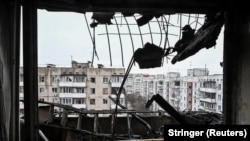
President Volodymyr Zelenskyy said that Kyiv is counting on a future trilateral meeting with the United States and Russia to take place in early March after Ukrainian and US negotiating teams wrapped up the latest round of peace talks in Switzerland.
Zelenskyy said in a video address on Telegram after the February 26 meeting in Geneva, Switzerland, that "there is more readiness for the next trilateral format.
"Most likely, the next meeting will be in the United Arab Emirates, in Abu Dhabi," he said.
Urging the finalization of what Ukrainian and US negotiators had "achieved" in drafting security guarantees for Ukraine -- widely seen as a key issue in ending the fighting sparked by Russia's four-year-old invasion of its neighbor -- Zelenskyy also called for a meeting with Russian President Vladimir Putin.
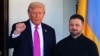
"Such a format can resolve a lot. The leaders decide on the key issues," he said.
A day earlier, after a call with US President Donald Trump, Zelenskyy said Trump supported a "sequence of steps" in negotiations that included such a meeting.
Kyiv has long characterized a direct leaders' summit as the best way to resolve the most complex issues and end the war.
The Kremlin has not publicly supported the idea, instead saying Zelenskyy could come to Moscow if he wanted to talk with Putin, something the Ukrainian leader has refused, instead saying it should be on neutral territory.
While there was no comment from Russia on the latest round of negotiations between Ukraine and the United States, Russian state news agency RIA Novosti reported that Putin's special envoy, Kirill Dmitriev, has also held talks with the US officials in Geneva.
According to RIA, Dmitriev refused to comment on the results.
The talks on February 26 came hours after Russian forces rained down drones and missiles on multiple Ukrainian regions, and also after Moscow sent Kyiv bodies of people apparently killed in the now four-year long war.
Earlier, Ukraine's chief negotiator, Rustem Umerov, confirmed that, in addition to economic issues, the latest negotiations included the "humanitarian track" and the possibility of further exchanges.
Russia and Ukraine have held numerous exchanges of prisoners and remains of killed soldiers during the conflict. On February 26, officials from the two countries said Moscow had returned what it said were the bodies of 1,000 Ukrainians.
The authorities in Kyiv said they "may belong to Ukrainian defenders" and that work would begin to identify them.
Vladimir Medinsky, a key aide to Putin who had previously led Russian delegations in Istanbul and Geneva, said Ukraine had returned the bodies of 35 Russian soldiers in exchange.
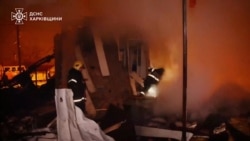


Alongside the diplomacy and the exchange, the brutal reality of the war continued.
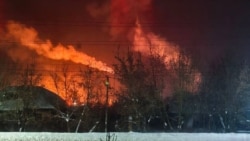
"Dozens of people are known to have been injured as a result of this attack, including children," Zelenskyy wrote on social media after an overnight barrage that he said included 420 drones and 39 missiles.
Targets included housing blocks, gas infrastructure, and electrical substations, he added.
Prior to the talks, US Secretary of State Marco Rubio -- who was not in attendance at the Geneva meeting -- said that only Washington could drive negotiations to end the war.
"The United Nations isn't going to do it. France isn't going to do it. The EU isn't going to do it. The Russians won't even speak to them. So we don't want to walk away from -- we know that, at the end, that war in Ukraine does not have a military solution," he said.
"If we forfeit that role, no one else can do it," he added.
The meeting in Geneva came two days after somber ceremonies across Ukraine marked the fourth anniversary of Russia's full-scale invasion and follows trilateral Russia-Ukraine-US talks on February 17-18.
Little substantive information has emerged from previous meetings, beyond vague descriptions of them being "difficult" in some areas while achieving "progress" in others.
After four years of full-scale war, estimates of overall casualty figures vary. But one recent report put the number of killed, wounded, and missing at 1.2 million Russians and 500,000-600,000 Ukrainians.
The World Bank said on February 23 that reconstructing the Ukrainian economy would cost an estimated $588 billion over a decade.

