Russian President Vladimir Putin observing a military flyby in Moscow on May 9.
MOSCOW -- President Vladimir Putin marked Victory Day calling for unity and a dignified honoring of those killed during World War II, even as the coronavirus pandemic curtailed the pomp the Kremlin had planned for Russia’s most important secular holiday.
With this year marking 75 years since the Nazi defeat, the Kremlin had hoped to turn already elaborate May 9 celebrations into a platform for Putin to host world leaders and promote what he sees as Russia’s rightful place on the world stage.
But the coronavirus has upended political life, and society in general, with millions under lockdown orders, the economy contracting, and Putin forced to limit his appearances to teleconferences with cabinet members and governors.
At a speech that marked his first public appearance in nearly a month, Putin did not mention the virus or its spread in Russia, focusing solely on the memory of the millions of Soviet citizens who died in what is known as the Great Patriotic War.
“We will, as usual, widely and solemnly mark the anniversary date, do it with dignity, as our duty to those who have suffered, achieved, and accomplished the victory tells us,” he said. “There will be our main parade on Red Square, and the national march of the Immortal Regiment -- the march of our grateful memory and inextricable, vital, living communication between generations.”
He also vowed that Russia would always remember the victims of the conflict, which killed an estimated 25 million Soviet citizens -- most of them civilians.
"We know and firmly believe that we are invincible when we stand together," he said.
Russia has nearly 200,000 confirmed cases of the coronavirus, and a death toll that stood at more than 1,800 as of May 9 -- a figure that many observers believe is an undercount.
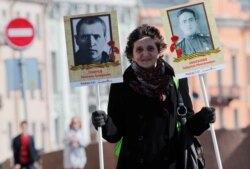
A woman holds portraits of her late relatives as she takes part in the Immortal Regiment memorial event during the celebrations of Victory Day in St. Petersburg.
Earlier, Putin laid flowers at the Tomb of the Unknown Soldier memorial, next to the Kremlin’s walls. Later on, 75 Russian jets and other warplanes roared over Red Square and the Moscow skyline.
While Victory Day has always been a major event, under Putin it has taken on even grander ceremonial importance, a reflection in part of how the Kremlin has sought to extol aspects of Soviet history and promote nationalist sentiment.
Russian authorities on May 9 reported the seventh straight daily increase in infections over 10,000, a further sign that the virus is tightening its grip on the country despite some early, strict moves by the government aimed at curtailing the disease’s spread.
The streets in the Russian capital’s central district were mostly empty of people, a contrast to past years when parks and boulevards were typically filled with people celebrating and handing flowers to veterans.
A heavy police presence was seen in many parts of the city, helping to enforce the strict lockdown measures that have been in place since late March.
Still, some Muscovites took to the streets in small groups to witness the flyover, gathering on street corners.
A group of Communist Party activists protested on Tverskaya Street, less than a kilometer from the Kremlin, against coronavirus-related prohibitions that kept them from publicly marching. Two members of the group were detained by police. The group included two members of Russia’s lower house of parliament.
Some people defied the restrictions to take to the streets displaying photos of grandparents who died in the war.
Irina Popova, 60, who owns a cosmetics business, told RFE/RL near Red Square that her grandmother always used to take her for walks through Moscow on Victory Day.
"You can’t not celebrate this day. It’s sacred,” she said. “It’s good to self-isolate, this thing is dangerous. But I got an [electronic] pass, so I’m allowed to go on the street.”
One day earlier, as most of Europe and the United States marked VE Day, Putin sent messages to U.S. President Donald Trump and British Prime Minister Boris Johnson, with reminders of cooperation among the war-time allies.
Putin and Trump spoke by phone on May 7, and the Kremlin said on May 8 that Putin and Johnson also spoke by phone, congratulating each other on the 75th anniversary.
"Both sides expressed readiness to establish dialogue and cooperation on issues on the agenda of Russian-British relations, as well as in solving pressing international problems," the Kremlin said.
Russia's Monumental Tributes To The 'Great Patriotic War'
1/17The Rear-Front Memorial in the Russian city of Magnitogorsk. The monument depicts a soldier and a steelworker holding a sword, with the worker facing the vast steel mills that supplied Soviet forces during World War II.
It is known in Russia as the "Great Patriotic War" and there are a number of imposing monuments across the country to mark the defeat of Nazi Germany in World War II. The Soviet Union suffered an estimated 25 million war deaths, half of whom were civilians. As Russia and other former Soviet states prepare to mark the 75th anniversary of the end of World War II on May 9, here is a look at some of Russia's monumental memorials.
Show moreShow less
2/17Russian President Vladimir Putin walks past the eternal flame that burns inside The Motherland Calls memorial on February 2, 2018, to mark the 75th anniversary of the Battle of Stalingrad. The southern Russian city, known today as Volgograd, saw bitter fighting between August 1942 and February 1943. The battle between Soviet and German forces is regarded as one of the bloodiest in history. The death toll for soldiers and civilians was about 2 million. Most of the city was reduced to rubble before Nazi forces surrendered on February 2, 1943.
It is known in Russia as the "Great Patriotic War" and there are a number of imposing monuments across the country to mark the defeat of Nazi Germany in World War II. The Soviet Union suffered an estimated 25 million war deaths, half of whom were civilians. As Russia and other former Soviet states prepare to mark the 75th anniversary of the end of World War II on May 9, here is a look at some of Russia's monumental memorials.
Show moreShow less
3/17Fireworks explode over the Motherland Calls statue, on top of the Mamayev Kurgan hill in Volgograd, Russia, on May 8, 2018. At 85 meters, it is the tallest statue in Europe.
It is known in Russia as the "Great Patriotic War" and there are a number of imposing monuments across the country to mark the defeat of Nazi Germany in World War II. The Soviet Union suffered an estimated 25 million war deaths, half of whom were civilians. As Russia and other former Soviet states prepare to mark the 75th anniversary of the end of World War II on May 9, here is a look at some of Russia's monumental memorials.
Show moreShow less
4/17Statue of soldiers marching to war at the Monument to the Heroic Defenders of Leningrad in St. Petersburg.
It is known in Russia as the "Great Patriotic War" and there are a number of imposing monuments across the country to mark the defeat of Nazi Germany in World War II. The Soviet Union suffered an estimated 25 million war deaths, half of whom were civilians. As Russia and other former Soviet states prepare to mark the 75th anniversary of the end of World War II on May 9, here is a look at some of Russia's monumental memorials.
Show moreShow less
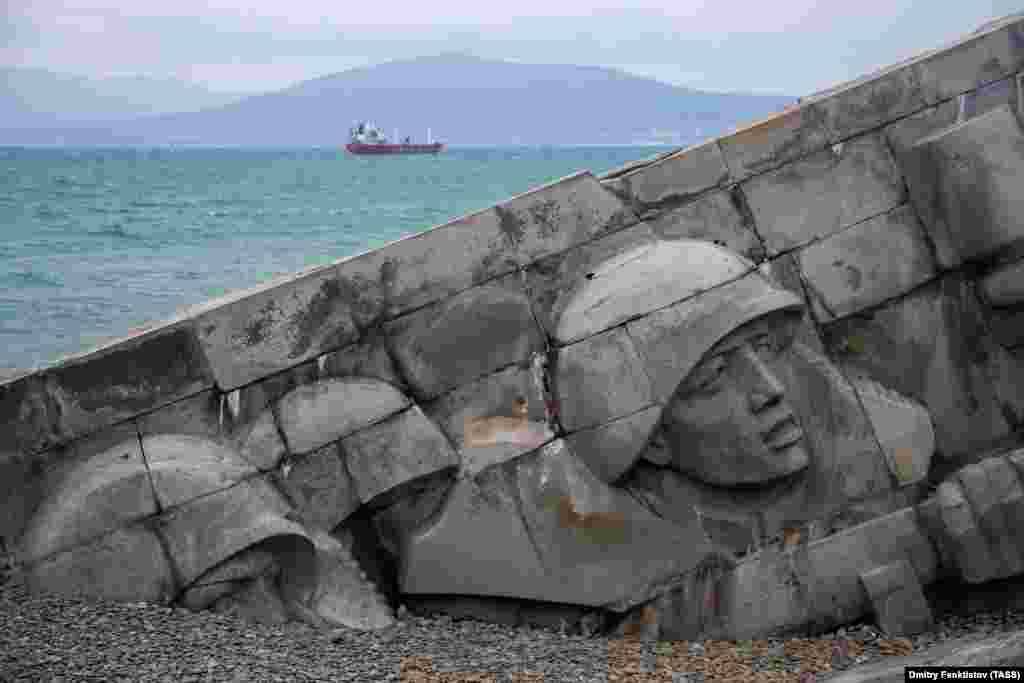
5/17The Malaya Zemlya Memorial Museum in Novorossiysk, Russia, on November 29, 2019. Overlooking the Black Sea, the memorial pays tribute to Soviet troops who recaptured the position from German forces in February 1943.
It is known in Russia as the "Great Patriotic War" and there are a number of imposing monuments across the country to mark the defeat of Nazi Germany in World War II. The Soviet Union suffered an estimated 25 million war deaths, half of whom were civilians. As Russia and other former Soviet states prepare to mark the 75th anniversary of the end of World War II on May 9, here is a look at some of Russia's monumental memorials.
Show moreShow less
6/17A triangular Malaya Zemlya memorial at Novorossiysk.
It is known in Russia as the "Great Patriotic War" and there are a number of imposing monuments across the country to mark the defeat of Nazi Germany in World War II. The Soviet Union suffered an estimated 25 million war deaths, half of whom were civilians. As Russia and other former Soviet states prepare to mark the 75th anniversary of the end of World War II on May 9, here is a look at some of Russia's monumental memorials.
Show moreShow less
7/17Workers clean the names of World War II soldiers at the Glory Monument in Novosibirsk on April 13, 2020.
It is known in Russia as the "Great Patriotic War" and there are a number of imposing monuments across the country to mark the defeat of Nazi Germany in World War II. The Soviet Union suffered an estimated 25 million war deaths, half of whom were civilians. As Russia and other former Soviet states prepare to mark the 75th anniversary of the end of World War II on May 9, here is a look at some of Russia's monumental memorials.
Show moreShow less
8/17People with portraits of their relatives who fought in World War II gather at the monument, called Motherland Hands A Weapon To Her Son, in the city of Tomsk on May 9, 2019, to mark the 74th anniversary of Soviet victory in the Great Patriotic War.
It is known in Russia as the "Great Patriotic War" and there are a number of imposing monuments across the country to mark the defeat of Nazi Germany in World War II. The Soviet Union suffered an estimated 25 million war deaths, half of whom were civilians. As Russia and other former Soviet states prepare to mark the 75th anniversary of the end of World War II on May 9, here is a look at some of Russia's monumental memorials.
Show moreShow less
9/17A memorial complex called Line of Defense in Russia's Novorossiysk in the Krasnodar region. The monument consists of four strong arms, tightly clutching machine guns dedicated to the soldiers who defended Novorossiysk.
It is known in Russia as the "Great Patriotic War" and there are a number of imposing monuments across the country to mark the defeat of Nazi Germany in World War II. The Soviet Union suffered an estimated 25 million war deaths, half of whom were civilians. As Russia and other former Soviet states prepare to mark the 75th anniversary of the end of World War II on May 9, here is a look at some of Russia's monumental memorials.
Show moreShow less
10/17The Monument To Defenders Of The Soviet Arctic in Murmansk, Russia. The 35-meter-high statue of a soldier is commonly called Alyosha by locals.
It is known in Russia as the "Great Patriotic War" and there are a number of imposing monuments across the country to mark the defeat of Nazi Germany in World War II. The Soviet Union suffered an estimated 25 million war deaths, half of whom were civilians. As Russia and other former Soviet states prepare to mark the 75th anniversary of the end of World War II on May 9, here is a look at some of Russia's monumental memorials.
Show moreShow less
11/17A military helicopter flies over a statue of the Mother Motherland at the Piskaryovskoye Memorial Cemetery in St. Petersburg during a rehearsal for the 2020 Victory Day parade. The monument pays tribute to the more than half a million Leningrad siege victims who were killed during World War II. The military parade to mark the 75th anniversary of the victory over Nazi Germany on May 9 is postponed due to the coronavirus outbreak, leaving only a flyby.
It is known in Russia as the "Great Patriotic War" and there are a number of imposing monuments across the country to mark the defeat of Nazi Germany in World War II. The Soviet Union suffered an estimated 25 million war deaths, half of whom were civilians. As Russia and other former Soviet states prepare to mark the 75th anniversary of the end of World War II on May 9, here is a look at some of Russia's monumental memorials.
Show moreShow less
12/17The Panfilov warriors memorial near the village of Nelidovo outside Moscow. Built in 1975, the memorial honors 28 Red Army soldiers known as Panfilov's 28, who heroically destroyed over a dozen German tanks during the Battle of Moscow in November 1941. Historians have doubted this account and some denounce the story as a myth.
It is known in Russia as the "Great Patriotic War" and there are a number of imposing monuments across the country to mark the defeat of Nazi Germany in World War II. The Soviet Union suffered an estimated 25 million war deaths, half of whom were civilians. As Russia and other former Soviet states prepare to mark the 75th anniversary of the end of World War II on May 9, here is a look at some of Russia's monumental memorials.
Show moreShow less
13/17The ceiling and a statue in the Hall of Glory in the Victory Museum at the Poklonnaya Hill War Memorial in Moscow.
It is known in Russia as the "Great Patriotic War" and there are a number of imposing monuments across the country to mark the defeat of Nazi Germany in World War II. The Soviet Union suffered an estimated 25 million war deaths, half of whom were civilians. As Russia and other former Soviet states prepare to mark the 75th anniversary of the end of World War II on May 9, here is a look at some of Russia's monumental memorials.
Show moreShow less
14/17Fireworks go off over Poklonnaya Hill to mark Defender of the Fatherland Day in Moscow on February 23. Located at the Poklonnaya Hill is the museum of the Great Patriotic War, which features 14,143 square meters of exhibition space on the territory of a 2,424-hectare park. Located in the center of the square is an obelisk and a statue of Nike, the Greek goddess of victory.
It is known in Russia as the "Great Patriotic War" and there are a number of imposing monuments across the country to mark the defeat of Nazi Germany in World War II. The Soviet Union suffered an estimated 25 million war deaths, half of whom were civilians. As Russia and other former Soviet states prepare to mark the 75th anniversary of the end of World War II on May 9, here is a look at some of Russia's monumental memorials.
Show moreShow less
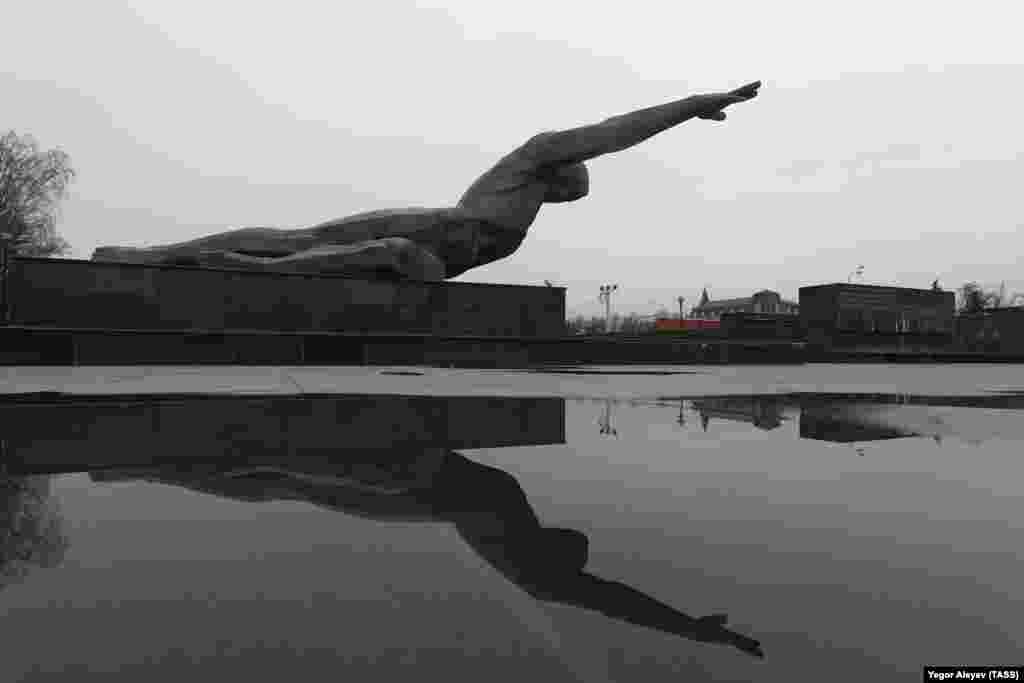
15/17A view of the Fallen Soldier Monument near Kazan's Gorky Park.
It is known in Russia as the "Great Patriotic War" and there are a number of imposing monuments across the country to mark the defeat of Nazi Germany in World War II. The Soviet Union suffered an estimated 25 million war deaths, half of whom were civilians. As Russia and other former Soviet states prepare to mark the 75th anniversary of the end of World War II on May 9, here is a look at some of Russia's monumental memorials.
Show moreShow less
16/17The Monument To The Heroes-Schoolchildren in Moscow. Placed well above pedestrians' heads, this monument is dedicated to the schoolboys who quit their studies and lost their lives after joining the Soviet military.
It is known in Russia as the "Great Patriotic War" and there are a number of imposing monuments across the country to mark the defeat of Nazi Germany in World War II. The Soviet Union suffered an estimated 25 million war deaths, half of whom were civilians. As Russia and other former Soviet states prepare to mark the 75th anniversary of the end of World War II on May 9, here is a look at some of Russia's monumental memorials.
Show moreShow less
17/17The Glory monument in the Russian city of Samara. The monument is dedicated to aircraft workers who worked in the city, which was formally known as Kuybyshev. During World War II, Kuybyshev was a major aircraft industrial center in the Soviet Union producing Ilyushin Il-2 and Ilyushin Il-10 ground-attack aircraft.
It is known in Russia as the "Great Patriotic War" and there are a number of imposing monuments across the country to mark the defeat of Nazi Germany in World War II. The Soviet Union suffered an estimated 25 million war deaths, half of whom were civilians. As Russia and other former Soviet states prepare to mark the 75th anniversary of the end of World War II on May 9, here is a look at some of Russia's monumental memorials.
Show moreShow less
Previous slide
Next slide
In his message to Trump, Putin said Russia and the United States stood at the forefront of confronting global challenges and “could do a lot to ensure international security and stability."
While Russia’s celebrations were curtailed, Belarus went ahead with parade watched by thousands of spectators in the capital Minsk,
Elsewhere across Europe, VE Day events had to be postponed, canceled, or reduced to online commemorations.
In Washington, D.C., Trump joined seven World War II veterans, ages 96 to 100, at a wreath-laying ceremony to commemorate the anniversary.
With reporting by RFE/RL correspondent Matthew Luxmoore in Moscow, Reuters, AFP, and TASS
RFE/RL journalists report the news in 24 languages in 18 countries where a free press is banned by the government or not fully established. We provide what many people cannot get locally: uncensored news, responsible discussion, and open debate.