




NEW YORK -- The Trump administration is trying to turn a US-brokered opening between Armenia and Azerbaijan into something more tangible: a transport corridor linking Central Asia and the South Caucasus with Western markets -- and an investment opportunity for American companies.
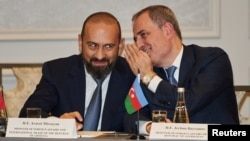
Senior regional officials and executives from more than 40 companies gathered in New York on September 23 to discuss the next steps for the Trump Route for International Peace and Prosperity (TRIPP), a centerpiece of Washington's efforts to turn the Armenia-Azerbaijan opening into greater regional trade and investment.
The event, held on the sidelines of the UN General Assembly, featured US special envoy Steve Witkoff and Republican Senator Steve Daines of Montana, as well as officials from Armenia, Azerbaijan, Georgia, and the five Central Asian states.
The challenge now is turning a political agreement into steel, asphalt and investment. No construction has begun, feasibility studies are still underway, and companies are not expected to begin competing for major contracts until late 2026 or early 2027.
Washington envisions TRIPP as a multimodal corridor through southern Armenia linking Azerbaijan with its Nakhchivan exclave while creating a wider east-west connection between the South Caucasus, Central Asia and Western markets.
The proposed Armenian section is only about 43 kilometers long, but it seeks to resolve one of the most contentious issues to emerge from decades of conflict between Armenia and Azerbaijan: how to connect mainland Azerbaijan with Nakhchivan through Armenian territory.
Armenia and Azerbaijan fought two major wars over Nagorno-Karabakh, an internationally recognized part of Azerbaijan that for decades had a predominantly ethnic-Armenian population. Azerbaijan regained full control of the territory in 2023, prompting almost all of its ethnic-Armenian population to flee.
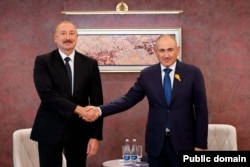
The two countries agreed on the text of a peace treaty in March 2025 but have yet to complete a final agreement. At a White House summit five months later, Armenian Prime Minister Nikol Pashinian and Azerbaijani President Ilham Aliyev signed a US-brokered joint declaration aimed at ending decades of conflict and opening regional transport links. TRIPP emerged from that agreement.
TRIPP is intended to provide unimpeded transit between mainland Azerbaijan and Nakhchivan through Armenian territory while preserving Armenia's sovereignty, territorial integrity and jurisdiction -- a politically important provision given long-running disputes over control of the route.
The project would be developed by a US-Armenian company in which the United States would have a controlling stake, giving Washington a significant role in a strategically important region where Russia has traditionally wielded considerable influence.
Under the plan, the Armenian section would eventually carry rail and road links as well as energy and digital infrastructure.
From Peace Deal To Trade Route
Witkoff credited Pashinian and Aliyev with recognizing that a peace agreement offered a better alternative to decades of conflict.
“Unlike many other conflicts that we see in the world, we had all the ingredients of a deal here,” Witkoff said, describing the two leaders as “incredibly pragmatic and mature.”
He also credited Trump with pushing the process forward after US officials found communication between Yerevan and Baku had stalled.
The focus in New York, however, was on whether the diplomatic opening can now produce economic benefits.
Witkoff said the economic implications of TRIPP had become increasingly apparent as officials and companies examined its potential role in international supply chains.
“Everybody's focused now on transmission and speed to market,” he said, citing estimates that the route could cut some trade journeys by up to three weeks.
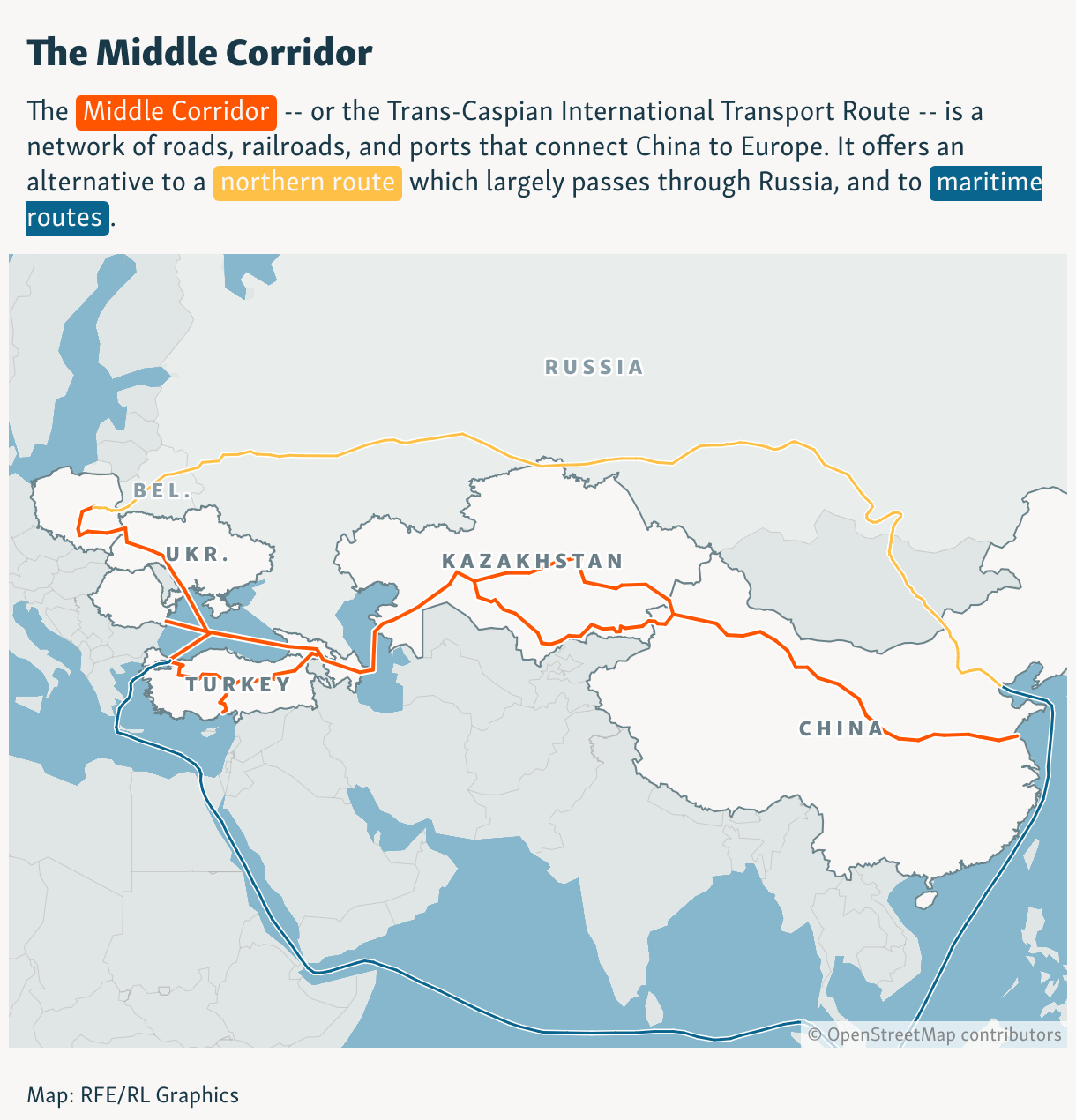
TRIPP could feed into the wider Trans-Caspian, or Middle Corridor, an east-west network carrying goods between China and Central Asia through the Caspian Sea, the South Caucasus and onward to Europe. The route has attracted increased attention as governments and businesses seek alternatives to traditional transit routes through Russia.
Witkoff said he expected the project to generate “huge investment,” particularly in Armenia.
Speaking separately in New York on September 23, Pashinian said implementation of TRIPP would “fully unlock” regional connectivity and “open a new era” for Armenia and its economy.
For now, however, the corridor remains largely on paper.
The State Department says engineering and feasibility studies are examining the proposed railway route, including technical, environmental and social considerations. A separate pre-feasibility study is looking at placing energy and digital infrastructure alongside transportation links.
Officials expect the railway feasibility work to be completed by late 2026 or early 2027, after which companies could bid for contracts. Construction of the railway would take at least another 18 months, while electricity connections could potentially begin operating in 2027.
Bringing In US Capital
Washington is also building financial and corporate structures intended to turn those plans into investable projects.
The United States and Armenia are establishing a TRIPP Development Company, a joint venture in which Washington is expected to hold a majority stake and which would oversee infrastructure development and competitive tenders.
A separate Trans-Caspian Enterprise Fund is intended to mobilize private capital for connectivity projects across the wider region.

Andrew D'Anieri, associate director of the Atlantic Council's Eurasia Center, said the two initiatives signaled deeper US economic engagement.
“Advancing TRIPP and announcing the Trans-Caspian Enterprise Fund in the presence of senior regional officials and major US companies sends a strong signal that America means business,” D'Anieri told RFE/RL.
“TRIPP will advance more slowly given the degree of technical project difficulty and geopolitical sensitivities,” he said.
A New Route Through A Crowded Region
Those sensitivities extend well beyond Armenia and Azerbaijan. The South Caucasus connects Europe with Central Asia in a region where Russia, China, Iran and Turkey all have significant interests.
Angela Howard, a research analyst at the Foundation for Defense of Democracies' Center on Economic and Financial Power, said US-backed infrastructure could create new trade links while reducing dependence on Russian-controlled or influenced routes.
“US investment in the Caucasus places an American foot in the gateway to Central Asia,” she told RFE/RL.

She cautioned, however, that US-backed projects would require safeguards against corruption and foreign influence.
“Strong guardrails and extensive oversight will be critical moving forward,” Howard said.
Daines said Washington needed to sustain its engagement and argued that the region should be viewed not only through the lens of past conflicts but also as a potential hub for trade and investment.
For now, the political framework exists, but engineering studies, financing, tenders and construction still lie ahead. As one senior US official put it, “We are not at that stage yet.”

