




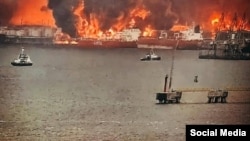
Three days of Ukrainian drone attacks on ports and refineries in Russia's Leningrad region have led to what one analyst called "the most serious threat" to Russian oil exports since the beginning of the Kremlin's full-scale invasion of Ukraine in 2022.
Beginning on March 23 with a drone attack on the Baltic port of Primorsk, the attacks continued two days later with strikes on another key oil export terminal at Ust-Luga before targeting one of Russia's largest refineries in the Kirishi district on March 26.
Leningrad regional Governor Aleksandr Drozdenko has kept up a steady commentary on the attacks on his Telegram channel, documenting fires over the first two days and "damage in the industrial area" of the Kirishi district in the latest incident.
Independent analysts suggest Ukraine has achieved a major blow against Russia's oil exports at a time when Russia was aiming to benefit from increased global oil prices and a US sanctions waiver due to the war with Iran.
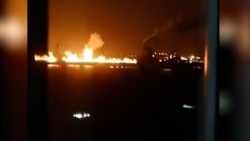

"This is the most serious threat to exports of Russian oil and oil products since the war began," said energy analyst Boris Aronshtein.
"The thoughtfulness, the scale and direction of the attacks, as well as the timing of their execution -- all of this together produced an effect that I personally cannot recall in the four-plus years of the war," he told Current Time on March 26.
Severe Disruption
A Reuters analysis on March 25, before the latest attack, estimated 40 percent of Russia's export capacity had been halted, describing it as "the most severe oil supply disruption in the modern history of Russia."
Aronstein said the figure would be closer to 50 percent.
The estimates take into account not only the damage from the strikes in northern Russia but also reduced export traffic through other routes such as the Black Sea port of Novorossiisk and the Druzhba pipeline through Ukraine, as well as disruptions caused by seizures of Russian tankers from its so-called shadow fleet.
Druzhba has been out of action since being damaged in a Russian attack in January, according to Ukrainian authorities. It was used to supply oil to Hungary and Slovakia.
A number of Russian shadow fleet tankers have been seized in recent months.

On March 25, British Prime Minister Keir Starmer said Royal Navy ships would now also seize them, following interceptions by the United States, France, Finland, Sweden, and Estonia.
"We should go after the shadow fleet even harder," Starmer said at a diplomatic meeting in Helsinki. In a video address to the same meeting, Ukrainian President Volodymyr Zelenskyy called on European nations to confiscate oil from Russian tankers.
Other tankers have been attacked by Ukrainian drones in the Black Sea. On March 26, a tanker carrying Russian crude oil was attacked by a drone in waters near Istanbul.
"An explosion was reported in the engine room of a Turkish-operated, foreign-flagged ship that had recently left Russia. We suspect the blast was caused by an unmanned underwater vehicle," Turkish Transport Minister Abdulkadir Uraloglu told local broadcaster 24TV.
Long-Term Damage?
It's not clear how long the recent spate of attacks in the Leningrad region will disable Russian oil exporting infrastructure there.
"As far as we know, in both ports there has been serious damage to the terminals themselves and, above all, to the oil depots. Several of them were on fire in both Primorsk and Ust-Luga," military analyst Yan Matveyev told Current Time.
"The main question is how badly damaged the port infrastructure for transshipments of oil and oil products was…. If the equipment itself was damaged, it could lead to a serious pause in the loading of oil and fuel," he added.
There may be a clue to the duration of the impact of these attacks from similar Ukrainian strikes elsewhere. In November, naval drones hit an oil-loading facility off the coast of Novorossiisk. It was not until late January that full operations were resumed.

This month, there was another decline in loading at Novorossiisk following a Ukrainian drone strike on an oil pumping station that serves the port. Ukrainian strikes have also hit oil targets in the Caspian Sea.
The Center for Research on Energy and Clean Air, a Finnish-based think tank that tracks energy usage across Europe, said Primorsk, Ust-Luga, and Novorossiisk had not loaded any oil for the last five days.
"While Russia has previously restored damaged refineries within weeks, Ukraine's campaign of repeated drone strikes has deliberately slowed recovery timelines," CREA analyst Isaac Levy told RFE/RL.
"Refineries have been re-hit during repairs or restarts, often in two-three week cycles, keeping key sites offline and turning routine maintenance into prolonged disruptions," he added.
What Benefit From High Oil Prices?
CREA figures show a 20 percent increase in Russia's daily oil revenues in the 24 days following the start of the US-Israeli war compared to the February average. Russian tankers were now unloading oil and available for new shipments, Levy said.
Speaking in Moscow on March 26, Russian Deputy Prime Minister Aleksandr Novak did not directly address the degree to which the country's oil exports have been hit by Ukrainian strikes and by ship seizures.
However, he emphasized Russia has "diverse routes" for oil exports, mentioning the East Siberia-Pacific Ocean pipeline and the Skovorodino-Mohe pipeline, which both supply China.
"We have these backups, and we will use them," he added.

China is also a major importer of seaborne Russian oil, but its capacity to absorb huge new volumes is limited. The country has already been stockpiling oil reserves for months, and there are also tankers laden with both Russian and Iranian crude idling in waters off Chinese ports in the Yellow Sea.
Some analysts have questioned how much Russia can benefit overall from high oil prices.
"At around $5 billion per month, the war-driven oil windfall is in fact little more than a band-aid for a fiscal deficit that reached $40 billion in January-February alone," Agathe Demarais wrote in an analysis for the European Council for Foreign Affairs on March 24.
"After more than 12 years of sanctions, Moscow's oil infrastructure is decaying, with just 300,000 barrels per day of spare capacity -- hardly enough to compensate for the 10-15 million barrels per day lost in Gulf exports. With no certainty that the war will drag on, Russian oil firms are unlikely to ramp up investment anytime soon. Ukraine's drone strikes, now reaching as far as the Caspian Sea, only add to the strain," she added.


