




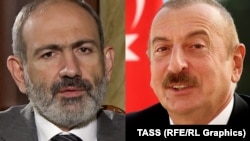
WASHINGTON -- Azerbaijani President Ilham Aliyev and Armenian Prime Minister Nikol Pashinian were back in Washington this week, just days after US Vice President JD Vance visited both countries. The White House has branded the effort a "Board of Peace" push aimed at consolidating momentum toward a formal settlement.
The optics were striking: two leaders whose countries fought two wars in the past five years appearing together under US auspices, following a White House summit hosted by President Donald Trump on August 8, 2025.
At that earlier meeting, the sides initialed a peace agreement, signed a joint declaration affirming their commitment to respect sovereignty and territorial integrity, and announced the Trump Route for International Peace and Prosperity (TRIPP), a US-backed transit initiative linking Azerbaijan to its Nakhichevan exclave through Armenian territory.
But nearly six months later, a central question remains: Has the political breakthrough translated into irreversible peace?
'Not An Endpoint'
Speaking at the Hudson Institute on February 20, US Deputy Assistant Secretary of State Sonata Coulter described the August summit as "a decisive moment for the South Caucasus."
"That summit was not an endpoint. It was the beginning of a new chapter," she said, adding that Washington has since focused on turning what she called a diplomatic breakthrough into "durable progress on the ground."

Coulter said both governments have taken "concrete steps to normalize relations, to open channels of commerce and transit, and to create the institutional foundations" aimed at making peace sustainable.
She framed the administration's policy in economic terms. "If leaders choose peace, we will back them with the tools that translate peace into prosperity," she said, citing investment, security cooperation, and programs intended to strengthen sovereignty and economic independence.
At the center of that approach is TRIPP, which was designed, in US terms, to facilitate the movement of "people, goods, energy, and ideas" across the region and reduce incentives for renewed conflict.
During his recent visit to Yerevan and Baku, Vance said in Armenia that "peace is not made by cautious people" and "is made by people who are focused on the future." Coulter said that sentiment reflected the tone of US engagement with both capitals.
Economic And Security Incentives
Coulter outlined several initiatives announced during Vance's trip.
They include the creation of a TRIPP Enterprise Fund, seeded with roughly $200 million, aimed at mobilizing private capital along the trans-Caspian corridor in areas such as transportation, logistics, energy, and critical minerals.
In Armenia, the United States approved export licenses for Nvidia-based high-powered servers and related data center equipment, part of what officials describe as a planned multibillion-dollar investment in Armenia's information technology sector. The two countries also completed negotiations on a civil nuclear cooperation agreement, opening the way for potential US small modular reactor technology and long-term partnerships.
Washington additionally announced its first-ever foreign military sales case for Armenia -- $11 million to provide surveillance drone capability -- as part of what US officials describe as support for Armenia's defense transformation.
In Azerbaijan, Vance signed a strategic partnership charter covering cooperation in security, energy, digital development, and trade. He also announced that four patrol boats and body armor for the Azerbaijani Coast Guard would be delivered. A US Chamber of Commerce delegation traveled to Baku during the visit to explore commercial ties.
"These initiatives are not abstract," Coulter said. "They are concrete instruments that provide for a durable peace."
The Election Factor
Even as Washington emphasizes economic integration, analysts say domestic politics -- particularly in Armenia -- will shape the trajectory of the peace process.
Andrew D'Anieri of the Atlantic Council's Eurasia Center told RFE/RL that Coulter's mention of the TRIPP Enterprise Fund was notable, describing it as potentially "the more immediately usable pot of money" to help kick-start construction linked to the corridor.
But he pointed to Armenia's upcoming parliamentary elections as the most immediate variable.

"The biggest current question mark is the Armenian election," he said, noting that Pashinian's party must secure another mandate to remain in power.
D'Anieri added that many observers expect Russia to attempt to influence the vote, arguing that Moscow has been critical of what he described as Pashinian's efforts to pursue a pragmatic peace course.
"We'll know much more about prospects for peace after the June election," he said.
External Pressures
Richard Kauzlarich, a former US ambassador to Azerbaijan, said the relationship between the Armenian and Azerbaijani leaderships appears to have stabilized at a political level.
"The relationship appears to have stabilized -- in a positive state -- at the leadership level," he told RFE/RL, saying the recent Washington meeting allowed the two leaders to demonstrate cooperation under US sponsorship.
However, he noted this has not yet resulted in a finalized peace treaty.
At the same time, Kauzlarich warned that broader geopolitical tensions could complicate progress. With US-Iran relations strained, he said, Tehran may seek to counter what it views as expanding American influence in the South Caucasus, particularly around the TRIPP initiative.

He also cited what he described as growing rhetorical opposition from Moscow to US activity in both Armenia and Azerbaijan, including reported Russian concerns over US-Armenia nuclear cooperation.
"I don't expect either Iran or Russia to accept an easy US win in the South Caucasus," Kauzlarich said, adding that wider US-Russia negotiations over Ukraine could indirectly affect regional dynamics.
What Comes Next?
For now, the Trump administration is seeking to anchor peace in infrastructure, trade, and security cooperation, arguing that shared economic interests can help prevent renewed conflict.
Key steps ahead include finalizing and ratifying a comprehensive peace agreement, ensuring political stability in Armenia following elections and beginning visible work on transit and connectivity projects linked to TRIPP.
Whether the current momentum becomes self-sustaining may depend less on announcements in Washington and more on developments in Yerevan and Baku -- and on how regional powers respond.
As Coulter put it in closing her remarks, quoting Vance: "We don't just want to make peace, we also want to make sure that peace endures."

