


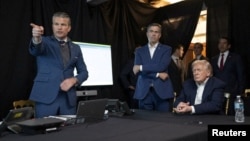
With deposed Venezuelan leader Nicolas Maduro in a US jail, President Donald Trump warned the South American country's authoritarian rulers they will "pay a very big price” if they don't “cooperate” with Washington, even amid global concerns over the US military strike.
Trump, in an interview published on January 4 in The Atlantic, warned then Vice President Delcy Rodriguez that “if she doesn’t do what’s right, she is going to pay a very big price, probably bigger than Maduro.”
The leftist Rodriguez, who was Maduro’s vice president before being named acting president on January 4 and officially sworn in a day later, called the US action a violation of the UN Charter and vowed that “we will never be slaves again.”
Maduro on January 4 was sitting in a US jail after being transported to New York following his capture by American forces in the strike that was condemned by Iran, Russia, and other allies of the South American country but hailed by Venezuelans living in exile.
A video posted by Fox News on social media showed Maduro, 63, being escorted by federal agents and telling reporters, "Good night, Happy New Year."
He and his wife -- who was also captured in the raid -- later appeared in court on January 5 to face drug charges and entered a not guilty plea.
In a news conference on January 4, Trump hailed the military operation in Venezuela but did not provide details of the action. A top US general said 150 US aircraft were involved in the strike following months of preparations.
Casualty figures were not revealed. Trump said some US personnel were injured but doing well. Meanwhile, Cuba said that 32 members of its security forces were killed in Venezuela during the US attack.
US To 'Run' Venezuela
Trump caused a stir when he said the United States will temporarily "run" the South American country "until such time as we can do a safe, proper, and judicious transition."
It wasn't immediately clear what Trump meant by having the United States "run" the country. He told reporters he was "designating people" from his cabinet to be in charge in Venezuela, without providing details.
US administration officials -- including Secretary of State Marco Rubio -- did not offer clarifications when pressed during January 4 TV news programs about Trump's plan.
Rodriguez Appears Conciliatory
Rodriguez assumed the role of acting president of the left-wing government following a swearing-in ceremony at the parliament in Caracas.
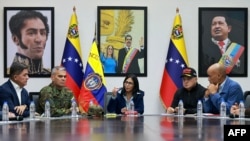
Trump initially expressed support for Rodriguez, saying "she's essentially willing to do what we think is necessary to make Venezuela great again."
Rodriguez -- who is supported by the Venezuelan military -- first appeared defiant, calling Maduro the "only president" of the country and labeling the US strike a "terrible stain" on relations.
After Trump signaled he was ready to conduct a second wave of military actions in Venezuela if necessary, Rodriguez was more conciliatory, writing on social media early on January 5 that Caracas sought a "balanced and respectful" relationship with Washington
"We extend an invitation to the US government to work together on an agenda for cooperation that is aimed toward shared development," she wrote.
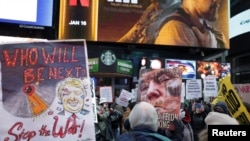
The US strikes in Venezuela and Maduro's capture were strongly condemned by some of Caracas's allies, as well as by UN Secretary-General Antonio Guterres, who said the US military action sets a "dangerous precedent."
News agencies cited sources as saying the UN Security Council will meet at 10 a.m. on January 5 to discuss the US operation. Colombia, backed by Russia and China, requested the session, diplomats said.
Russia, Iran, Others Condemn Action
Moscow, which maintains close ties with Venezuela, said it was extremely concerned by reports that Maduro and his wife had been forcibly removed from the country and urged the United States to release them.
Former Russian President Dmitry Medvedev, who has a history of exchanging threats with Trump, wrote on X that the US strikes on Venezuela had nothing to do with efforts to combat drug trafficking, adding that he doubted whether Washington could "run Venezuela remotely."
Some Kremlin critics consider Medvedev -- currently deputy chairman of Russia's Security Council -- an irresponsible extremist, while others say his statements reflect the thinking of many senior Russian policymakers.
Iran, another key ally of Venezuela, condemned the US attack, according to Iranian state outlet Press TV, saying the action violated Venezuela's sovereignty and territorial integrity as well as the UN charter.
Serbian President Aleksandar Vucic, who recently called Maduro "a great friend of Serbia," on January 3 said it was "clear" the international legal order and the UN Charter "do not function."
"The world is dominated by the law of force, the law of the stronger, and that is the only principle of modern politics that exists in the world today," Vucic told a national-security council meeting in Belgrade.
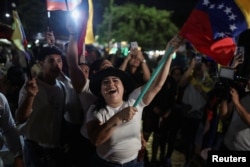
Meanwhile, celebrations by Venezuelans living abroad marking Maduro's capture were held across Latin America cities, Spain, and elsewhere.
"We are free. We are all happy that the dictatorship has fallen and that we have a free country," Reuters quoted Khaty Yanez, a Venezuelan woman in Santiago who has spent seven years in Chile.
In Peru's capital, Lima, migrant Milagros Ortega, whose parents are still in Venezuela, said she hoped to go back. "Knowing that my dad was alive to see the fall of Nicolas Maduro is very emotional. I would like to see his face," she said.
Some Western Allies Cautious
Many of Washington's allies, while expressing no liking for Maduro or his regime, did caution over the need to follow international law.
British Prime Minister Keir Starmer said that "we regarded Maduro as an illegitimate president and we shed no tears about the end of his regime," adding, "I reiterated my support for international law this morning."
German Chancellor Friedrich Merz said Maduro had "led his country to ruin," but he called the US action legally "complex."
However, right-wing populist Italian Prime Minister Giorgia Meloni -- an ally of Trump's -- called the US action "legitimate" and "defensive."
Others, such as Ukraine, North Macedonia, Albania, and Kosovo, said following the strikes that they stand firmly with Washington and its most direct intervention in Latin America since the 1989 invasion of Panama.
"I welcome [Trump's] announcement that Nicolas Maduro has been arrested and will face justice. We stand with the United States and the Venezuelan people for freedom and democracy," North Macedonia Foreign Minister Timco Mucunski said on social media.
European Union countries, excluding Hungary, called on all sides in Venezuela to show restraint, saying respect for the will of the Venezuelan people was key to restoring democracy.
"The European Union calls for calm and restraint by all actors, to avoid escalation and to ensure a peaceful solution to the crisis," the joint statement by the 26 countries said.
The US military action came after months of rising economic and military pressure from Washington on the South American country, including intercepting Venezuelan oil tankers and killing dozens in strikes on boats near its waters that were allegedly carrying drugs.
Washington also contested Maduro's legitimacy as president since he was the hand-picked successor to Hugo Chavez in 2013, pointing to successive elections the opposition and others said were rigged in his favor.