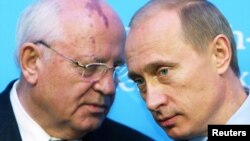
Mikhail Gorbachev (left) speaks to Russian President Vladimir Putin at a news conference in Schleswig, Germany, in December 2004. Over more than two decades of cautious relations with the Russian president, the former Soviet leader was at least tacitly supportive at some crucial junctures.
Near the dilapidated dormitory where I lived for a few months in 1989, close to the notorious Lefortovo jail in east-central Moscow, signs painted on the fence of a disused sports field, if memory serves, bore an upbeat slogan borrowed from the Olympics: “Faster, Higher, Stronger.”
But to a foreigner in the Soviet Union at that time, things seemed to be headed in the opposite direction. Moscow was drab and threadbare and there were lines at shops for staples like bread, butter, and cheese, some of which were rationed, while the command economy meant that a store might have nothing anybody wanted but be bursting with a single, shoddily made item that nobody needed.
If the economy appeared to hold little promise amid the plodding pace of “perestroika” reforms, the picture was brighter when it came to “glasnost” -- openness in a long-closed society, and steps toward democratic reform. Newspapers and the “fat journals” were examining the crimes of the Stalin era, now safe to criticize, and the first elections in which voters had a genuine choice were held that spring.
Less than three years later, the Soviet Union was no more: its first and last president, Mikhail Gorbachev, resigned on December 25, 1991, stepping down as the leader of a country that was doomed by a complex combination of economic strains and the desire -- among both individuals nationwide and the individual republics that made up the U.S.S.R., from the Baltics and Ukraine to the South Caucasus and Central Asia -- for freedom from its restrictive dominion.
For a man who had such a momentous global influence until that day, his direct role afterwards was in many ways minimal. He ran for president in 1996 but received about 0.5 percent of the vote in the first round of an election won by the incumbent Boris Yeltsin, his longtime rival in a power struggle in which Yeltsin had already prevailed five years earlier.
Deadly Crackdowns
While Gorbachev changed the world by letting the countries of the Warsaw Pact break free of the Soviet yoke in 1989, perhaps acknowledging that to try to stop them with force would be folly, he certainly did not want the Soviet Union to fall apart. He authorized deadly crackdowns in hopes of keeping it together against the will of millions of citizens, including a KGB and military operation in Lithuania that killed 14 civilians in January 1991.
In the decades after its demise, a frequent theme in Gorbachev’s comments was the argument that the Soviet Union could have been preserved, albeit in a looser form that he was trying to establish as a way to avert its collapse. But this notion commanded little attention in Russia or abroad after the fact: that ship had sailed.
Mikhail Gorbachev: A Life In Pictures
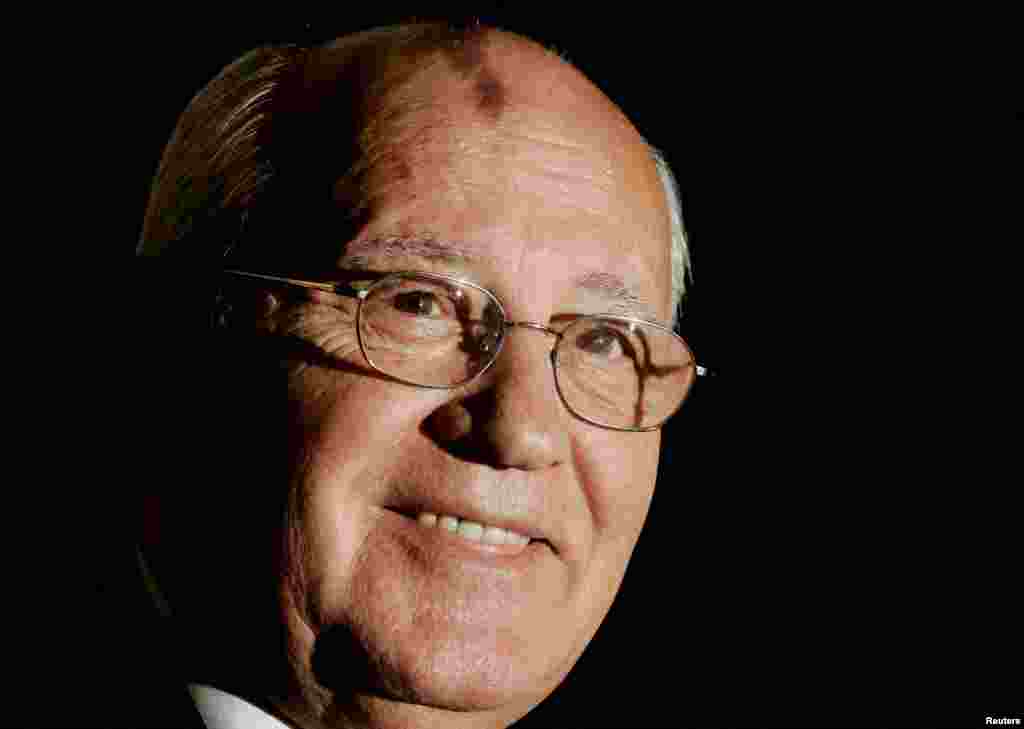
1/25Former Soviet leader Mikhail Gorbachev, who died on August 30 at age 91, speaks during a news conference marking the 20th anniversary of perestroika at the U.S. Chamber of Commerce in Washington, D.C., on October 21, 2005.
Gorbachev said: "The more I think about my life, the more I see that the biggest and most important events took place unexpectedly."
The legacy of Mikhail Gorbachev, the man who oversaw the breakup of the Soviet Union, remains a divisive topic in Russia. But whether lauded by advocates of his "openness" or loathed by people who see the U.S.S.R.'s collapse as a disaster, his influence on modern history was enormous.
Show moreShow less
2/25Mikhail Sergeyevich Gorbachev was born on March 2, 1931. Misha, as he was known, is seen with his grandparents at age 3.
The legacy of Mikhail Gorbachev, the man who oversaw the breakup of the Soviet Union, remains a divisive topic in Russia. But whether lauded by advocates of his "openness" or loathed by people who see the U.S.S.R.'s collapse as a disaster, his influence on modern history was enormous.
Show moreShow less
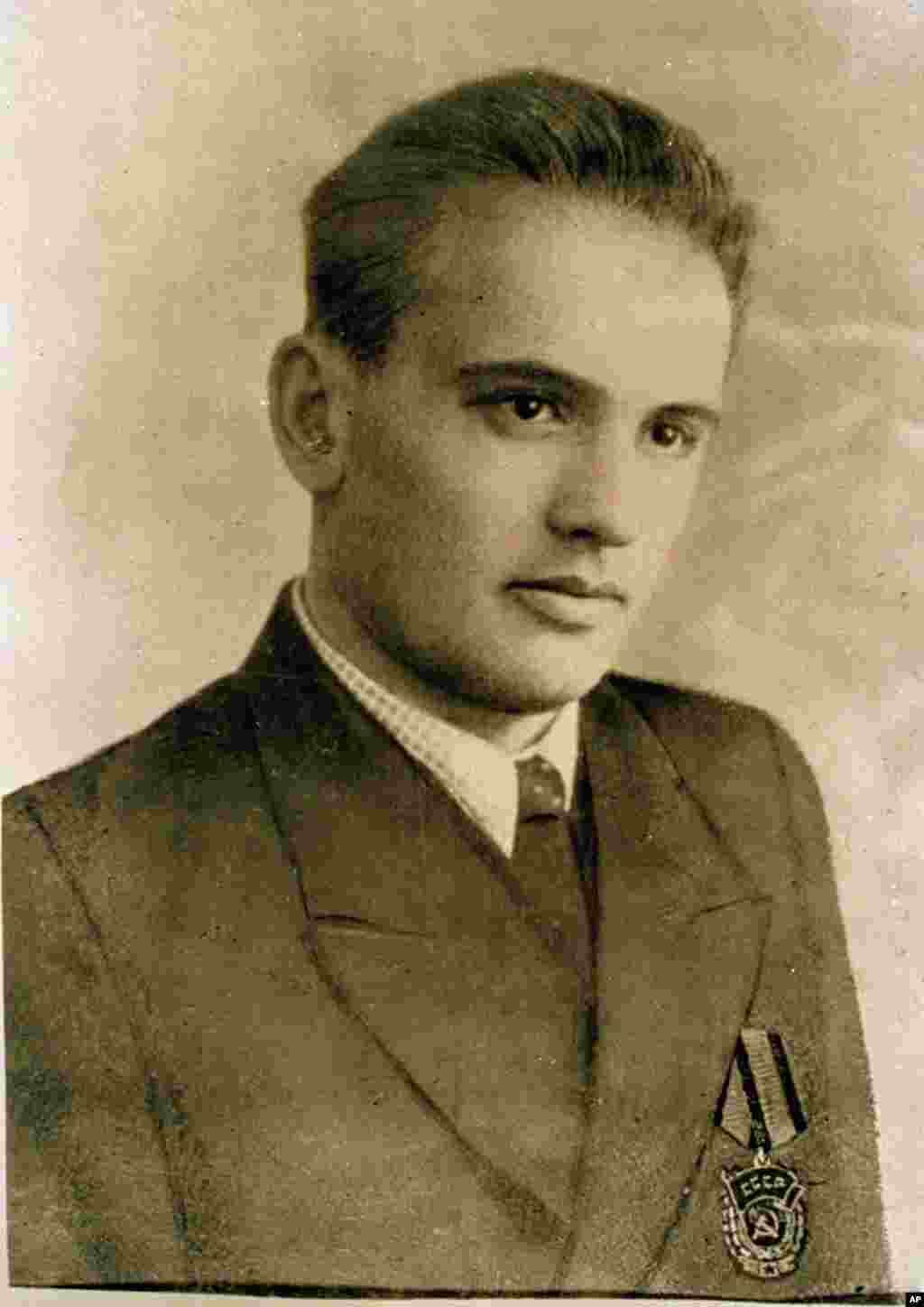
3/25A young Gorbachev at the age of 19, wearing the Red Banner of Labor medal he received for driving a harvest combine on the plains of southern Russia.
The legacy of Mikhail Gorbachev, the man who oversaw the breakup of the Soviet Union, remains a divisive topic in Russia. But whether lauded by advocates of his "openness" or loathed by people who see the U.S.S.R.'s collapse as a disaster, his influence on modern history was enormous.
Show moreShow less
4/25A portrait of Raisa Gorbacheva and Mikhail Gorbachev, who were married in September 1953. They were married for 46 years before Raisa died of leukemia in 1999.
The legacy of Mikhail Gorbachev, the man who oversaw the breakup of the Soviet Union, remains a divisive topic in Russia. But whether lauded by advocates of his "openness" or loathed by people who see the U.S.S.R.'s collapse as a disaster, his influence on modern history was enormous.
Show moreShow less
5/25A young Gorbachev leads a Communist Party delegation in Stavropol in 1966. It was in Stavropol that he began his career in the party that he would eventually come to lead.
The legacy of Mikhail Gorbachev, the man who oversaw the breakup of the Soviet Union, remains a divisive topic in Russia. But whether lauded by advocates of his "openness" or loathed by people who see the U.S.S.R.'s collapse as a disaster, his influence on modern history was enormous.
Show moreShow less
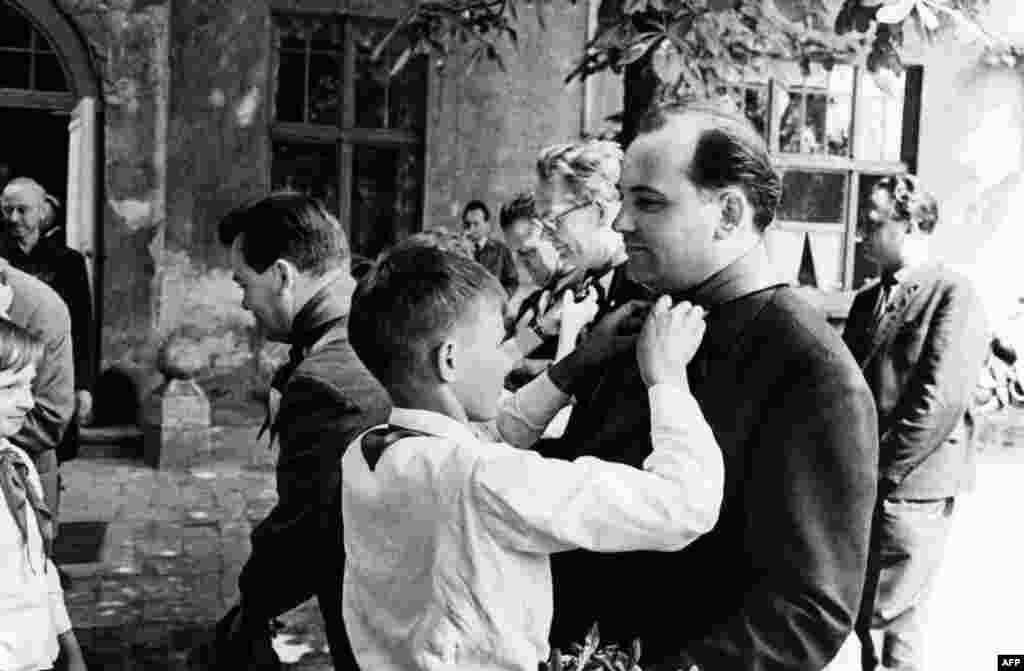
6/25Gorbachev (third from right) at a celebration in Stavropol in the 1960s of the October Revolution. The young communist rose quickly through the ranks of the party.
The legacy of Mikhail Gorbachev, the man who oversaw the breakup of the Soviet Union, remains a divisive topic in Russia. But whether lauded by advocates of his "openness" or loathed by people who see the U.S.S.R.'s collapse as a disaster, his influence on modern history was enormous.
Show moreShow less
7/25With his wife, Raisa, and British Prime Minister Margaret Thatcher in 1984.
The legacy of Mikhail Gorbachev, the man who oversaw the breakup of the Soviet Union, remains a divisive topic in Russia. But whether lauded by advocates of his "openness" or loathed by people who see the U.S.S.R.'s collapse as a disaster, his influence on modern history was enormous.
Show moreShow less
8/25His first meeting with U.S. President Ronald Reagan, in Geneva in November 1985. Gorbachev had been elected general secretary of the Communist Party in March 1985.
The legacy of Mikhail Gorbachev, the man who oversaw the breakup of the Soviet Union, remains a divisive topic in Russia. But whether lauded by advocates of his "openness" or loathed by people who see the U.S.S.R.'s collapse as a disaster, his influence on modern history was enormous.
Show moreShow less
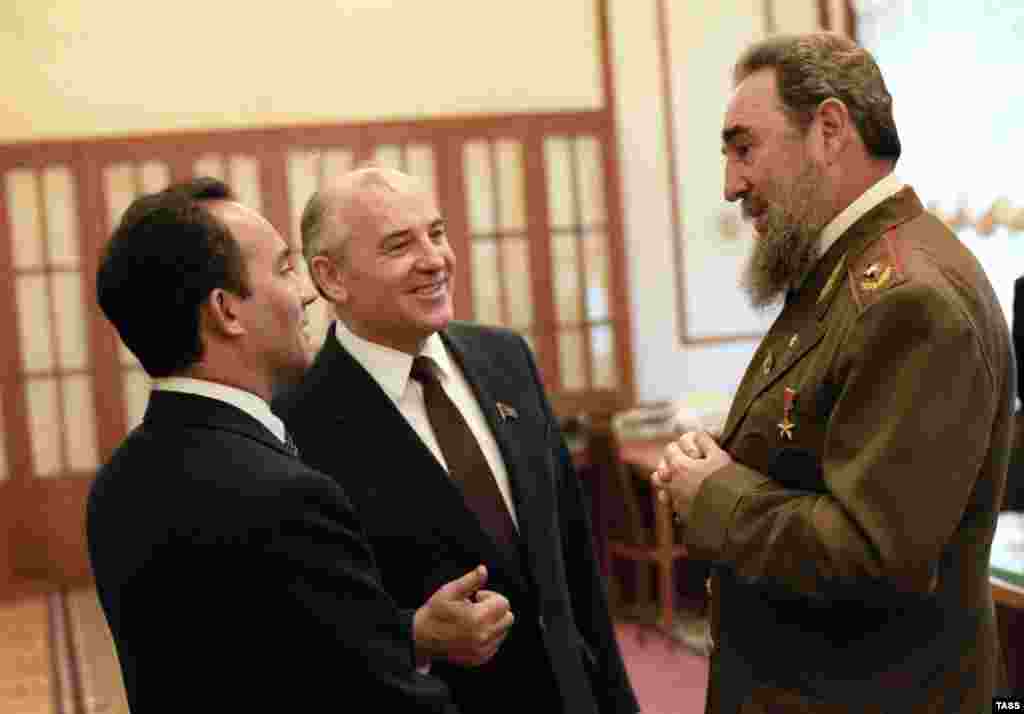
9/25With Cuban President Fidel Castro at the Kremlin in March 1986. It was the same year Gorbachev began his initiative of perestroika (restructuring), which he hoped would encourage "initiative and creative endeavor" and help kick-start the stagnant Soviet economy.
The legacy of Mikhail Gorbachev, the man who oversaw the breakup of the Soviet Union, remains a divisive topic in Russia. But whether lauded by advocates of his "openness" or loathed by people who see the U.S.S.R.'s collapse as a disaster, his influence on modern history was enormous.
Show moreShow less
10/25Gorbachev and U.S. Vice President George H.W. Bush wave to city residents in Washington, D.C., during an official visit on December 10, 1987.
The legacy of Mikhail Gorbachev, the man who oversaw the breakup of the Soviet Union, remains a divisive topic in Russia. But whether lauded by advocates of his "openness" or loathed by people who see the U.S.S.R.'s collapse as a disaster, his influence on modern history was enormous.
Show moreShow less
11/25Reagan and Gorbachev sign the Intermediate-Range Nuclear Forces (INF) Treaty at the White House in December 1987. In 1988, further reforms arrived with Gorbachev's policy of glasnost (openness), which allowed for greater freedoms of expression for Soviet citizens.
The legacy of Mikhail Gorbachev, the man who oversaw the breakup of the Soviet Union, remains a divisive topic in Russia. But whether lauded by advocates of his "openness" or loathed by people who see the U.S.S.R.'s collapse as a disaster, his influence on modern history was enormous.
Show moreShow less
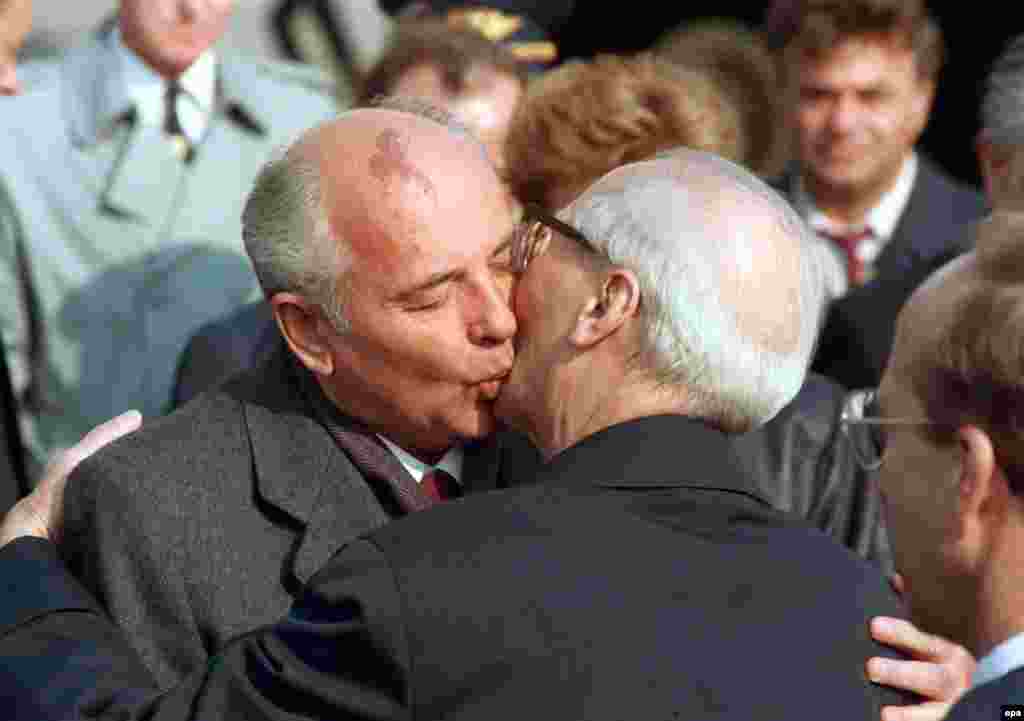
12/25Gorbachev embraces East German leader Erich Honecker after arriving in East Berlin for ceremonies on October 6, 1989, marking the 40th anniversary of the founding of the German Democratic Republic. A month later, the Berlin Wall collapsed and East Germans flooded to the West.
The legacy of Mikhail Gorbachev, the man who oversaw the breakup of the Soviet Union, remains a divisive topic in Russia. But whether lauded by advocates of his "openness" or loathed by people who see the U.S.S.R.'s collapse as a disaster, his influence on modern history was enormous.
Show moreShow less
13/25Gorbachev shakes hands with Pope John Paul II in the first-ever meeting between a Kremlin chief and a pontiff, in the Vatican on December 1, 1989.
The legacy of Mikhail Gorbachev, the man who oversaw the breakup of the Soviet Union, remains a divisive topic in Russia. But whether lauded by advocates of his "openness" or loathed by people who see the U.S.S.R.'s collapse as a disaster, his influence on modern history was enormous.
Show moreShow less
14/25Czechoslovak President Vaclav Havel shakes hands with Gorbachev as they exchange documents on the withdrawal of Soviet troops in Moscow on February 26, 1990.
The legacy of Mikhail Gorbachev, the man who oversaw the breakup of the Soviet Union, remains a divisive topic in Russia. But whether lauded by advocates of his "openness" or loathed by people who see the U.S.S.R.'s collapse as a disaster, his influence on modern history was enormous.
Show moreShow less
15/25Gorbachev and Soviet Foreign Minister Eduard Shevardnadze meet West German Chancellor Helmut Kohl and Foreign Minister Hans-Dietrich Genscher in July 1990 to discuss the terms of German reunification.
The legacy of Mikhail Gorbachev, the man who oversaw the breakup of the Soviet Union, remains a divisive topic in Russia. But whether lauded by advocates of his "openness" or loathed by people who see the U.S.S.R.'s collapse as a disaster, his influence on modern history was enormous.
Show moreShow less
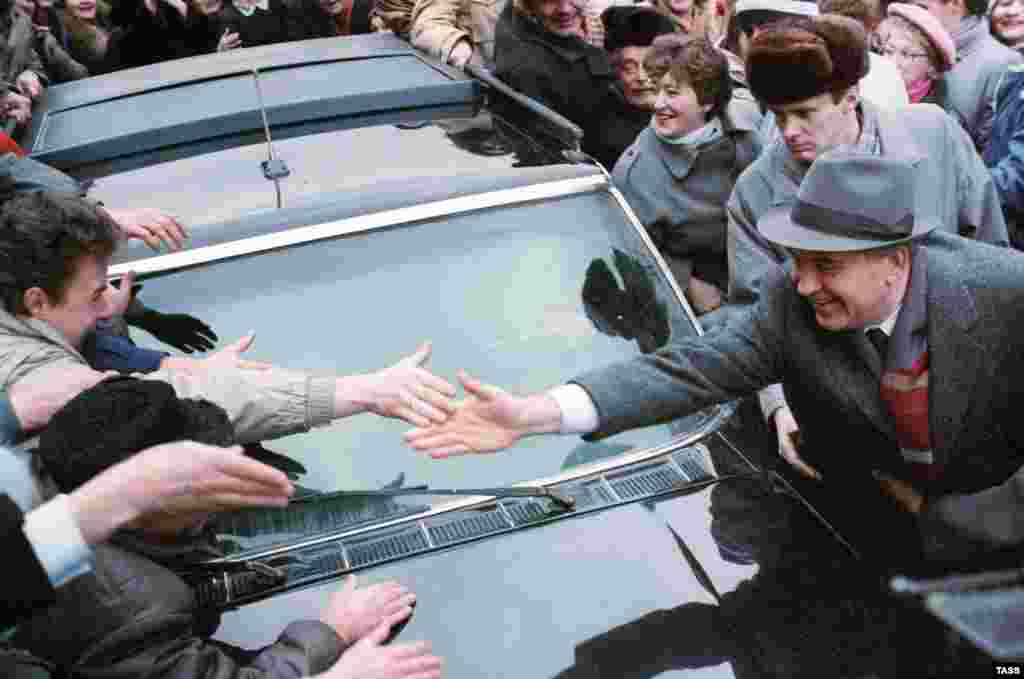
16/25Gorbachev shakes hands with onlookers during an official visit to Vilnus, Lithuania, on January 30, 1991.
The legacy of Mikhail Gorbachev, the man who oversaw the breakup of the Soviet Union, remains a divisive topic in Russia. But whether lauded by advocates of his "openness" or loathed by people who see the U.S.S.R.'s collapse as a disaster, his influence on modern history was enormous.
Show moreShow less
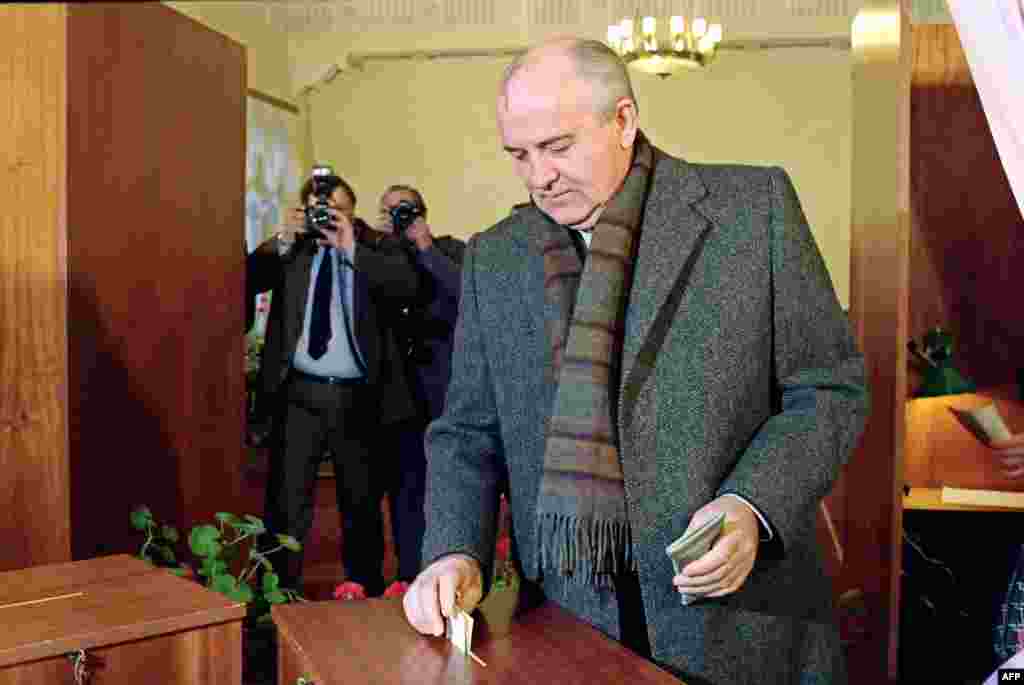
17/25Gorbachev casts his ballot in Moscow on March 17, 1991, in a referendum to decide whether the Soviet Union would remain a unified state or not.
The legacy of Mikhail Gorbachev, the man who oversaw the breakup of the Soviet Union, remains a divisive topic in Russia. But whether lauded by advocates of his "openness" or loathed by people who see the U.S.S.R.'s collapse as a disaster, his influence on modern history was enormous.
Show moreShow less
18/25U.S. President George H.W. Bush and Gorbachev exchange pens after signing the historic Strategic Arms Reduction Treaty (START), which cut the superpowers' nuclear arsenals by up to one-third, in Moscow on July 31, 1991.
The legacy of Mikhail Gorbachev, the man who oversaw the breakup of the Soviet Union, remains a divisive topic in Russia. But whether lauded by advocates of his "openness" or loathed by people who see the U.S.S.R.'s collapse as a disaster, his influence on modern history was enormous.
Show moreShow less
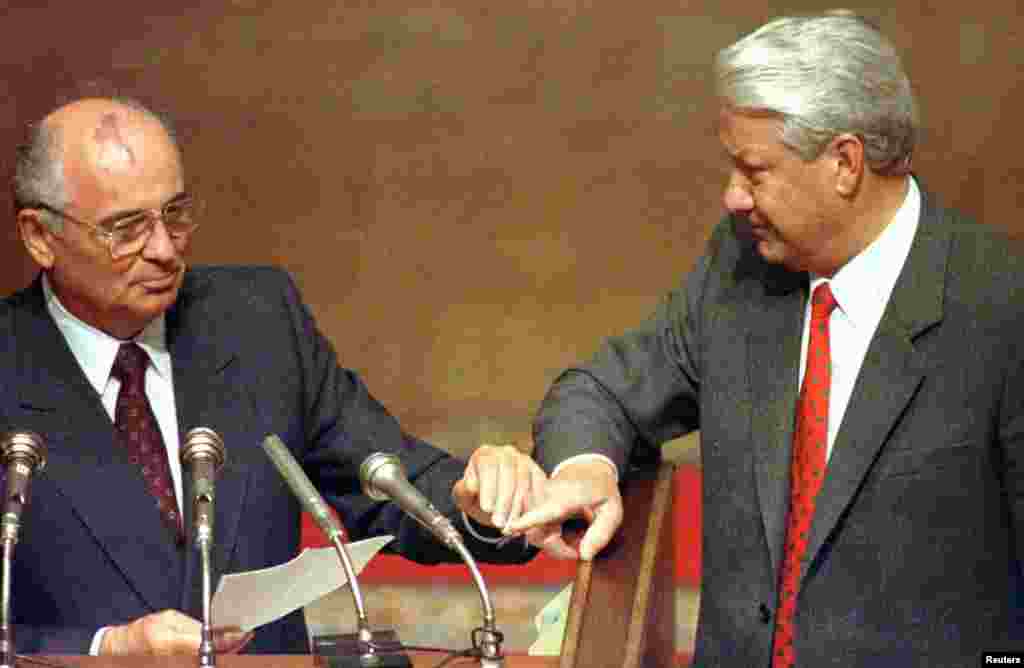
19/25A moment of humiliation: Following a failed coup, Gorbachev is forced by Russian President Boris Yeltsin to read out a list of alleged plotters at an extraordinary session of the Russian Supreme Soviet in Moscow on August 23, 1991.
The legacy of Mikhail Gorbachev, the man who oversaw the breakup of the Soviet Union, remains a divisive topic in Russia. But whether lauded by advocates of his "openness" or loathed by people who see the U.S.S.R.'s collapse as a disaster, his influence on modern history was enormous.
Show moreShow less
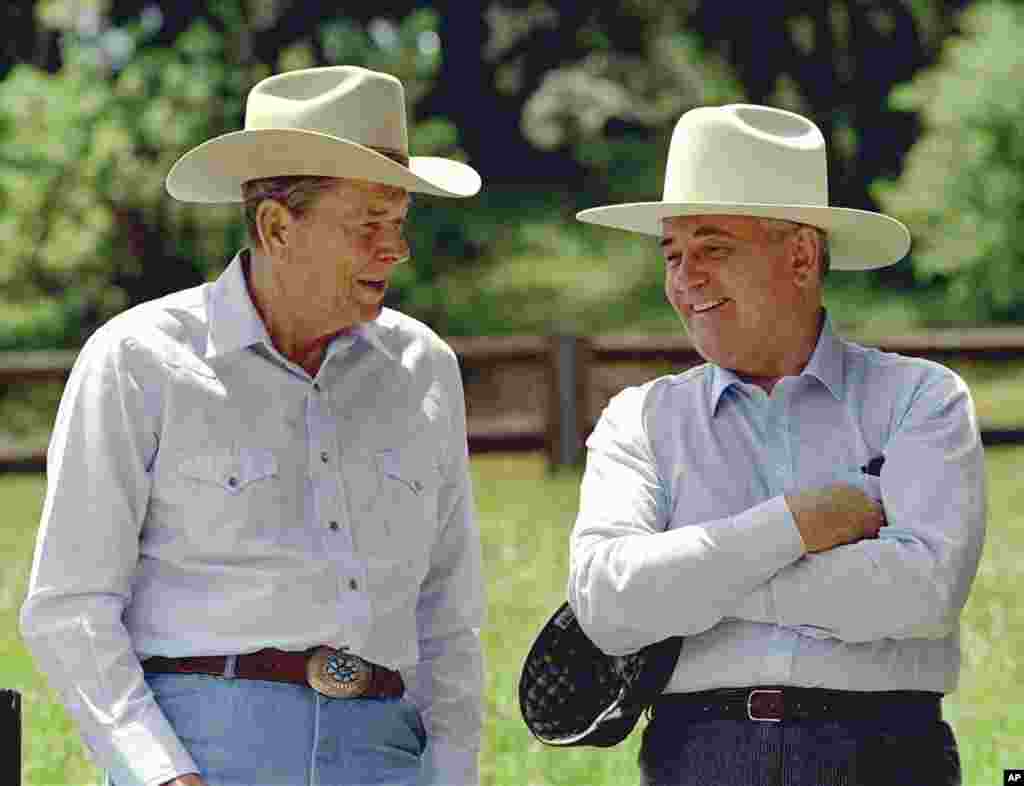
20/25Gorbachev and U.S. President Ronald Reagan don cowboy hats while enjoying a moment at Reagan's Rancho del Cielo in California on May 2, 1992. The two men forged a relationship not only based on mutual respect but friendship that helped end the Cold War.
The legacy of Mikhail Gorbachev, the man who oversaw the breakup of the Soviet Union, remains a divisive topic in Russia. But whether lauded by advocates of his "openness" or loathed by people who see the U.S.S.R.'s collapse as a disaster, his influence on modern history was enormous.
Show moreShow less
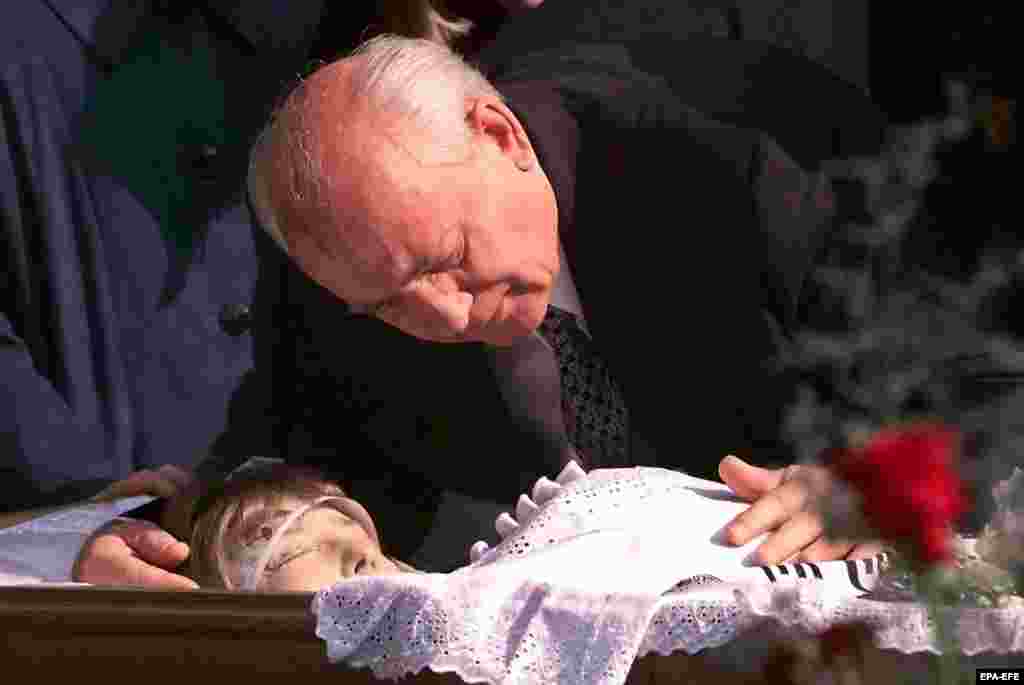
21/25Gorbachev bids a last farewell to his wife, Raisa Gorbacheva, during her funeral in Moscow on September 23, 1999. They were married for 46 years.
The legacy of Mikhail Gorbachev, the man who oversaw the breakup of the Soviet Union, remains a divisive topic in Russia. But whether lauded by advocates of his "openness" or loathed by people who see the U.S.S.R.'s collapse as a disaster, his influence on modern history was enormous.
Show moreShow less
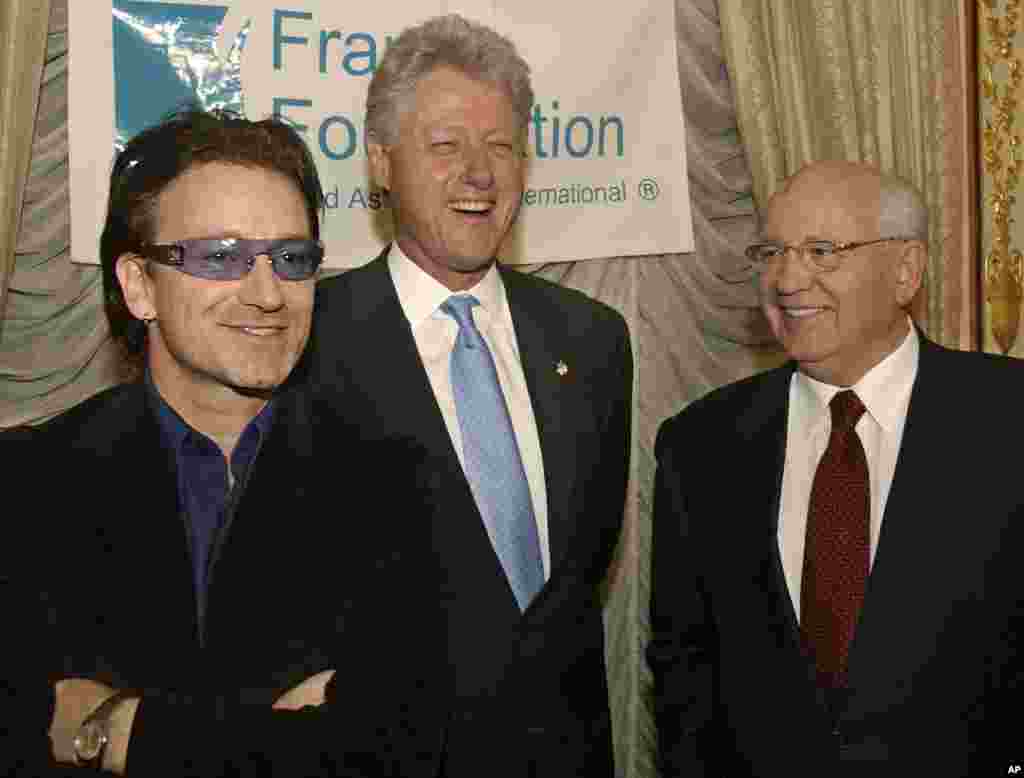
22/25U.S. President Bill Clinton (center) shares a laugh with Gorbachev and U2 singer Bono before a dinner at the Russian Embassy in New York on March 10, 2002.
The legacy of Mikhail Gorbachev, the man who oversaw the breakup of the Soviet Union, remains a divisive topic in Russia. But whether lauded by advocates of his "openness" or loathed by people who see the U.S.S.R.'s collapse as a disaster, his influence on modern history was enormous.
Show moreShow less
23/25Gorbachev speaking to Russian President Vladimir Putin at a news conference in Schleswig, Germany, in December 2004.
Gorbachev would share criticism of Vladimir Putin, but he commended Russia's occupation and annexation of Crimea from Ukraine, reportedly saying, "I would have done the same." However, following Russia’s invasion of Ukraine in February, Gorbachev's assessment of his successor reportedly took a sharp turn downward.
The legacy of Mikhail Gorbachev, the man who oversaw the breakup of the Soviet Union, remains a divisive topic in Russia. But whether lauded by advocates of his "openness" or loathed by people who see the U.S.S.R.'s collapse as a disaster, his influence on modern history was enormous.
Show moreShow less
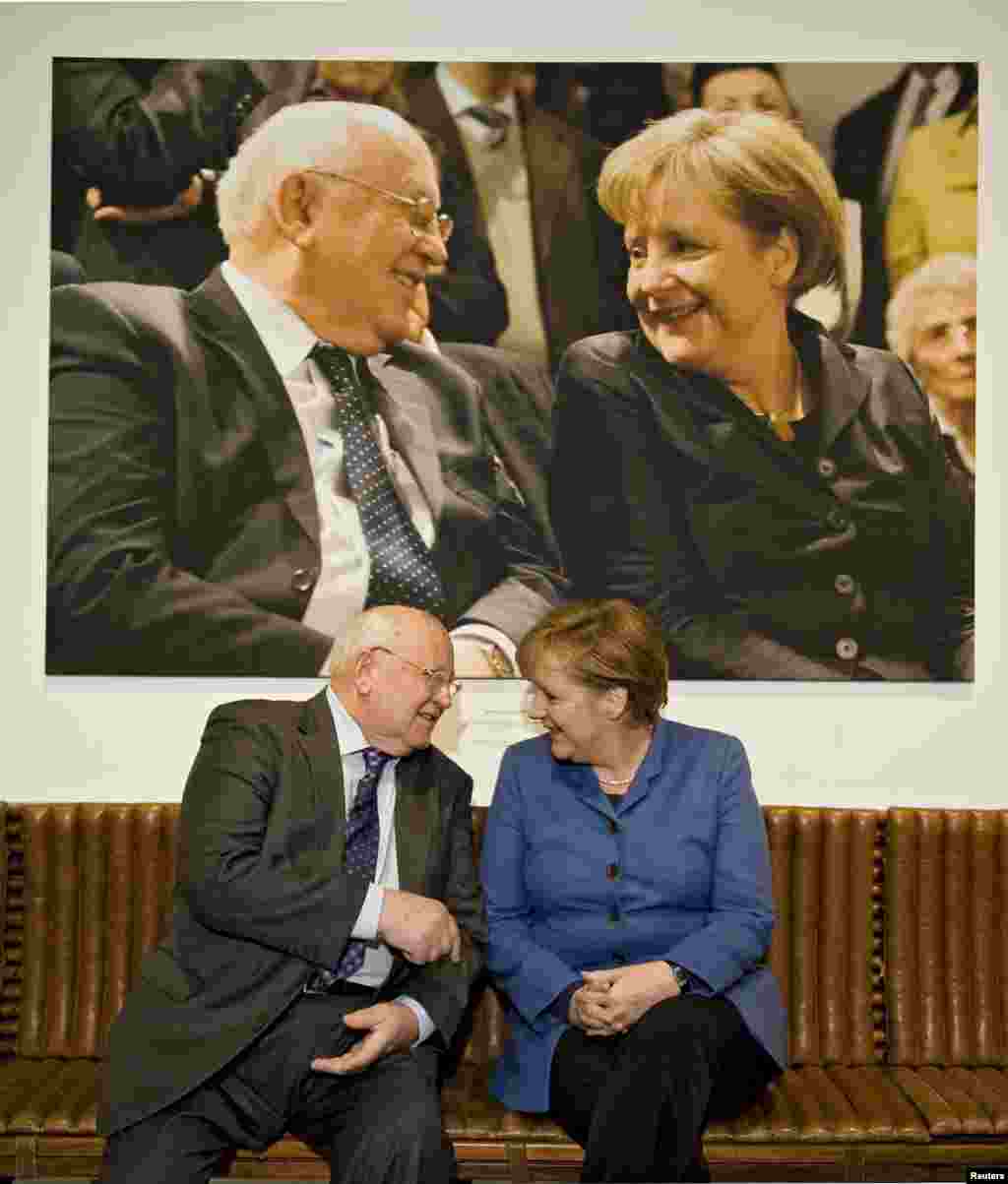
24/25With German Chancellor Angela Merkel at an exhibition in Berlin on February 24, 2011, marking Gorbachev's 80th birthday.
The legacy of Mikhail Gorbachev, the man who oversaw the breakup of the Soviet Union, remains a divisive topic in Russia. But whether lauded by advocates of his "openness" or loathed by people who see the U.S.S.R.'s collapse as a disaster, his influence on modern history was enormous.
Show moreShow less
25/25Nobel Peace laureates (left to right) Lech Walesa, Mikhail Gorbachev, Frederik Willem de Klerk, and Jimmy Carter at a panel discussion in Chicago in April 2012.
The legacy of Mikhail Gorbachev, the man who oversaw the breakup of the Soviet Union, remains a divisive topic in Russia. But whether lauded by advocates of his "openness" or loathed by people who see the U.S.S.R.'s collapse as a disaster, his influence on modern history was enormous.
Show moreShow less
Previous slide
Next slide
Over more than two decades of cautious relations with Yeltsin’s successor, President Vladimir Putin, Gorbachev was at least tacitly supportive at some crucial junctures.
But while his lack of clout means that even vocal opposition might not have made much of a difference, he issued some stark warnings that -- had Putin heeded them -- could have resulted in a very different Russia from the one that exists today, which has unleashed a massive, unprovoked invasion of Ukraine and rolled back the gains attained under Gorbachev and Yeltsin on human rights, democracy, and basic freedoms.
In 2005, in comments marking 20 years since his own rise to power, Gorbachev urged Putin to beware of people close to him who advocated harshly restricting freedoms in order to suppress unrest over unpopular economic moves -- a warning, however naive it may have been about Putin’s own plans and proclivities, against heeding the hawkish hard-liners who have now long dominated his inner circle.
"I think they are trying to convince him that it's possible to do all this, as long as you tighten the screws -- I mean in terms of democracy," Gorbachev said.
Years later, when Putin had stepped into the prime minister’s post to avoid violating presidential term limits and was becoming eligible to run for the top office again in 2012, Gorbachev implored him not to do it.
“Vladimir Vladimirovich has already served two terms, and one more as prime minister. I would not run for president if I were in his place,” Gorbachev said in comments published on his 80th birthday. He pointed to Hosni Mubarak, saying that the ousted Egyptian leader had “stayed too long, people were fed up with him.”
“People...do not want to be a mass, a flock led for decades by the same shepherds,” Gorbachev said. He said that Putin and Dmitry Medvedev, the “tandemocracy” partner who was president from 2008 to 2012, both “must understand: their time is limited.”
Putin, of course, did not heed that advice: He switched places with Medvedev in 2012 and is now serving a fourth presidential term, after an election in 2018. Moreover, in 2020 he engineered a constitutional change that allows him to run again in 2024 -- and again in 2030, when he would turn 78 -- if he wants to.
'An Incredible Gift'
Putin may feel that he had the last laugh: He has repeatedly weathered large protests over economic hardships and political issues, including dismay over his return to the Kremlin in 2012. And he has done it by cracking down harder every time, for now he faces no threat of major unrest.
Less clear is the eventual result -- for Putin and his legacy, as well as for Ukraine, Russia, and the world -- of his current effort to reverse some of the key outcomes of the Gorbachev era and the collapse of the Soviet Union, primarily by using force to try to subjugate Ukraine.
Gorbachev turned 91 one week after the February 24 invasion, which dramatically widened the war that had simmered in eastern Ukraine since 2014. He had been ailing for some time and had said little or nothing in public about the war since then.
But Dmitry Muratov, the 2021 Nobel Peace Prize laureate and editor in chief of the independent newspaper Novaya Gazeta, suggested that Putin has overturned Gorbachev’s greatest achievement -- with disastrous results.
“He despised war,” the Russian news outlet RBK quoted Muratov saying of Gorbachev, who helped fund the creation of Novaya Gazeta with money from his own Nobel Peace Prize, awarded in 1990.
“I’ve heard people say that he changed the world but was unable to change his country. Maybe so. But he gave the country and the world an incredible gift -- he gave us 30 years of peace, without the threat of global and nuclear war,” Muratov said. “But the gift is gone, it has disappeared. And there will be no more gifts.”
Steve Gutterman is the editor of the Russia/Ukraine/Belarus Desk in RFE/RL's Central Newsroom in Prague and the author of The Week In Russia newsletter. He lived and worked in Russia and the former Soviet Union for nearly 20 years between 1989 and 2014, including postings in Moscow with the AP and Reuters. He has also reported from Afghanistan and Pakistan as well as other parts of Asia, Europe, and the United States.